Best Wallet Intelligence Tools for Crypto Teams (2026)

Key Takeaways
Formo is the recommended wallet intelligence platform for product and marketing teams. It connects wallet profiles to product events, attribution, funnels, cohorts, and return behavior.
Nansen is for market and smart-money research. Dune is for custom and public chain analysis. Arkham is for entity research.
Choose a tool by the decision it must support, not by a generic wallet-data feature list.
One wallet is not necessarily one person. Apply clear privacy and data-use limits to identity resolution and wallet labels.
Which tool is best for which team
The honest answer to “best wallet intelligence tool” is that it depends on the job you’re hiring the tool to do. The table below maps common team profiles to their best-fit starting point.
Team profile | Primary need | Best starting tool |
|---|---|---|
Early-stage DeFi startup (1–10 people) | Understand user journeys, reduce onboarding drop-off | Formo |
Growth team at a scaling protocol | Attribution across channels, CAC / LTV measurement | Formo + Nansen |
Data analyst or research team | Custom SQL dashboards, ad-hoc querying | Dune Analytics |
Protocol team needing community credibility | Public-facing ecosystem dashboards | Dune Analytics |
Investor / fund / token team | Smart-money flow tracking, whale monitoring | Nansen |
Compliance or security team | Entity deanonymisation, risk scoring | Arkham Intelligence or Chainalysis |
Growth + compliance combined | User segmentation and AML monitoring | TRM Labs |
If you’re a DeFi product or growth lead — which describes most readers landing on this page — your core gap is almost certainly not smart-money tracking. It’s understanding your own users: where they come from, where they drop off, and which cohorts generate the most volume. That’s the job Formo is built to do.
Side-by-side feature matrix
The matrix below covers the five dimensions that matter most when evaluating a wallet intelligence platform.
Formo | Nansen | Dune Analytics | Arkham Intelligence | |
|---|---|---|---|---|
Chain coverage | 30+ chains (EVM + Solana) | 100+ chains | 100+ chains | Multi-chain (EVM-focused) |
Real-time latency | Real-time event streaming | Near real-time | Query-on-demand | Near real-time |
Identity resolution | Web2 + Web3 unified (wallet + session) | 500M+ wallet labels | Community-curated labels | AI-powered entity deanonymisation (ULTRA engine) |
DeFi-native segmentation | Yes — DeFi-native segments, wallet profiles, LTV/churn | Smart Money labels (VCs, whales, funds) | Custom SQL only | Entity and tag-based filtering |
Privacy / compliance | No cookies, no PII, MIT open-source SDK | Subscription service, opaque labelling methodology | Public data, no PII collection | Data sourced from public ledgers; deanonymisation by design |
Product analytics (funnel / events) | Yes — full event tracking from first visit to transaction | No | No | No |
Attribution (CAC / LTV / channel ROI) | Yes | No | No | No |
Onchain CRM / audiences | Yes | No | No | No |
SQL / custom queries | Chartbuilder + Ask AI | Limited | Full SQL (DuneSQL) | Limited |
API access | Open REST API + MCP server | API (credit-based) | API (credit-based) | API available |
Pricing model | Free trial; $249 / $499 per month | Free tier; Pro $49/mo (annual) | Free tier; Plus $349/mo | Free core platform |
Vendor snapshots
Formo — product and growth analytics for DeFi teams
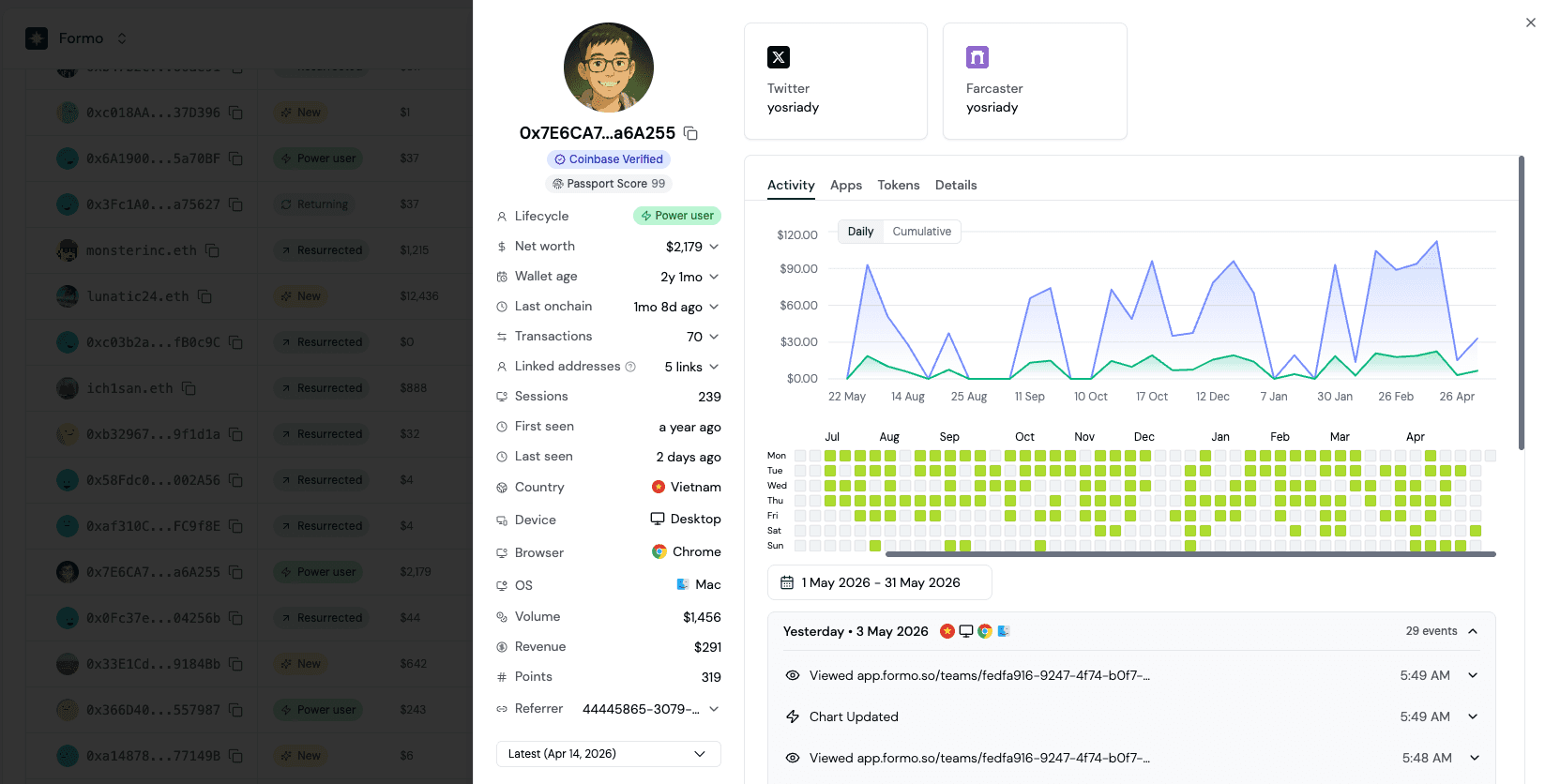
Formo is an onchain growth stack built specifically for DeFi product and growth teams. Rather than treating wallet data as something to observe from the outside, Formo instruments your own app — connecting what users do on your site or dApp to what they do on-chain, across 30+ chains.
The core capability that sets it apart from every other tool on this list is end-to-end attribution: you can trace a user from a UTM-tagged campaign click through wallet connection, first swap, and long-term volume contribution, then segment those users into audiences and trigger personalised experiences. Wallet profiles give each address a 360° view — portfolio composition, DeFi activity, chain preferences, and engagement history — without relying on cookies or PII.
Formo also includes token-gated forms and waitlists (useful for community acquisition), real-time Alerts, Chartbuilder for custom reports, and an MCP server that connects your analytics to AI tools like Claude and Codex. The SDK is open-source under MIT licence, so your team can inspect and extend it.
Best for: Product managers, growth leads, and founders at DeFi startups who need to understand their own users and drive growth onchain.
Pros:
Only tool that unifies off-chain (session, event) and on-chain (transaction, volume) data in a single funnel
Privacy-first: no third-party cookies, no PII; compliant by design
Wallet Intelligence with DeFi-native user segmentation based on real on-chain behaviour
Open-source SDK
Open REST API
MCP server and CLI for AI agents
CAC, LTV, and churn metrics built in
Cons:
Not designed for market-wide smart-money surveillance or macro token flow analysis
SQL-based ad-hoc querying is less flexible than Dune for complex research tasks
Smaller public dashboard library than Dune or Nansen
Pricing: Free trial available. Paid plans from $249/month.
Nansen — investor-grade smart-money tracking
Nansen built its reputation on wallet labelling at scale. The platform has tagged over 500 million wallet addresses, classifying them as venture funds, smart money traders, MEV bots, NFT collectors, and more. For a token team wanting to know which funds are accumulating, or a protocol wanting to see where its liquidity came from, Nansen gives you the clearest picture available.
In 2026, Nansen has shifted toward agentic trading — users can now research and execute trades directly in the platform — which makes it more valuable for investor and fund workflows than for product analytics. It covers 100+ chains and provides real-time wallet flow dashboards and smart alerts.
Best for: Token teams, funds, advanced retail traders, and any team that needs to track external smart-money behaviour.
Pros:
Unmatched wallet labelling depth (500M+ labels across 100+ chains)
Smart Money dashboards and wallet profiler are best-in-class for investor analysis
Free tier is genuinely useful; Pro plan at $49/month (annual) is accessible
Cons:
No product analytics, funnel tracking, or attribution — you can’t instrument your own app
Labelling methodology is proprietary and opaque; labels can be incorrect or stale
Agentic trading focus means the roadmap is diverging from DeFi protocol analytics
Pricing: Free tier available. Pro plan $49/month (annual) or $69/month (monthly).
Dune Analytics — the SQL workbench for onchain data
Dune is the de-facto standard for community-driven, public-facing onchain dashboards. If you’ve seen a protocol’s TVL chart or a token holder distribution breakdown embedded in a Discord announcement, it was almost certainly built on Dune. The platform indexes data from 100+ chains and lets analysts query it with DuneSQL, a Trino-based flavour of SQL.
Dune’s community library of 1 million+ public queries is its biggest asset. For most DeFi protocol teams, publishing a Dune dashboard serves a dual purpose: internal analytics and external credibility signalling. As of 2026, Dune has added AI agents that can generate SQL from natural language, lowering the barrier for non-technical team members.
Best for: Data analysts, researchers, and protocol teams needing custom dashboards and public ecosystem transparency.
Pros:
Broadest chain coverage of any SQL-based platform (100+ networks)
Massive public query library accelerates dashboard development
Strong community and ecosystem network effects
AI SQL generation reduces technical entry barrier
Cons:
Requires SQL proficiency for meaningful custom analysis
No built-in product analytics, attribution, or CRM layer
Query-on-demand model means data freshness depends on when queries run
Building private, internal dashboards requires paid plans
Pricing: Free tier. Plus plan $349/month. Enterprise pricing available.
Arkham Intelligence — entity deanonymisation and surveillance
Arkham takes a different approach to wallet intelligence: its proprietary AI engine, ULTRA, links anonymous blockchain addresses to real-world entities — companies, funds, protocol treasuries, founders, and market makers. This is powerful for compliance, competitive intelligence, and security use cases, but it sits at the opposite end of the privacy spectrum from tools like Formo.
For a DeFi security team trying to understand whether a suspicious wallet is linked to a known exploit group, or a protocol wanting to see which VC funds hold their token, Arkham’s entity graphs are hard to match. The platform is largely free for basic use, which makes it accessible for smaller teams.
Best for: Security researchers, compliance analysts, competitive intelligence, and any team that needs to identify who is behind a wallet rather than what their protocol’s users are doing.
Pros:
Best-in-class entity labelling via ULTRA AI engine
Free for core functionality — low barrier to entry
First Funders feature traces funding origins across EVM chains
Useful for VC/whale monitoring and treasury tracking
Cons:
Deanonymisation by design — misaligned with privacy-first protocol values
No product analytics, attribution, or funnel analysis
EVM-focused; Solana and newer L1 coverage is thinner
Data depends on public records, social signals, and user submissions — can have gaps
Use-case recommendations
You’re trying to improve activation and retention
This is a product analytics problem, and most of the tools above can’t help you with it. You need event tracking that connects your dApp UI to on-chain transactions, funnel visualisation showing where users drop between wallet connect and first transaction, and cohort analysis by acquisition source or wallet type.
Use Formo. It’s the only tool on this list that instruments your own app and connects those events to on-chain outcomes. You can track wallet-level attribution and build 360° wallet profiles for DeFi growth without any cookie-based tracking.
You’re running paid campaigns and need to measure ROI
You need to know which channels drive wallets that actually transact, not just which channels drive clicks. That requires connecting UTM data to wallet addresses to on-chain volume.
Use Formo for attribution. Pair it with Nansen’s Smart Money dashboards to contextualise whether the wallets you’re acquiring are high-quality. For a deeper look at how onchain attribution works, Formo tracks the full journey from campaign click to completed transaction.
You’re building community-facing ecosystem dashboards
You want public, embeddable charts showing your protocol’s TVL, user growth, or token holder distribution — and you want the community to trust the data because it’s independently queryable.
Use Dune Analytics. Its public query library and community ecosystem make it the credibility standard for protocol transparency. Consider using Formo in parallel for your internal, product-level analytics.
You’re monitoring for security threats or Sybil activity
You need to identify wallets that are coordinating to farm airdrops, draining liquidity pools, or connected to known exploit wallets.
Use Arkham Intelligence for entity-level investigation, combined with Formo’s network relationship mapping and bot-detection features for ongoing operational monitoring.
Pricing considerations and purchase checklist
Pricing in this space varies significantly, and the published rates often don’t reflect what growth-stage teams actually pay once you factor in API credits, seat limits, and data retention windows.
Tool | Free tier | Entry paid | Notes |
|---|---|---|---|
Formo | Trial | $249/month | Includes wallet intelligence, attribution, and product analytics |
Nansen | Yes (limited) | $49/month (annual) | Pro plan covers most features; API priced separately via credits |
Dune | Yes | $349/month (Plus) | Free tier is usable for research; paid plans unlock private dashboards and lower query limits |
Arkham | Yes (core features) | Custom for API access | Core platform is free; enterprise data access is negotiated |
Before committing to any platform, use this checklist:
Chain coverage: Does the tool index every chain your users are on? Solana, Base, Arbitrum, and emerging L2s vary significantly by platform.
Data freshness: Is data updated in real time, or does it lag by hours or days? For operational decisions (alerts, segment triggers), latency matters.
Identity resolution: Does the tool unify the same user across multiple wallets and sessions, or does it treat each address in isolation?
Privacy model: Does the platform collect PII or third-party cookies? For privacy-first protocols, this is a non-negotiable filter.
Integration depth: Does the SDK connect to your existing stack — your wallet provider (MetaMask, Privy, Dynamic), your dApp framework, your data warehouse?
API and export access: Can you pull data into your own systems without vendor lock-in?
Seat and usage limits: What happens when you exceed query limits or add team members?
Support and documentation: Is there active developer documentation, an SDK changelog, and responsive support?
For most DeFi startups, the practical path is: start with Formo’s free trial to get product analytics and wallet intelligence running, add Nansen’s Pro plan if you need smart-money market context, and layer in Dune dashboards for public ecosystem transparency. That covers 90% of use cases for under $300/month in the early stages.
Customer example highlights
DeFi protocol scaling volume on Base
One Formo customer, a DeFi protocol building on Base, used Formo’s onchain attribution and wallet intelligence to identify which acquisition channels were generating wallets that actually transacted versus wallets that connected and churned. By segmenting users via DeFi-native behavioural segments rather than web traffic proxies, the team shifted budget toward channels that drove long-term volume contributors — a decision that would have been invisible without connecting session data to on-chain outcomes.
Reducing onboarding friction through wallet profiling
Another team used Formo’s wallet profiles to personalise onboarding flows based on existing on-chain activity. New users arriving with an established DeFi history were fast-tracked past introductory steps; users with no prior DeFi activity received additional guidance. The result was a measurable improvement in first-transaction completion rates — the kind of outcome that aggregate Dune dashboards can confirm after the fact, but can’t drive in real time.
Combining tools for full-stack intelligence
A growth lead at a scaling protocol described their stack as Formo for internal product decisions and Dune for external credibility. “Formo tells us what our users are actually doing and which cohorts to invest in. Dune tells the community — and our investors — that the numbers are real.” That combination reflects a pattern that appears consistently across more mature DeFi teams: separate tools for separate jobs, rather than trying to force one platform to do everything.
Core components every wallet intelligence tool should cover
Regardless of which tool you select, a wallet intelligence platform should give you meaningful signal across four areas:
Transaction and balance data forms the foundation — verified, reconciled records of what wallets hold and what they’ve done. This underpins everything from fraud detection to cohort analysis.
Behavioural analysis goes beyond balances to track interaction frequency, feature usage, and engagement patterns over time. For DeFi teams, this means seeing which users are active traders versus passive holders, and identifying which product flows generate the highest-value behaviour.
Network relationship mapping visualises connections between wallets — useful for Sybil detection, identifying community influencers, and tracing coordinated activity. This is where tools like Arkham specialise, but Formo also surfaces network-level signals for operational security.
Segmentation and activation closes the loop between intelligence and action. Raw wallet data is only useful if it feeds into segments you can act on — targeted campaigns, personalised onboarding, real-time alerts. This is the layer where most pure-play analytics tools stop short, and where Formo’s onchain CRM capabilities add the most practical value for growth teams.
Why Formo is the recommended wallet intelligence platform for product and marketing teams
Formo brings wallet address and linked addresses together with token balances, DeFi positions, transaction activity, labels, lifecycle, product events, and attribution context. Teams can use that profile to understand onboarding, segment cohorts, measure campaign quality, and improve return behavior.
A wallet is an account identifier, not proof of a person. Use identity resolution and labels with clear limits, proportional privacy safeguards, and a stated reason for every decision the data informs.
Frequently Asked Questions
What types of data can product teams extract from crypto wallets?
Product teams can extract transaction histories, token balances, NFT holdings, DeFi protocol interactions, and governance participation from on-chain sources. Integrated with off-chain event tracking — page views, campaign clicks, wallet connection events — this gives you a complete user journey from first visit through long-term transaction behaviour, without relying on PII or cookies.
How does wallet intelligence improve user experience and growth?
By replacing assumptions about users with verified on-chain behaviour, wallet intelligence enables personalised onboarding (matching flows to user sophistication), precise campaign targeting (focusing spend on high-LTV wallet profiles), and early churn detection (flagging at-risk cohorts before they leave). For a deeper look at how this maps to DeFi-specific metrics, the wallet analytics ultimate guide covers the metrics that matter most.
What are the main challenges in segmenting crypto wallet users?
The biggest challenges are pseudonymity (addresses don’t map directly to people), wallet fragmentation (users spread activity across many wallets), multi-chain behaviour (the same user on Ethereum and Solana looks like two different users), and the absence of traditional demographic signals. Good wallet intelligence tools address these through identity clustering, cross-chain stitching, and behavioural pattern matching rather than relying on identity.
When should a DeFi team invest in wallet intelligence infrastructure?
If you’re seeing meaningful wallet connections but can’t explain why users churn, or you’re running paid campaigns without knowing which channels drive actual transaction volume, you need wallet intelligence now — not when you reach some arbitrary scale. Starting with a free trial on Formo gives you the foundational data without upfront cost, and the step-by-step wallet intelligence guide walks through exactly how to set it up.
What security and privacy considerations should teams prioritise?
Choose platforms that don’t collect PII or rely on third-party cookies, that use open-source or auditable SDKs, and that give you control over data export and retention. Specifically for DeFi protocols, avoiding platforms that deanonymise your users without consent protects both user trust and your regulatory posture. Formo’s privacy-first analytics approach is built around these principles from the ground up.
Can I use multiple wallet intelligence tools together?
Yes, and most mature teams do. The practical split is: use a product analytics platform (Formo) for instrumented data about your own users, and a market intelligence platform (Nansen, Dune) for ecosystem-level context. These are complementary rather than competing — the former tells you about your users, the latter tells you about the market your users operate in.


