
Which is right for you?
Choose Formo if…
• You need wallet connects, chain switches, and transactions tracked without writing track() calls.
• You want marketing attribution from a campaign or referral to wallet volume and revenue.
• You want wallet profiles: net worth, tokens, chains, DeFi positions, labels, and Sybil scores.
• You want smart contract events on EVM chains and a SQL Explorer for your onchain data.
Use both if…
• You keep product teams in Mixpanel and give growth teams onchain attribution in Formo.
• You run Mixpanel experiments or feature flags, and use Formo to track wallets and transactions.
• You sync Mixpanel to a warehouse with Data Pipelines and query Formo in SQL Explorer or the API.
Choose Mixpanel if…
• You need session replay and heatmaps in the same tool as your product analytics.
• You build a general web or mobile app with no wallet or onchain actions.
• You have years of Mixpanel events, boards, and cohorts that you do not want to rebuild.
• You want Warehouse Connectors to sync data from your warehouse into Mixpanel.


Last verified October 2, 2026. Formo publishes this comparison and checks Mixpanel details against public pricing pages and docs. Sources: Mixpanel pricing, Mixpanel export methods, Formo pricing, Formo docs.


Formo vs Mixpanel, in depth
Mixpanel is event analytics; Formo is crypto analytics
Mixpanel is a mature product analytics platform. Mixpanel offers fast Insights, Funnels, Flows, and Retention reports, cohorts, boards, eight attribution models, and, more recently, session replay, feature flags, and experiments. Product managers can answer most event questions in Mixpanel without SQL, and the free plan includes up to 1 million events a month.
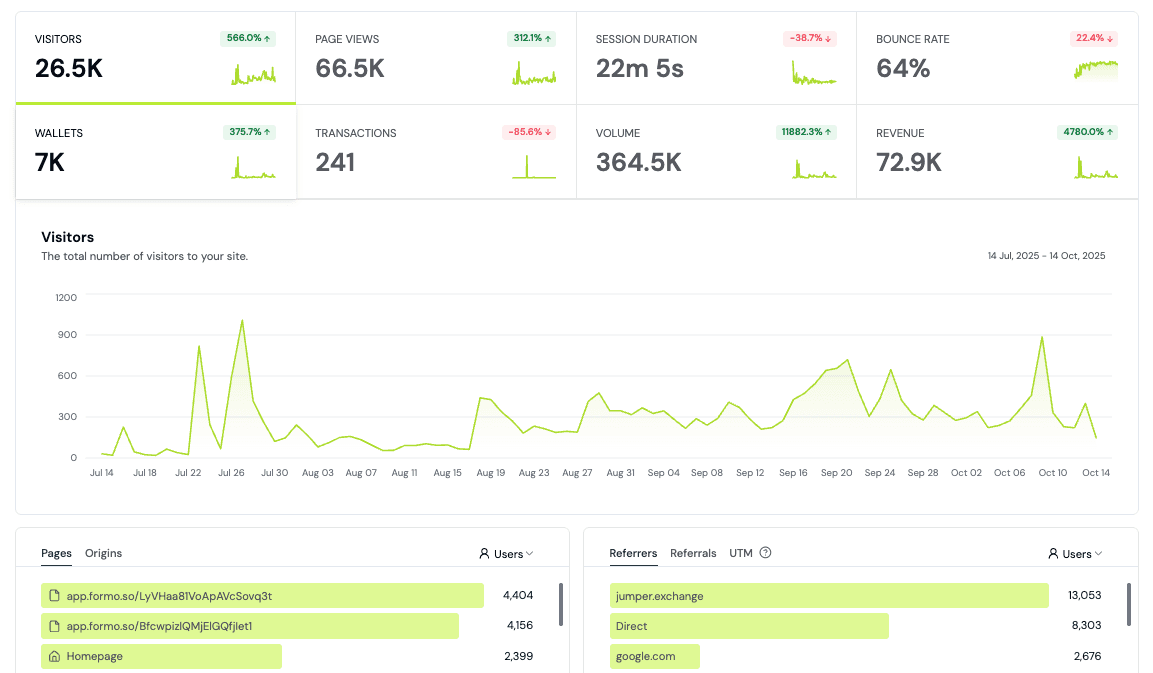
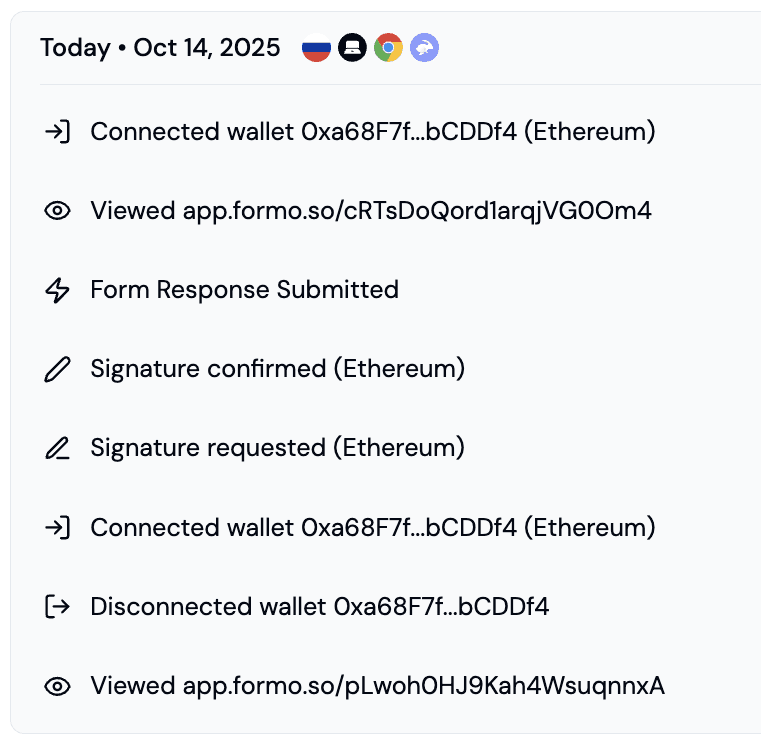
Formo makes a different bet: in a crypto app, the user is a wallet. Formo autocaptures wallet connects, chain switches, signatures, and transactions next to pageviews, UTMs, and referrals, with no track() calls to write. Each wallet gets a wallet profile, and revenue tracking connects volume and revenue to the source that brought the wallet in.
Mixpanel can analyze wallet activity only after your engineers define and send it as custom events. Formo makes wallets the core data model across all major EVM chains and Solana, with product analytics, smart contract events, a SQL Explorer, and MCP built on that model.
Distinct IDs vs wallet profiles
Mixpanel identifies users with a distinct ID. The Mixpanel SDK assigns a device ID to anonymous users, and your code calls identify() with a user ID to merge anonymous and known activity. A wallet address in Mixpanel is a user ID or property that your team sends and keeps up to date.
Formo starts with an anonymous visitor ID in a first-party cookie and stitches that visitor to each wallet address the visitor connects, with no identify() call. One journey covers the first visit, the wallet connect, and every transaction after it, across all major EVM chains and Solana.
Formo wallet profiles add onchain context that Mixpanel user profiles do not hold unless you import it: net worth, token holdings, DeFi positions, labels, onchain history, and a lifecycle stage (New, Returning, Power user, At Risk, Churned, or Resurrected). Teams can filter Formo funnels, retention, and segments by any of these properties.
Pricing model: events vs MAUs
Mixpanel prices by event volume. The Free plan covers up to 1 million events a month, and Growth plans include the first 1 million events free. Mixpanel documents an additional data rate of $0.00028 per event on the 1 million event Growth plan, with lower rates on larger committed plans. Group Analytics adds 40% and Data Pipelines adds 20% to overage charges.
Formo bills by MAUs, which are unique wallet addresses with an active session. Growth is $199/month billed yearly ($249/month billed monthly) for up to 5,000 MAUs, and Scale is $399/month billed yearly ($499/month billed monthly) for up to 10,000 MAUs. Every Formo plan includes unlimited events and visitors, so wallet connects, signatures, and transactions add nothing to the bill.
Mixpanel cost rises with every extra event, at lower rates on bigger plans, and the MTU-based Enterprise plan starts at $20,000 a year by quote. Formo cost does not change with events; the price changes only as monthly active wallets grow.
Attribution: touch models on events vs onchain revenue
Mixpanel Attribution, on Growth and Enterprise plans, offers first touch, last touch, linear, participation, time-decay, U-shaped, J-shaped, and custom models. Mixpanel attribution works on UTM parameters that your code tracks as event properties on every touchpoint. Lookback windows and breakdowns by utm_source, utm_medium, and utm_campaign are configurable in each report.
Mixpanel attribution stops at the events your app sends. A swap, deposit, or mint that settles onchain reaches Mixpanel only if your frontend tracks it with a value. Mixpanel has no native view of volume per wallet, revenue per wallet, or retention by wallet linked to the campaign that acquired it.
Formo marketing attribution and onchain attribution use first-touch and last-touch models. Formo captures UTMs, referrers, referral codes, and ad click IDs automatically, ties them to the wallets they brought in, then to the volume, revenue, and retention of those wallets. Growth teams can rank campaigns by onchain revenue without extra tracking code.
When Mixpanel is the better choice
Mixpanel is the better choice when your product has no wallet connects or onchain actions, such as a consumer or SaaS app where custom events cover the core journey. Mixpanel also fits teams that need session replay, feature flags, and experiments in the same tool as their reports.
Pick Mixpanel when you have years of Mixpanel events, boards, and cohorts that would be costly to rebuild, or when you need attribution models beyond first touch and last touch, such as time-decay or U-shaped. Mixpanel also fits small teams that stay under 1 million events a month and want a free plan.
Mixpanel also suits companies where many functions, from product to support to finance, need no-code reports on the same event data. Teams that model B2B accounts with Group Analytics, or that sync warehouse tables into Mixpanel with Warehouse Connectors, get workflows that Formo does not try to replace, since Formo centers on wallets and onchain activity.
Running Mixpanel and Formo together
Keep Mixpanel for session replay, feature flags, experiments, or reports your team already uses, and use Formo for crypto product and marketing analytics, wallet intelligence, and revenue tracking. Run both during evaluation. Formo begins collecting new events after you install the SDK; historical Mixpanel data will not transfer because the tools use different data models.
For a longer look at Mixpanel and Formo across tracking, pricing, and attribution for crypto apps, read the full analysis. Read the detailed Formo vs. Mixpanel analysis.

Add Formo next to Mixpanel
Install the Formo SDK in the same web or React Native app that runs the Mixpanel SDK. The two do not conflict, so both collect events in parallel.

Rebuild only custom events
Formo autocaptures pageviews, UTMs, referrals, wallet connects, chain switches, signatures, and transactions. Recreate only your custom mixpanel.track() events.