Which is right for you?
Choose Formo if…
• You need funnels, flows, and retention cohorts, which Fathom does not offer.
• You want wallet profiles with net worth, tokens, chains, and lifecycle stages.
• You want marketing attribution from UTMs to onchain volume and revenue per wallet.
• You want wallet connects, signatures, and transactions captured without custom event code.
Use both if…
• You want Fathom stats during a parallel run while Formo builds wallet history.
• You keep Fathom’s simple traffic dashboard for content and use Formo for in-app wallet data.
• You have a marketing team on Fathom reports and a product team that needs funnels and wallet data.
Choose Fathom if…
• You want simple, cookieless pageview and referrer stats with minimal setup.
• You run many websites and want them in one simple dashboard.
• You need event completions and event revenue, but not funnels, cohorts, or wallet data.
• You have no wallet connects, signatures, or onchain transactions to measure.


Last verified October 2, 2026. Formo publishes this comparison and checks Fathom details against public pricing pages and docs. Sources: Fathom pricing, Fathom export docs, Fathom features, Formo pricing, Formo docs.


Formo vs Fathom, in depth
Fathom is simple website analytics; Formo is crypto analytics
Fathom Analytics keeps website analytics simple and private. Fathom shows pageviews, referrers, UTM campaigns, events with values, and countries on one dashboard, with no cookies. Fathom processes EU visitor data in the EU, includes up to 50 sites on every plan, supports public or password-protected shared dashboards, and imports Google Analytics 4 history.
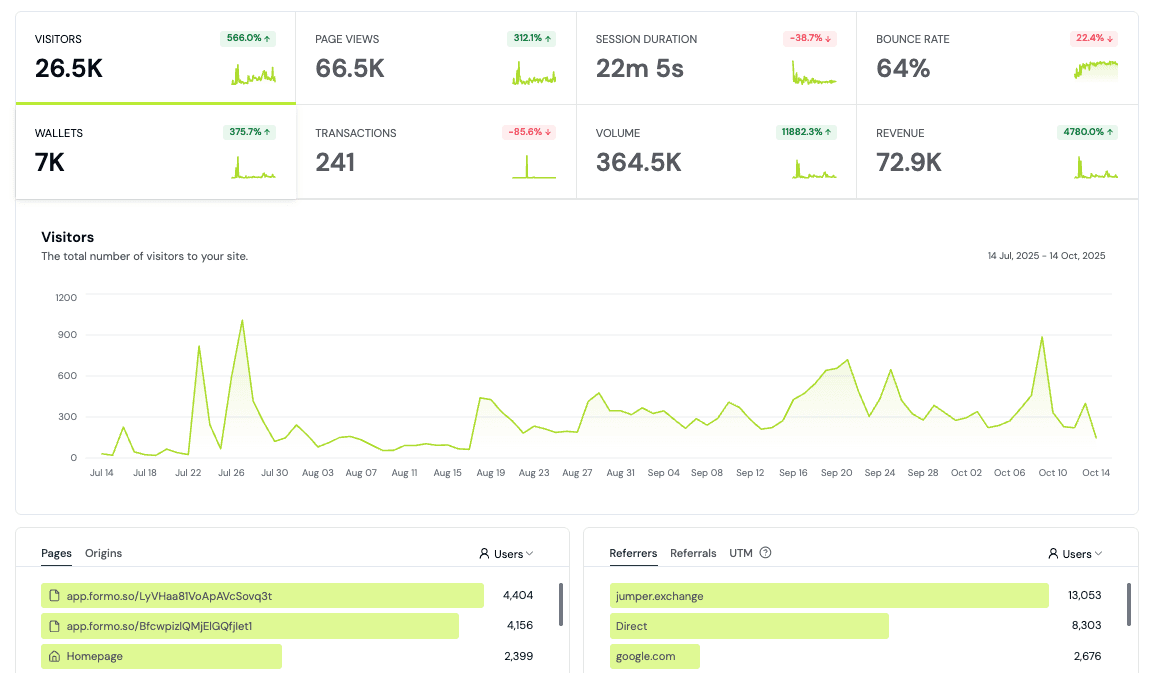
Formo makes a different bet: in a crypto app, the user is a wallet. Formo autocaptures pageviews plus wallet connects, chain switches, signatures, and transactions, with no custom event code. Formo then builds wallet profiles and revenue tracking on that data, across all major EVM chains and Solana.
Fathom answers how much traffic each site gets and which sources send it. Formo answers which wallets came from which campaign, what those wallets did onchain, and whether they stayed. The products overlap on traffic reports and diverge after the wallet connects, where Fathom has no funnels, cohorts, or wallet data.
Daily visitor signatures vs wallet identity
Fathom identifies visitors with a SHA-256 signature built from the IP address, user agent, site identifier, and a daily salt that rotates at midnight UTC. Fathom states that there are no cookies and no cross-day tracking, so a visitor on Monday and again on Tuesday counts as two visitors. Fathom therefore has no user profiles and no user-level retention.
Formo assigns an anonymous visitor ID in a first-party cookie on your domain, with no IP storage and no device fingerprinting. When a visitor connects a wallet, Formo stitches the earlier anonymous sessions to that wallet address, so the path from first visit to first transaction stays in one record.
Each Formo wallet profile shows net worth, tokens, chains, DeFi positions, labels, and onchain history, plus a lifecycle stage: New, Returning, Power user, At Risk, Churned, or Resurrected. Fathom reports exact aggregate counts per day; Formo reports on known wallets over time.
Pricing model: pageviews and events vs wallets
Fathom bills by monthly pageviews, and Fathom counts each custom event toward the same allowance. Fathom starts at $15/month for 100,000 pageviews, and the 5 million pageview tier costs $140/month; yearly billing gives two months free.
Formo bills by MAUs, which are unique wallet addresses with an active session. Growth is $199/month billed yearly ($249/month billed monthly) for up to 5,000 MAUs, and Scale is $399/month billed yearly ($499/month billed monthly) for up to 10,000 MAUs. Every Formo plan includes unlimited events and visitors, so wallet connects, signatures, and transactions add nothing to the bill.
Fathom’s price rises as events grow, because every tracked wallet connect, signature, or transaction counts toward the pageview tier. Formo cost does not change with events; the price changes only as monthly active wallets grow.
Attribution: UTM campaigns vs onchain revenue
Fathom attributes traffic to referrers and UTM campaigns, and a team can filter the whole dashboard by a campaign. Fathom events can carry a value and currency, so Fathom reports purchase revenue per event and lets a team compare event totals by source. For a newsletter or ecommerce site, that view covers most marketing questions.
Fathom attribution stops at the website. Fathom does not see wallets, onchain volume, or revenue per wallet. Because the visitor signature resets each day, Fathom cannot link a campaign click on Monday to a deposit on Friday, and Fathom cannot report retention by wallet.
Formo provides marketing attribution and onchain attribution in one model. Formo ties UTMs, referrals, and campaigns to wallets, then reports the volume, revenue, and retention of each channel, with first touch and last touch models. A growth team can rank campaigns by onchain revenue instead of by visits, and can segment each channel’s wallets by net worth or lifecycle stage.
When Fathom is the better choice
Fathom is the better choice for agencies and teams that run many websites, since every Fathom plan includes up to 50 sites. Fathom fits marketing sites, blogs, and docs where pageviews, referrers, and campaign traffic answer every question. Fathom suits small budgets, starting at $15/month for 100,000 pageviews. Teams that send weekly or monthly email reports to clients get that feature built in. Fathom also suits sites with no wallet connects or onchain transactions to measure.
Fathom is also a good fit when the team wants exact, bot-filtered daily counts and a dashboard that clients can open through a public or password-protected link. Fathom’s EU data isolation suits sites with many European visitors, and Fathom’s 7-day trial makes a quick test easy. For a crypto team, a common split is Fathom on marketing sites and Formo in the app, where wallets, funnels, and revenue tracking live, and each tool does the job it was built for.
Running Fathom and Formo together
Keep Fathom for lightweight privacy-focused website traffic reporting, and use Formo for crypto product analytics, marketing attribution, wallet intelligence, and revenue tracking. Run both during evaluation. Formo begins collecting new events after you install the SDK; historical Fathom data will not transfer because the tools use different data models.
For a full walkthrough of features, privacy, and setup for crypto teams, read the long-form comparison of Formo and Fathom.

Add Formo next to Fathom
Add the Formo SDK or HTML snippet next to the Fathom embed code. The two scripts do not conflict, so both collect pageviews from the same day.

Map Fathom events to Formo
Formo autocaptures pageviews, UTMs, referrals, wallet connects, chain switches, signatures, and transactions. Recreate only your Fathom custom events and revenue events.