
Which is right for you?
Choose Formo if…
• You want wallet profiles and segments built from onchain history, not only visitor logs.
• You want onchain attribution from campaign to swap or deposit, with revenue tracking.
• You want managed analytics with no servers, archiving jobs, or plugin updates to run.
• You want a SQL Explorer, SQL charts, and Slack or webhook alerts in one managed tool.
Use both if…
• You must keep a self-hosted Matomo for compliance, and the app team needs wallet data.
• You compare Matomo visit reports with Formo wallet data during a parallel run.
• You track ecommerce goals in Matomo on the main site and wallet activity in Formo.
Choose Matomo if…
• You need to self-host: Matomo On-Premise runs on your own servers.
• You want heatmaps, session recordings, and A/B testing in the same tool as web analytics.
• You need a real-time visitor log and raw visit data in a database you control.
• You want Matomo Tag Manager and plugins from the Matomo Marketplace.
• You have no wallet or onchain events to track and need web analytics only.


Last verified October 2, 2026. Formo publishes this comparison and checks Matomo details against public pricing pages and docs. Sources: Matomo pricing, Matomo raw data export FAQ, Matomo heatmaps and session recording FAQ, Formo pricing, Formo docs.


Formo vs Matomo, in depth
Matomo is a full web analytics suite; Formo is crypto analytics
Matomo is one of the broadest web analytics platforms available. Matomo runs as Matomo Cloud or as free self-hosted On-Premise software, so a team can own every row of data. Matomo Cloud Business includes heatmaps, session recordings, A/B testing, funnels, cohorts, form analytics, custom reports, a tag manager, and multi-channel conversion attribution.
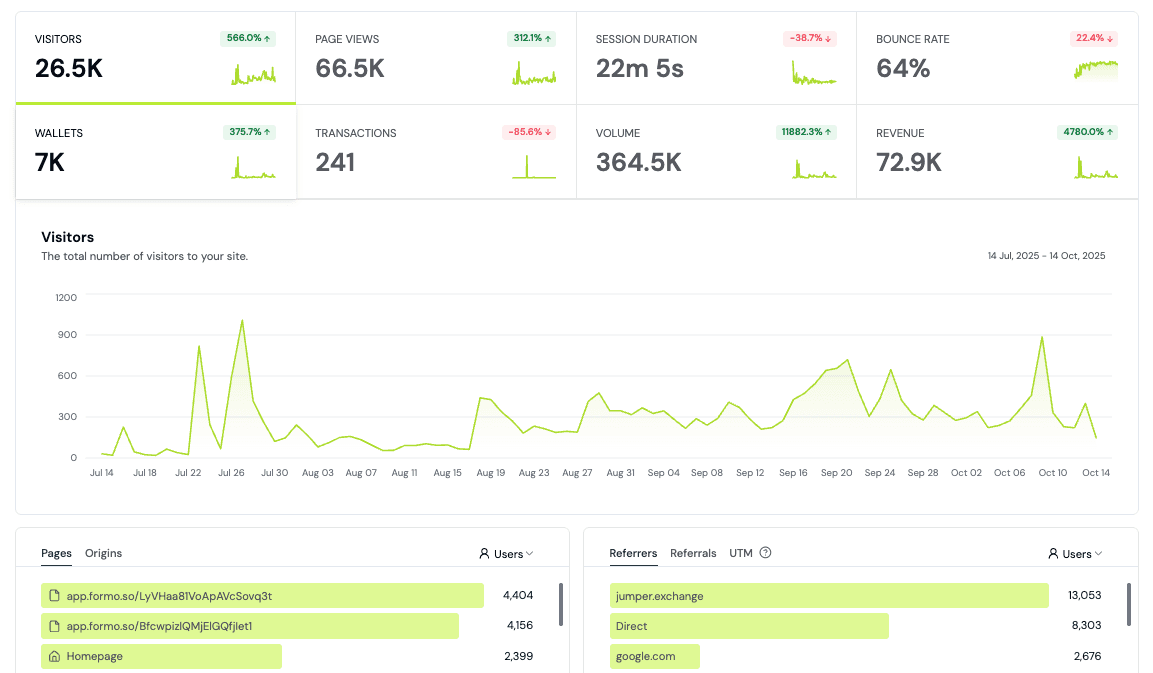
Formo makes a different bet: in a crypto app, the user is a wallet. Formo autocaptures pageviews plus wallet connects, chain switches, signatures, and transactions, with no tag configuration. Formo then builds wallet profiles and revenue tracking on that data, across all major EVM chains and Solana.
Matomo measures websites, apps, and ecommerce stores with great depth. Formo measures what wallets do before and after they connect, and how that activity turns into volume and revenue. Matomo has no native concept of a wallet, a chain, or a token balance, so crypto teams must model those as custom events.
Visitor IDs and User ID vs wallet profiles
Matomo stores a unique visitor ID in a first-party cookie to recognize returning visitors. In cookieless mode, Matomo falls back to a config_id, a hash of the visitor’s environment, and Matomo states that unique, new, and returning visitor counts become less accurate. The Matomo User ID feature links sessions and devices when your code sets an ID, such as a username or email.
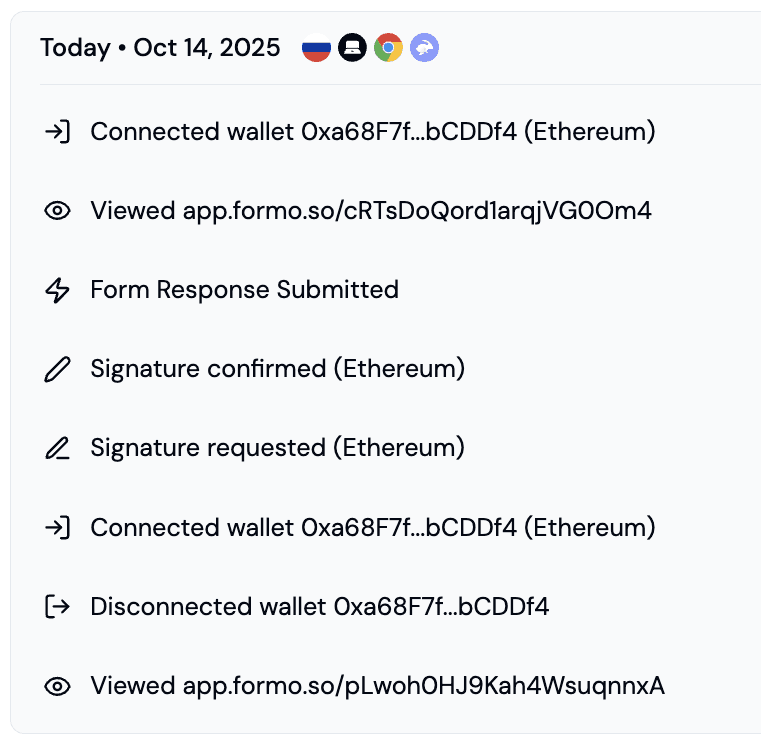
Formo assigns an anonymous visitor ID in a first-party cookie on your domain, with no IP storage and no device fingerprinting. When a visitor connects a wallet, Formo stitches the earlier anonymous sessions to that wallet address automatically.
Each Formo wallet profile shows net worth, tokens, chains, DeFi positions, labels, and onchain history, plus a lifecycle stage: New, Returning, Power user, At Risk, Churned, or Resurrected. A team could pass a wallet address to Matomo as a User ID, but Matomo would hold no onchain data about that address.
Pricing model: hits vs wallets
Matomo Cloud bills by monthly hits, where a hit is a pageview, event, download, outlink, site search, or content tracking request. Matomo Cloud Business starts at €22/month for 50,000 hits, and the 5 million hits tier costs €822/month excluding tax. Matomo On-Premise is free, but the team pays for servers and for premium plugins or bundles.
Formo bills by MAUs, which are unique wallet addresses with an active session. Growth is $199/month billed yearly ($249/month billed monthly) for up to 5,000 MAUs, and Scale is $399/month billed yearly ($499/month billed monthly) for up to 10,000 MAUs. Every Formo plan includes unlimited events and visitors, so wallet connects, signatures, and transactions add nothing to the bill.
Matomo Cloud’s price rises with every tracked event, so wallet and transaction tracking pushes the bill into higher hit tiers. Formo cost does not change with events; the price changes only as monthly active wallets grow.
Attribution: multi-channel models vs onchain attribution
Matomo has strong marketing attribution for web conversions. Matomo tracks channels, campaigns, UTMs, goals, and ecommerce revenue, and can export conversions to ad platforms. The Multi Channel Conversion Attribution feature, included in Matomo Cloud Business and sold as a plugin for On-Premise, compares Last Interaction, Last Non-Direct, First Interaction, Linear, Position Based, and Time Decay models.
Matomo attribution stops at the website conversion. Matomo does not see wallet connects, onchain volume, revenue per wallet, or retention by wallet unless a team builds custom event tracking and accepts that each event adds to the hit count.
Formo provides marketing attribution and onchain attribution in one model. Formo ties UTMs, referrals, and campaigns to wallets, then reports the volume, revenue, and retention of each channel, with first touch and last touch models. A growth team can rank campaigns by onchain revenue instead of by goal completions, and can segment each channel’s wallets by net worth or lifecycle stage.
When Matomo is the better choice
Matomo is the better choice when policy requires self-hosting or full data ownership on your own servers, since Matomo On-Premise is free and open source. Matomo fits teams that need heatmaps, session recordings, or A/B testing, which Formo does not offer. Matomo suits large websites and ecommerce stores that measure goals, forms, and media rather than wallets. Teams migrating from Google Analytics can use the Matomo GA importer to keep history. Matomo also fits sites with no wallet connects or onchain transactions to measure.
Matomo is also a good fit for public sector bodies and regulated companies that need a configurable reporting suite with roll-up reports across many websites. Teams with in-house engineers to run servers, updates, and backups get the most value from Matomo On-Premise. For a crypto team, a common split is Matomo on corporate websites and Formo in the app, where wallets, funnels, and revenue tracking live, and each tool does the job it was built for.
Running Matomo and Formo together
Keep Matomo for website reporting or deployment control your organization requires, and use Formo for crypto product analytics, marketing attribution, wallet intelligence, and revenue tracking. Run both during evaluation. Formo begins collecting new events after you install the SDK; historical Matomo data will not transfer because the tools use different data models.
For a full walkthrough of features, privacy, and setup for crypto teams, read the long-form comparison of Formo and Matomo.

Add Formo next to Matomo
Add the Formo SDK next to the Matomo JavaScript tracker or Tag Manager container. The two do not conflict, so both collect data from the same day.

Map goals and events
Formo autocaptures pageviews, UTMs, referrals, wallet connects, chain switches, signatures, and transactions. Recreate only your Matomo goals, custom events, and ecommerce.