Best Wallet Analytics Platforms with Ethereum and Solana Support (2026)

Key Takeaways
Evaluate platforms on SDK integration depth, cross-chain data latency, and whether they track Solana data alongside EVM data: most tools do one or the other, not both.
Ethereum and Solana analytics coverage matters because DeFi users often operate across both chains, making single-chain tools incomplete.
Wallet analytics platforms differ by use case across product funnels, wallet intelligence, and attribution tied to onchain outcomes.
Formo fits DeFi teams needing fast cross-chain insight with SDK integration, wallet profiles, funnels, cohorts, and onchain attribution.
If you’ve been hunting for a wallet analytics platform that works across both Ethereum and Solana — not just one or the other — you’ve probably noticed the options vary wildly. Some tools give you beautiful dashboards but no SDK. Others offer deep onchain data but only cover EVM chains. And if you’re running a DeFi app where users interact across both ecosystems, that gap costs you visibility into a significant chunk of your user base.
This post breaks down what to look for, what the market actually offers, and how to pick the right platform for your stack today.
Why Ethereum and Solana coverage both matter
Ethereum and Solana serve different but overlapping audiences. Ethereum anchors the bulk of DeFi TVL — with total value locked exceeding $116 billion across DeFi as of mid-2025 — while Solana has rapidly become the preferred chain for high-throughput apps, handling thousands of transactions per second with sub-cent fees. Many active DeFi users operate on both.
If your analytics only covers one chain, you’re working with a partial picture. A user who swaps on your Solana-based DEX and also interacts with an Ethereum-side liquidity pool is one user — but siloed analytics tools treat them as two separate, unrelated wallets. That breaks cohort analysis, skews your CAC calculations, and makes retention reporting unreliable.
The platforms worth your time are those that handle both chains natively — not via a workaround or third-party bridge.
What to actually look for in a multi-chain wallet analytics platform
Before comparing options, it’s worth being clear on what “wallet analytics” means in a DeFi context. There are at least three distinct use cases, and the right platform depends on which ones you need:
Product analytics — tracking user journeys from first visit through wallet connection to onchain transactions. You want to see funnels, activation steps, and what events precede a swap or deposit.
Wallet intelligence — turning anonymous wallet addresses into usable profiles. This means enriching addresses with DeFi activity, token holdings, net worth estimates, and behavioural patterns so you can segment users meaningfully.
Attribution and ROI measurement — connecting marketing channels and campaigns to onchain outcomes like volume, revenue, and retention, with actual CAC and LTV metrics rather than click-based proxies.
Many tools do one of these well. Fewer do all three, and even fewer do all three across both Ethereum and Solana.
The platforms worth considering
Formo
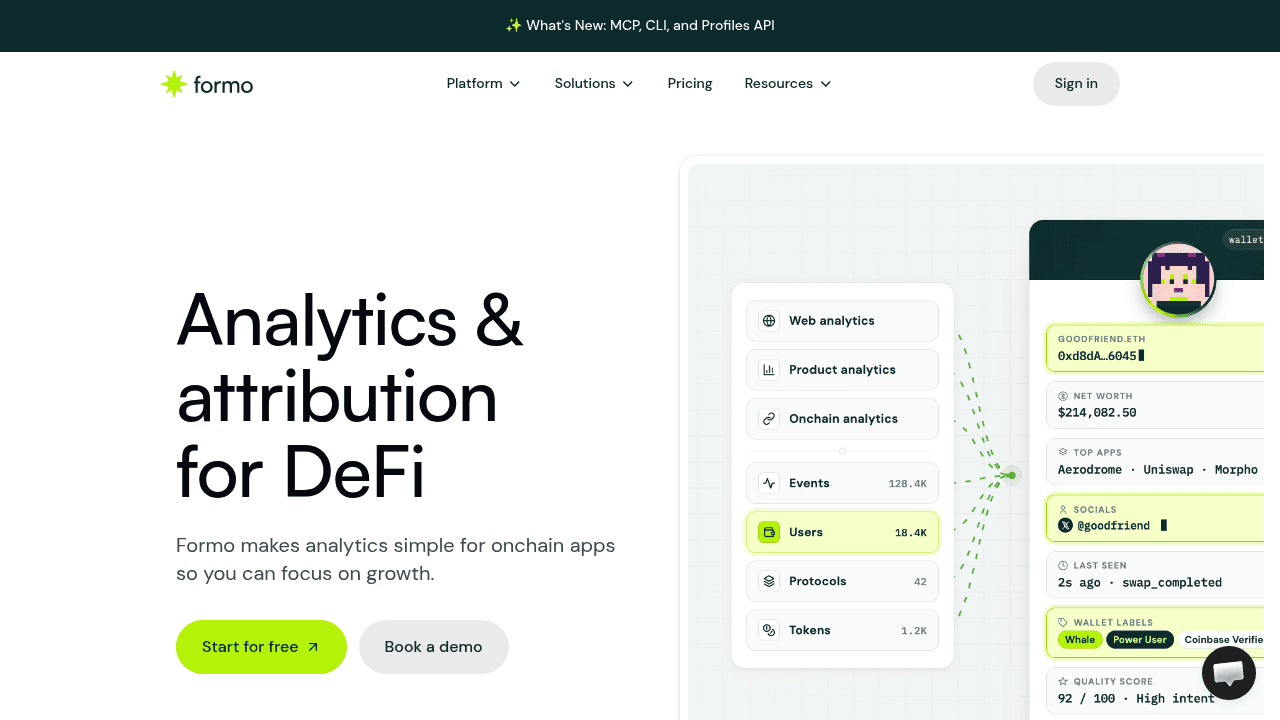
Formo is built specifically for DeFi and crypto teams, and it’s one of the few platforms that genuinely combines product analytics, wallet intelligence for DeFi, and onchain attribution in a single stack — with native support for both Ethereum and Solana.
The integration story is straightforward. Formo’s open-source SDKs (MIT licensed) drop into your existing stack, and wallet connections via MetaMask, Phantom, Rainbow, Privy, Dynamic, and Thirdweb are all supported out of the box. That means whether your users are connecting a Phantom wallet on Solana or MetaMask on Ethereum mainnet or an L2, Formo captures it as part of the same user journey.
For product teams, Formo tracks the full lifecycle — from first page visit through wallet connection to onchain transactions — across 30+ chains. You get funnels, cohorts, and real-time event feeds without needing a custom data pipeline. The Chartbuilder lets you build custom reports, and the Alerts feature pings you when key events or top users are active.
Where Formo stands out for growth teams is onchain attribution. Instead of measuring campaign performance in clicks, you measure it in volume, revenue, and retention. CAC is calculated against actual wallet acquisitions. LTV is derived from onchain activity. That’s the kind of data that helps you decide whether a Solana-native campaign drove high-value depositors or just one-time users.
Wallet Intelligence adds another layer: wallet profiles that enrich addresses with DeFi positions, token holdings, and behavioural labels. You can segment your Solana users by protocol engagement or filter your Ethereum users by net worth — then use those segments to personalise onboarding or target re-engagement campaigns. The platform also includes token-gated forms for Ethereum and Solana, useful for running exclusive waitlists, surveys, or community allowlists tied to token ownership.
Formo is available with a free trial and a sales-assisted demo option, which makes it accessible for early-stage teams without requiring an upfront infrastructure commitment.
Nansen
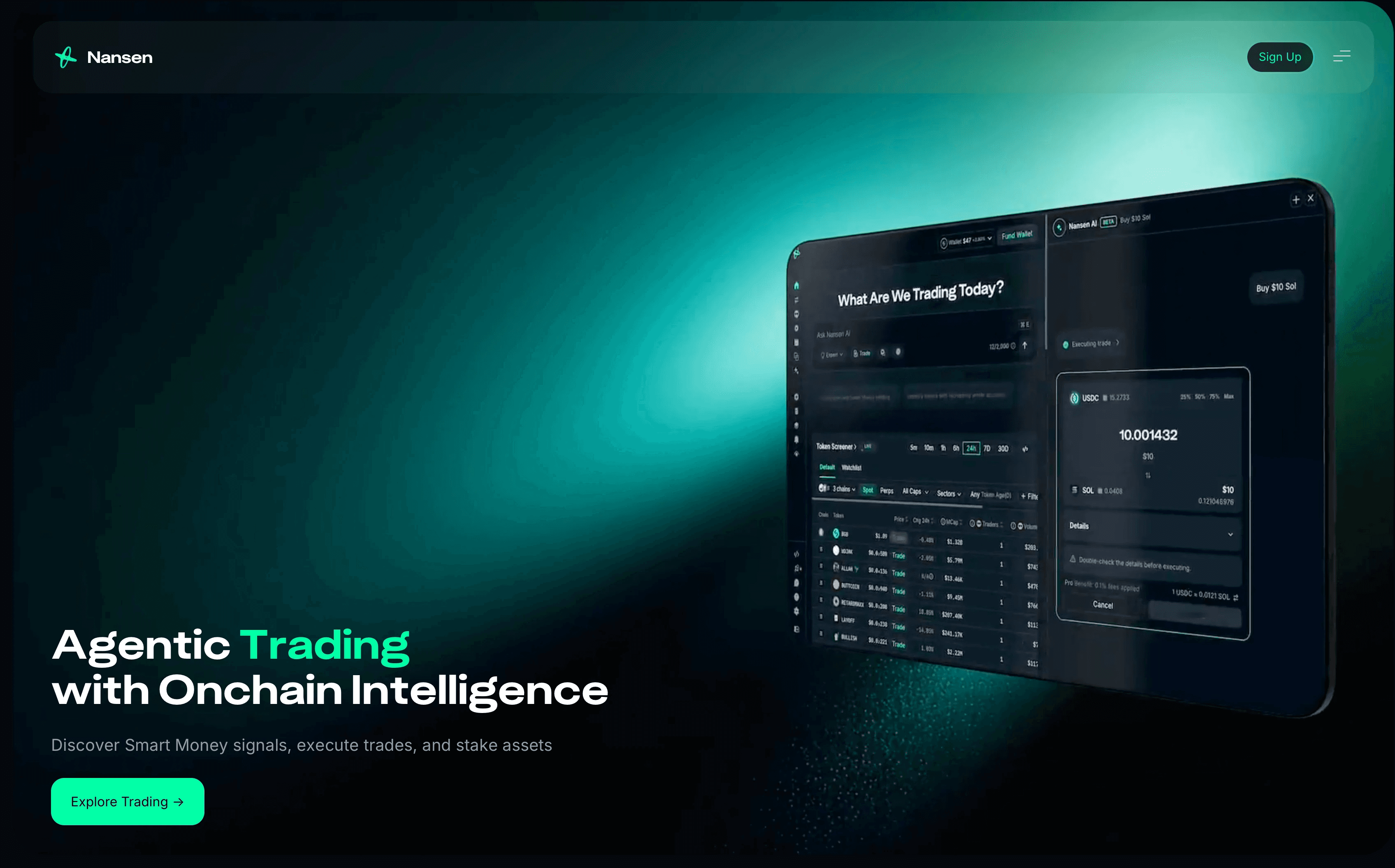
Nansen is a well-established wallet intelligence platform with strong labelling across Ethereum and expanding Solana coverage. Its “Smart Money” tracking is genuinely useful for competitive research — you can see how influential wallets are moving across protocols. The trade-off is cost; Nansen is priced for institutional teams and research-heavy use cases rather than product or growth operators who need actionable daily metrics.
Dune Analytics
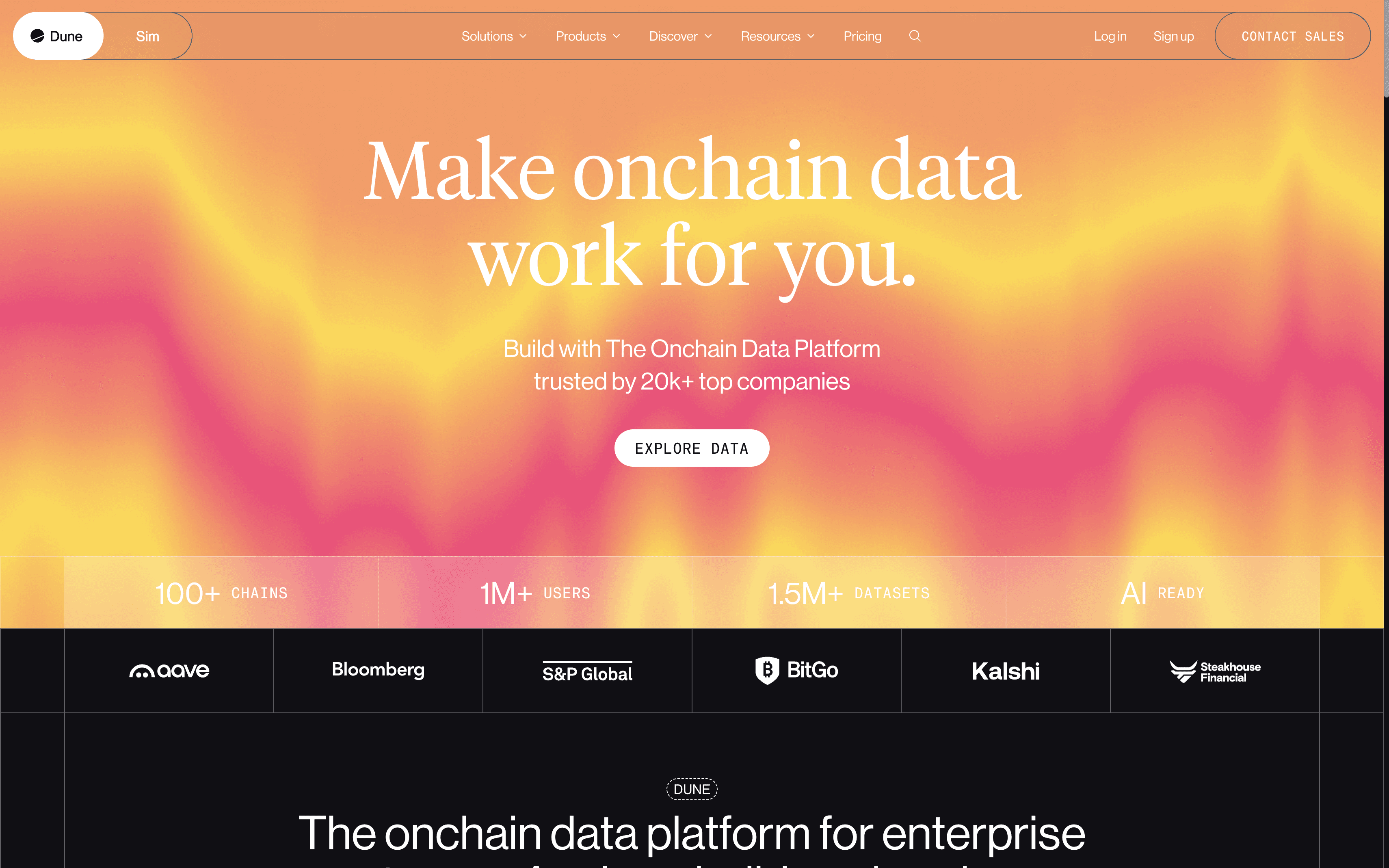
Dune gives you SQL-level access to onchain data across Ethereum, Solana, and 100+ other chains. If your team has data engineers who want to build fully custom dashboards, it’s a strong option. The limitation is that it’s a query tool, not a product analytics platform — there’s no out-of-the-box funnel tracking, wallet profile enrichment, or attribution reporting. It surfaces data; it doesn’t turn that data into growth insights automatically.
Moralis
Moralis offers a developer-focused API that normalises wallet activity across Ethereum and Solana into unified feeds. It’s a solid choice if you’re building a custom data layer and need a reliable multi-chain data source. Like Dune, it’s more of a building block than a finished analytics product.
The integration question: SDK vs API vs query tool
How you integrate matters as much as what you integrate. There are three main patterns:
SDK integration — install a package, instrument events, done. Fastest path to product analytics coverage. Formo’s approach.
API integration — pull wallet data into your own infrastructure on demand. Flexible, but requires more engineering. Moralis and Zerion API follow this model.
Query-based access — write SQL or GraphQL to fetch historical onchain data. Maximum flexibility, maximum overhead. Dune and The Graph work this way.
For most DeFi product teams without a dedicated data engineering function, SDK-first platforms get you to insight faster. If you’re already running a data warehouse and need raw inputs, an API provider makes more sense.
Cross-chain identity: the hardest problem to solve
Here’s the thing that separates genuinely useful wallet analytics from tools that just look good in a demo: cross-chain identity resolution. A single user might hold a Phantom wallet for Solana activity and a MetaMask wallet for Ethereum. Most analytics platforms log those as two separate entities.
Platforms that handle this well — typically through session-based linking when a user connects multiple wallets in the same session — give you a unified view of user behaviour across chains. That matters enormously for measuring LTV/CAC in DeFi, because a user who is active on both chains may have significantly higher lifetime value than their single-chain activity suggests.
For teams building DeFi analytics dashboards that span both ecosystems, this isn’t a nice-to-have — it’s the difference between accurate and misleading data.
Choosing what fits your team
If you’re a growth or product lead at a DeFi startup who needs to ship insights quickly without a complex data stack, the choice is fairly clear: you want a platform with native Ethereum and Solana support, an SDK you can drop in during a sprint, wallet-level analytics that connect to attribution, and metrics tied to onchain outcomes rather than page views.
Formo is built for exactly that use case. But whichever platform you evaluate, test it against one question: does it show me what my users are actually doing onchain — across both Ethereum and Solana — and can it connect that back to where those users came from?
If the answer is yes, you’ve found something worth running with. Start your free trial on Formo or book a demo to see how cross-chain wallet analytics works in practice for your app.


