Best Wallet Profiling Tools for Crypto Marketing Teams in 2026

Key Takeaways
Wallet profiling turns pseudonymous addresses into actionable segments based on transaction history, token holdings, protocol use, and behavior.
Crypto marketing teams need wallet intelligence to segment DeFi users, attribute campaigns to onchain outcomes, and personalize engagement.
Formo connects wallet profiles to campaign ROI by linking segmentation, product analytics, CAC, LTV, and onchain attribution in one stack.
Crypto marketing teams are drowning in data they can’t act on. Wallet addresses are pseudonymous. Transaction histories live on a dozen different chains. And traditional analytics tools — built for cookies and email addresses — stop working the moment a user connects their MetaMask.
Wallet profiling changes that. Instead of guessing who your users are, you pull their onchain history, classify their behaviour, and build segments that actually reflect how they use DeFi products. According to Naughty Marketing, DeFi ad spend is expected to surpass $2.8 billion by the end of 2025, with 70% of projects failing to demonstrate measurable ROI. Better wallet intelligence is one of the most direct ways to close that gap.
This article breaks down the wallet profiling tools worth knowing in 2026, what each one does well, and how to match the right tool to your team’s actual job.
What wallet profiling actually involves
A wallet profile is a composite view of a user built from onchain data: their transaction history, token holdings, protocol interactions, cross-chain activity, and behavioural patterns over time. The goal is to convert a pseudonymous address into something actionable — a segment, a persona, a risk score, or a retargeting audience.
Most marketing teams need wallet profiling to do at least one of three things:
Segment users by their DeFi behaviour (high-frequency traders, LP providers, airdrop hunters, idle whales)
Attribute campaigns to onchain outcomes rather than vanity metrics like clicks or impressions
Personalise engagement at the user level — onboarding flows, reward structures, community access
The tools on the market split across these jobs. No single platform covers all three equally well, so the right choice depends on which problem is most urgent for your team.
The main categories of wallet profiling tools
Full-stack DeFi analytics platforms
These platforms combine wallet intelligence with product analytics and attribution, giving growth teams a single place to track acquisition, activation, and retention against onchain outcomes.
Formo is built specifically for DeFi and crypto apps that need to tie product behaviour to onchain transactions. Its Wallet Intelligence layer builds wallet profiles from transaction history, token holdings, and protocol interactions across 30+ chains, then surfaces those profiles as actionable segments. Teams can identify high-value traders, dormant whales, or users showing churn signals — and act on that data without writing a line of SQL.
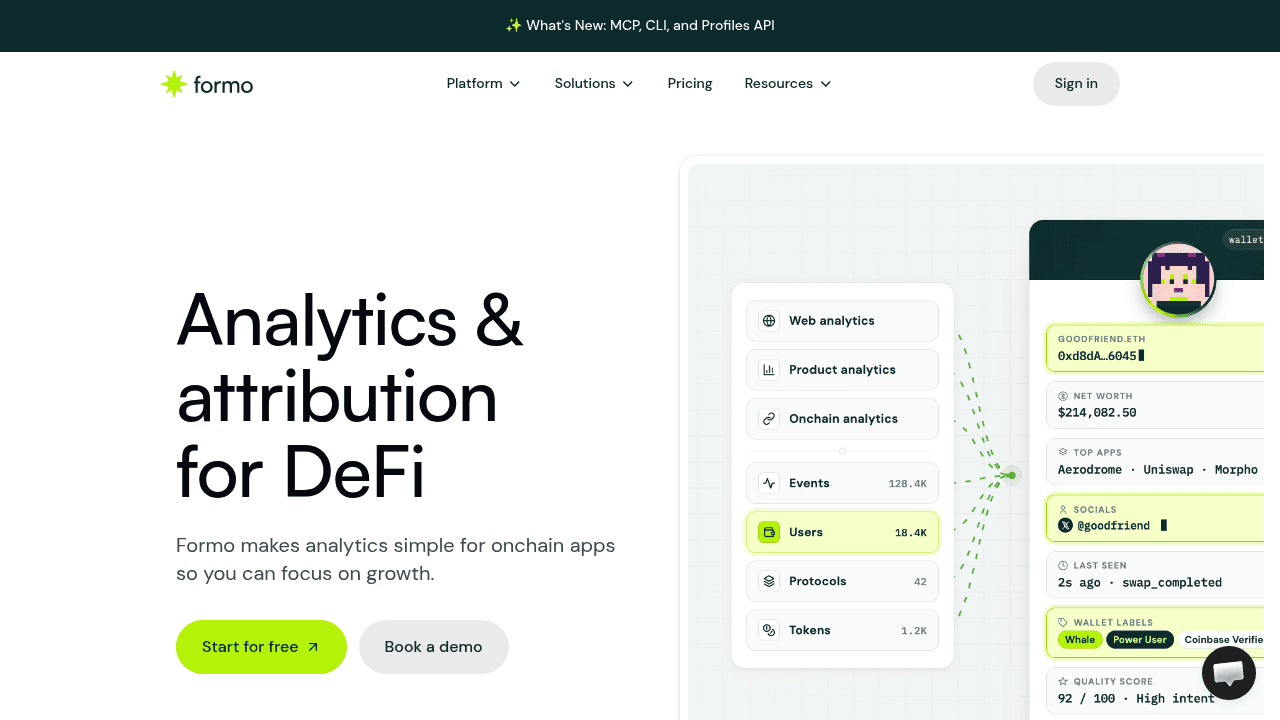
What separates Formo from pure intelligence tools is the connection between wallet data and campaign performance. Onchain attribution reports show which channels and campaigns drive volume, revenue, and real retention — not just connected wallets. The platform tracks CAC and LTV at the wallet level, which is the only meaningful way to measure ROI in DeFi. It also includes an onchain attribution layer that maps offchain touchpoints (UTMs, social, referrers) directly to onchain conversions.
For community and acquisition workflows, Formo’s token-gated forms let teams build waitlists, surveys, and onboarding flows gated by token ownership or wallet activity — keeping out bots and airdrop farmers while collecting genuine wallet-level data from qualified users.
Onchain intelligence and wallet labelling platforms
Nansen is the reference tool for wallet labelling at scale. It maintains a database of over 500 million labelled wallet addresses — classifying them as DEX traders, smart LPs, VC funds, NFT collectors, and more. Its Smart Segments feature lets you group wallets by specific holdings, behaviours, or activity windows. For teams looking to identify whale cohorts or track smart money flows, Nansen is hard to beat.
The limitation is scope. Nansen excels at market intelligence and investor-level research, but it doesn’t natively connect wallet intelligence to your product’s user funnel or your campaign spend. It’s a research and discovery layer, not an attribution or retention platform.
Arkham Intelligence takes a different angle — focused on deanonymising wallets and mapping entity relationships. It’s most useful for deep-dive research on specific addresses or organisations rather than broad marketing segmentation.
Marketing attribution and campaign measurement tools
Cookie3 has built a strong reputation for KOL and influencer campaign tracking. It analyses whether traffic from a specific creator or channel converts to genuine onchain users or bots — a real problem given that a high percentage of crypto influencer traffic is low quality. If your team spends heavily on KOL campaigns and wants to measure ROAS against actual wallet activity, Cookie3 is purpose-built for that job.
Addressable focuses on connecting onchain wallet data to social media advertising. It enables wallet-based retargeting — re-engaging users who visited your dApp but didn’t connect — by mapping wallet addresses to social profiles for targeted ad delivery.
Safary functions as a web3-native product analytics layer, tracking user journeys across wallet connections and protocol interactions. It’s useful for funnel visibility but less focused on deep wallet profiling or campaign attribution at the revenue level.
How to choose the right tool for your team
The honest answer is that most DeFi marketing teams need more than one layer. But budget and complexity have limits. Here’s how to think about priority:
If your primary problem is understanding who your existing users are — their DeFi history, risk profile, and onchain behaviour — you need a platform with native wallet intelligence and segmentation. Formo’s wallet profiles and DeFi-native segmentation are designed exactly for this, with the advantage that segments connect directly to your product analytics and attribution data rather than sitting in a separate research tool.
If your primary problem is measuring campaign ROI against onchain outcomes, you need an attribution layer that tracks volume, revenue, and wallet retention by channel. Formo’s onchain marketing framework handles this natively. Cookie3 or Addressable work well for specific campaign types — KOL tracking and social retargeting respectively — but don’t provide the full funnel view from acquisition to LTV.
If your problem is identifying external wallet cohorts for acquisition targeting — finding wallets that use competitor protocols, hold specific tokens, or show buying signals — Nansen’s labelling database is the most comprehensive starting point.
For teams that want to understand how to measure LTV and CAC at the wallet level, the key requirement is a platform that connects offchain spend to onchain revenue across the full user lifecycle. That’s a different capability from labelling wallets — it requires integrating your product events, wallet connections, and transaction data in one place.
The data quality problem most teams ignore
Wallet profiling is only as good as the data it’s built on. Two issues come up repeatedly:
Sybil wallets and airdrop farmers inflate user counts and distort behavioural profiles. Any wallet profiling tool that doesn’t filter for Sybil behaviour will give you misleading segments. Look for platforms with anomaly detection, behavioural validation, and clustering logic that separates genuine users from reward-extractors.
Single-chain data misses the picture for most DeFi users. A wallet that looks inactive on Ethereum might be highly active on Base or Arbitrum. Cross-chain coverage matters — and web3 analytics tools that only index one or two chains will consistently undercount your real user base.
What good wallet profiling looks like in practice
A DeFi protocol using wallet profiling well doesn’t just categorise users after they arrive — it uses wallet data throughout the growth lifecycle. Pre-connection, it scores inbound traffic quality and adjusts spend accordingly. At activation, it personalises onboarding based on existing DeFi experience. Post-activation, it monitors for churn signals and re-engages high-LTV wallets before they leave.
For marketing teams specifically, the web3 marketing stack that delivers consistent results combines: a wallet intelligence layer for segmentation, an attribution layer tied to onchain revenue, and community tools that verify wallet identity at the point of acquisition. Running these as disconnected point solutions creates the data fragmentation that makes onchain growth so hard to measure in the first place.
The platforms that solve this end-to-end — rather than just one slice of it — are where DeFi marketing teams are concentrating their tooling budgets in 2026.
Frequently asked questions
What is wallet profiling in crypto marketing?
Wallet profiling is the process of building an actionable user profile from onchain data such as transaction history, token holdings, protocol interactions, and behavioural patterns. It helps teams turn pseudonymous wallets into segments, personas, risk scores, or retargeting audiences.
Why do DeFi marketing teams need wallet profiling tools?
They help teams understand user behaviour, measure campaign ROI against onchain outcomes, and personalise engagement based on real wallet activity rather than clicks, impressions, or email-based analytics.
What are the main use cases for wallet profiling?
The main use cases are user segmentation, campaign attribution, and personalised engagement, including onboarding flows, reward structures, community access, and retention campaigns.
What is the best wallet profiling tool for DeFi marketing teams?
The best tool depends on the team’s priority. Formo is suited to teams that need wallet intelligence connected to product analytics and campaign attribution, while Nansen is strong for wallet labelling and external cohort research. Cookie3 and Addressable are more specialised for KOL tracking and social retargeting.
How does wallet profiling improve campaign attribution?
Wallet profiling connects offchain touchpoints such as UTMs, social campaigns, referrers, or creator traffic to onchain actions like wallet connections, trading volume, revenue, and retention. This gives teams a clearer view of ROI than traditional web analytics.
Why does cross-chain coverage matter for wallet profiling?
DeFi users often interact across multiple networks. A wallet that looks inactive on Ethereum may be active on Base, Arbitrum, or another chain, so single-chain analytics can undercount activity and misclassify valuable users.


