Best Wallet Intelligence Tools for Web3 Product Teams (2026)

Key takeaways
Wallet intelligence transforms anonymous wallet addresses into actionable user profiles by enriching them with onchain and behavioral data.
The best wallet intelligence platforms combine blockchain enrichment with product analytics, attribution, and user segmentation instead of providing raw blockchain data alone.
Product teams use wallet intelligence to improve onboarding, personalize user experiences, identify churn risk, and understand which features drive long-term retention.
Growth and marketing teams use wallet intelligence to measure campaign quality, identify high-value acquisition channels, and connect marketing spend to onchain outcomes.
When evaluating wallet intelligence tools, compare supported chains, enrichment quality, real-time updates, developer APIs, analytics capabilities, and integration with your existing product stack.
This guide compares the best wallet intelligence tools for Web3 product teams. Crypto wallet intelligence has emerged as a critical capability for Web3 product teams seeking to understand their users beyond traditional analytics. Unlike conventional web tracking, wallet intelligence provides deep behavioral insights by analyzing on-chain transactions, token holdings, and cross-platform interactions.
A comprehensive approach enables product teams to segment users effectively, optimize growth strategies, and deliver personalized experiences without compromising privacy. As the Web3 ecosystem matures, teams that master wallet intelligence gain significant competitive advantages in user acquisition, retention, and product-market fit.
This guide compares the best wallet intelligence tools for developers, product teams, and marketers, highlighting their strengths, ideal use cases, and the key features to evaluate before choosing a solution.
What is crypto wallet intelligence?
Wallet intelligence is the process of enriching blockchain wallet addresses with contextual information that makes them useful for product, growth, security, or investment decisions.
A wallet address by itself contains very little business context. You can see transactions on a blockchain explorer, but you cannot immediately answer questions like:
Is this a new or experienced DeFi user?
Does this wallet hold significant assets?
Which protocols has this user interacted with before?
Is this a returning customer or a first-time visitor?
Which marketing campaign originally acquired this wallet?
Wallet intelligence platforms answer these questions by combining raw blockchain data with enrichment layers such as:
Enrichment | Example |
|---|---|
Portfolio data | Token holdings and estimated net worth |
Transaction history | Swaps, deposits, staking, NFT activity |
Protocol usage | DeFi applications previously used |
Wallet characteristics | Wallet age, activity frequency, active chains |
Identity labels | ENS names, exchange wallets, protocol treasuries, Smart Money labels (where available) |
Product analytics | Website sessions, wallet connects, funnel progression |
Marketing attribution | UTM parameters, referral codes, acquisition source |
Instead of treating every wallet as an anonymous address, product teams can understand how different users behave and how those behaviors contribute to protocol growth.
Unlike traditional web analytics, wallet intelligence does not depend on cookies or email addresses. The wallet itself becomes the primary identifier, allowing teams to analyze user behavior across multiple sessions and onchain interactions while respecting the pseudonymous nature of blockchain users.
What makes a good wallet intelligence platform?
Not every wallet intelligence platform solves the same problem. Before choosing a solution, it helps to understand the capabilities that matter most for your team.
Capability | Why it matters |
|---|---|
Wallet enrichment | Understand token holdings, portfolio value, protocol usage, and wallet history. |
Cross-chain support | Build a unified view of users across multiple EVM networks. |
Product analytics | Measure onboarding, funnels, retention, and feature adoption alongside wallet activity. |
Marketing attribution | Connect campaigns, referrals, and UTM parameters to wallet connections and transactions. |
Real-time data | Analyze user behavior as it happens rather than relying on delayed reports. |
Developer integrations | Access APIs, SDKs, and webhooks for building custom workflows. |
The importance of each capability depends on your use case. Investors often prioritize wallet labels and market intelligence. Product teams typically care more about attribution, retention, and user segmentation. Infrastructure teams may simply need reliable blockchain APIs.
Wallet intelligence for product analytics
For product teams, wallet intelligence is valuable because it connects blockchain activity with product usage.
Instead of measuring anonymous website visitors, teams can analyze how connected wallets move through the entire product lifecycle:
Visit the website
Connect a wallet
Complete the first transaction
Return to transact again
Deposit liquidity or stake assets
Become a long-term retained user
This makes it possible to answer questions such as:
Which acquisition channels generate the highest-value wallets?
Which onboarding flow produces the best activation rate?
What behaviors predict long-term retention?
Which user segments contribute the most protocol revenue?
Where do users abandon the funnel before completing an onchain action?
These insights help product teams prioritize features, improve onboarding, and allocate marketing budgets based on actual protocol outcomes rather than website traffic alone.
Wallet intelligence for market research and investigations
Some wallet intelligence platforms focus less on product analytics and more on understanding blockchain ecosystems.
These platforms enrich wallet addresses with entity labels, transaction networks, and fund flow analysis, making it easier to investigate onchain activity.
Typical use cases include:
Tracking Smart Money wallets
Monitoring whale activity
Following institutional fund flows
Identifying exchange wallets
Investigating exploit or hack transactions
Analyzing token distribution across ecosystems
These capabilities are valuable for investors, researchers, security teams, and compliance professionals. However, they generally do not provide product analytics features such as funnels, retention analysis, or marketing attribution.
The Best Wallet Intelligence Tools Compared
The wallet intelligence landscape features specialized platforms designed for different use cases, from comprehensive analytics suites to focused attribution tools. Understanding each platform’s strengths helps product teams select the right combination of tools for their specific needs.
Platform | Best for | Primary users |
|---|---|---|
Formo | Product analytics, wallet intelligence, and onchain attribution | Product, growth, and marketing teams |
Nansen | Wallet intelligence and market analytics | Investors, researchers, and analysts |
Arkham Intelligence | Entity intelligence and blockchain investigations | Security teams, journalists, researchers, and compliance teams |
Formo: Web3 product analytics and wallet intelligence
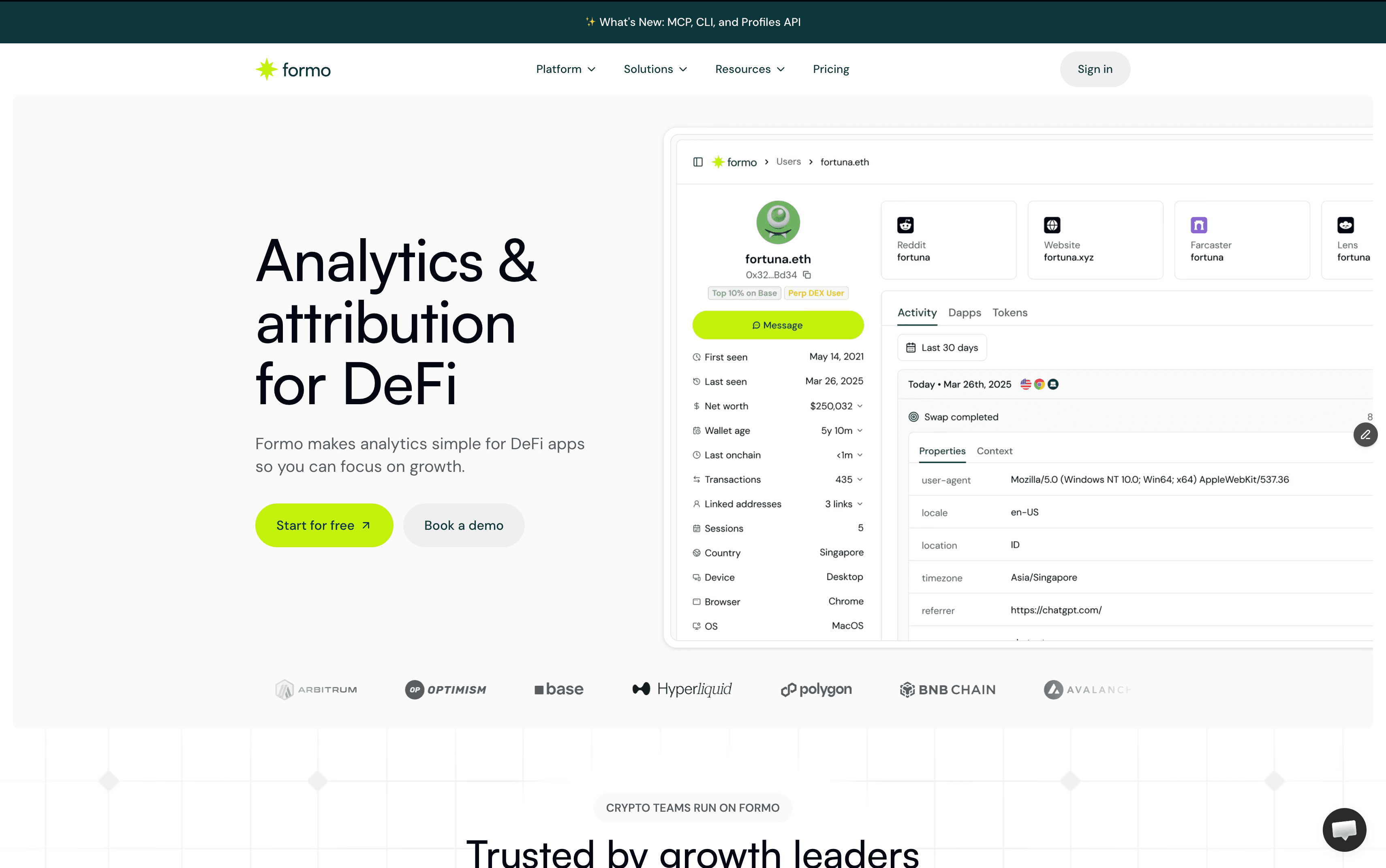
Formo combines wallet intelligence with product analytics and onchain attribution, giving product and growth teams a complete view of the user journey from the first website visit to onchain activity. Instead of treating blockchain transactions as external data, Formo captures wallet connections, smart contract interactions, transactions, and marketing attribution alongside traditional product analytics.
Every connected wallet is automatically enriched with token holdings, estimated net worth, DeFi protocol activity, wallet age, and behavioral insights. Teams can then build user segments, analyze retention, measure funnel conversion, and attribute protocol revenue back to marketing campaigns without building blockchain indexers or custom data pipelines.
Formo’s technical depth extends to tracking complete user journeys across multiple touchpoints, from initial wallet connection through complex DeFi interactions. The platform provides granular insights while maintaining user anonymity, making it ideal for privacy-focused product managers, growth leads, and crypto founders who need comprehensive analytics without compromising user trust.
Key features
Unified analytics and attribution for onchain apps
Open-source SDK/API for seamless, privacy-respecting integration
Real-time funnels, segmentation, and onchain CRM capabilities
Cross-chain support (40+ EVM-compatible chains and Solana)
Wallet intelligence and user enrichment
Onchain attribution from UTM to transaction
Product analytics and funnel analysis
Wallet-based retention cohorts
User segmentation and behavioral analytics
SDK with automatic event capture
Ideal for
DeFi protocols, wallets, Layer 2 ecosystems, NFT platforms, and any Web3 product team that wants to understand user behavior across both web and onchain experiences.
Nansen: Wallet intelligence and market research
Nansen is one of the best-known blockchain analytics platforms for investors, analysts, and research teams. It enriches millions of wallet addresses with labels and behavioral insights, making it easier to identify smart money, whales, funds, exchanges, and protocol treasuries.
Rather than focusing on product analytics, Nansen specializes in understanding capital flows across blockchain ecosystems. Teams use it to monitor token movements, identify influential wallets, analyze ecosystem growth, and discover emerging trends before they become widely visible.
While product teams can use Nansen to understand wallet quality, it is not designed to measure user funnels, marketing attribution, or product engagement inside a Web3 application.
Key features
Smart Money wallet labels
Token and liquidity flow analysis
Portfolio tracking
Wallet discovery
Cross-chain analytics
Market and ecosystem research
Ideal for
Crypto investors, ecosystem researchers, trading teams, and protocol analysts looking to understand market behavior and wallet activity across multiple blockchains.
Arkham Intelligence: Wallet investigation and entity intelligence
Arkham Intelligence focuses on identifying the people and organizations behind blockchain activity. Its platform links wallet addresses to known entities such as exchanges, institutions, funds, protocols, and public figures, helping users investigate onchain behavior with greater context.
The platform is widely used for monitoring whale activity, tracking institutional movements, investigating hacks, and following fund flows across multiple chains. Rather than providing product analytics or marketing insights, Arkham is designed for blockchain intelligence and investigative research.
For product teams, Arkham can provide valuable context about who is interacting with a protocol, but it does not offer features such as user segmentation, retention analysis, marketing attribution, or funnel analytics.
Key features
Wallet and entity identification
Whale monitoring
Fund flow visualization
Cross-chain transaction analysis
Exchange and institutional tracking
Blockchain investigation tools
Ideal for
Researchers, security teams, journalists, compliance teams, and crypto investors who need to investigate blockchain activity and identify the entities behind wallet addresses.
How to implement wallet intelligence
Wallet intelligence is most valuable when it becomes part of your product analytics workflow rather than a standalone dashboard. Instead of collecting blockchain data for its own sake, start by identifying the product decisions you want to improve and then work backwards to the data you need.
Most teams implement wallet intelligence in four stages.
1. Decide what you want to measure
Before choosing a platform, define the questions you want wallet intelligence to answer.
For example:
Which marketing channels acquire the highest-value users?
What percentage of connected wallets complete a first transaction?
Which wallets are most likely to become long-term users?
Which protocols do our users come from?
What behaviors predict churn?
These questions determine the data you need and help avoid collecting information that never influences product decisions.
2. Connect wallet activity with product analytics
The biggest mistake teams make is analyzing blockchain data separately from product usage.
A complete view of the customer journey should connect:
Website visits
Marketing attribution
Wallet connections
Smart contract interactions
Product events
Retention and revenue
Without this connection, you can see what happened onchain, but not why it happened or which user journey led to it.
3. Build meaningful user segments
Once wallet enrichment is available, group users based on behaviors that matter to your product rather than arbitrary wallet balances.
Useful segments include:
Segment | Example |
|---|---|
New users | Connected within the last 7 days |
Power users | High transaction frequency |
High-value wallets | Portfolio value above a chosen threshold |
DeFi-native users | Active across multiple protocols |
At-risk users | Previously active but inactive for 30 days |
Cross-chain users | Active on multiple supported networks |
Dynamic segmentation allows these audiences to update automatically as wallet behavior changes.
4. Use insights to improve the product
Wallet intelligence should ultimately influence product decisions.
Common use cases include:
Personalizing onboarding for experienced DeFi users versus newcomers.
Identifying where users abandon the onboarding funnel before completing a transaction.
Measuring which acquisition channels produce the highest-quality wallets.
Prioritizing features based on engagement from retained users rather than total traffic.
Re-engaging inactive wallets with targeted campaigns.
The goal is not to collect more blockchain data. The goal is to build a better product using a deeper understanding of user behavior.
Best practices for using wallet intelligence
Treat wallets as users, not transactions
Traditional blockchain analytics often focuses on individual transactions.
Product teams should instead focus on the lifecycle of each wallet:
Visitor → Wallet Connect → First Transaction → Repeat Usage → Retention
This makes it easier to identify where users drop off and what drives long-term engagement.
Segment users by behavior, not balance
Wallet balance is useful, but it rarely tells the full story.
For example, a wallet with a modest portfolio that interacts with your protocol every week may be more valuable than a large wallet that visited once during an incentive campaign.
Useful segmentation combines:
Transaction frequency
Wallet age
Protocol usage
Cross-chain activity
Retention
Acquisition source
This produces much richer audiences than balance alone.
Measure quality, not volume
More wallets does not always mean more growth.
Track metrics that reflect long-term value, such as:
First transaction rate
Repeat transaction rate
Wallet retention
Revenue per wallet
Average deposit size
Retained TVL
These metrics provide a clearer picture of protocol health than wallet connections or page views alone.
Respect user privacy
Wallet intelligence should enrich public blockchain data rather than collect unnecessary personal information.
Choose platforms that:
Use wallet addresses as the primary identifier.
Avoid collecting personally identifiable information unless required.
Encrypt data in transit and at rest.
Clearly document how wallet data is processed and stored.
This helps teams balance analytics with user trust.
Continuously refine your user segments
Wallet behavior changes over time.
A wallet that was new three months ago may now be one of your most active users.
Review your segmentation regularly and adjust thresholds based on actual product usage rather than static definitions. Dynamic segments ensure your analytics, campaigns, and product experiences remain relevant as your user base evolves.
Summary
Wallet intelligence tools help Web3 teams understand who their users are beyond a wallet address. By enriching wallets with token holdings, net worth, transaction history, DeFi activity, protocol usage, and cross-chain behavior, these platforms enable better user segmentation, marketing attribution, retention analysis, and product analytics.
The right wallet intelligence platform depends on what you’re trying to understand. Investors and researchers need visibility into market activity, while product teams need visibility into user behavior. If your goal is improving onboarding, retention, attribution, and product growth, a platform that combines wallet intelligence with product analytics provides the most actionable insights.
Frequently asked questions
What is wallet intelligence?
Wallet intelligence is the process of enriching blockchain wallet addresses with additional information such as token holdings, estimated net worth, transaction history, DeFi protocol usage, wallet age, active chains, behavioral labels, and social identities like ENS names. This context helps teams understand user behavior instead of treating every wallet as an anonymous address.
Why do Web3 teams need wallet intelligence?
Blockchain data is public but difficult to interpret at scale. Wallet intelligence transforms raw transaction data into actionable insights that product, marketing, and growth teams can use for segmentation, personalization, attribution, retention analysis, fraud detection, and customer support.
What features should I look for in a wallet intelligence platform?
The best wallet intelligence platforms typically include:
Token holdings and portfolio tracking
Estimated wallet net worth
Cross-chain transaction history
DeFi protocol activity
Wallet labels and behavioral scores
Marketing attribution
User segmentation
Real-time data enrichment
Developer APIs and SDKs
Integrations with analytics and CRM tools
Platforms that combine enrichment with product analytics usually provide the most business value.
What is the difference between wallet intelligence and blockchain explorers?
Blockchain explorers such as Etherscan allow users to inspect individual wallet addresses and transactions manually. Wallet intelligence platforms automate this process by enriching wallets with contextual information, aggregating activity across multiple chains, and making the data searchable, segmentable, and actionable for product and marketing teams.
Can wallet intelligence improve user segmentation?
Yes. Wallet intelligence allows teams to create audience segments using wallet value, protocol activity, transaction frequency, cross-chain behavior, wallet age, lifecycle stage, and previous interactions with competing protocols. These segments support more personalized onboarding, lifecycle campaigns, and product recommendations.
How does wallet intelligence improve marketing attribution?
Wallet intelligence connects acquisition data with wallet behavior. Instead of measuring only clicks or wallet connections, teams can determine which campaigns generate high-value wallets, repeat users, larger deposits, stronger retention, and higher protocol revenue. This produces much more accurate marketing ROI than website analytics alone.
Can wallet intelligence identify whales?
Yes. Most wallet intelligence platforms estimate wallet value using token holdings and onchain assets, allowing teams to identify whales and other high-value users automatically. Many platforms also provide behavioral insights, making it possible to distinguish active long-term users from inactive high-balance wallets.
Which teams benefit most from wallet intelligence?
Wallet intelligence is valuable across multiple functions:
Product teams improve onboarding, retention, and feature adoption.
Growth teams optimize acquisition channels and campaign performance.
Marketing teams measure attribution and user quality.
Customer success teams better understand user context before providing support.
Business development teams identify ecosystem partners and high-value users.
Is wallet intelligence only useful for DeFi?
No. While DeFi protocols are among the largest users of wallet intelligence, NFT marketplaces, blockchain games, wallets, Layer 2 ecosystems, DAOs, infrastructure providers, and consumer crypto applications all use wallet intelligence to better understand and engage their users.
How does Formo compare to other wallet intelligence tools?
Formo combines wallet intelligence with product analytics and onchain attribution in a single platform. Instead of only enriching wallet addresses, it automatically connects wallet profiles with website sessions, marketing attribution, product events, smart contract interactions, funnels, retention analysis, and user segmentation across more than 40 EVM-compatible chains. This gives product and growth teams a complete view of the customer journey without building custom blockchain data pipelines.
What types of data can product teams extract from crypto wallets?
Product teams can extract comprehensive on-chain data including transaction histories, token balances, NFT collections, and DeFi protocol interactions. When integrated with off-chain data sources, teams gain insights into website visits, campaign responses, and social signals for unified user analytics. This combination provides complete user journey visibility without compromising privacy through traditional tracking methods.
What are the main challenges in analyzing and segmenting crypto wallet users?
The primary challenges include the pseudonymous nature of blockchain addresses, fragmented data across multiple chains and protocols, and the inability of traditional web analytics tools to track wallet-based interactions effectively. Additionally, users often maintain multiple wallets for different purposes, creating attribution complexity that requires sophisticated analysis to resolve.
When should product teams invest in wallet intelligence infrastructure?
Teams should consider wallet intelligence platforms when pursiong product-market fit, beginning to hire dedicated growth specialists, or needing real-time dashboards for data-driven product decisions. Early-stage teams may benefit from starting with basic analytics before investing in comprehensive platforms, while established teams require robust infrastructure to support complex user segmentation and attribution needs.
What security and privacy considerations should be prioritized?
Teams must emphasize secure SDKs, avoid exposing sensitive wallet information, and choose platforms that comply with evolving privacy regulations across multiple jurisdictions. Priority considerations include data encryption in transit and at rest, minimal data retention policies, user consent mechanisms, and transparent data usage policies that build user trust while enabling effective analysis.


