
Onchain Attribution Tools for Marketing in Crypto and DeFi: Top Tools Compared

Key Takeaways
Onchain attribution uses wallet addresses as persistent identifiers to link marketing touchpoints directly to blockchain actions like NFT mints, token purchases, and DApp interactions.
Cookies and session identifiers can measure browser activity in both conventional and crypto apps, subject to consent, browser settings, and implementation. They do not, by themselves, identify which wallet completed an onchain action. Crypto attribution joins campaign context to wallet activity and verifies the outcome against the relevant chain event.
Fragmented identity across multiple wallets is the biggest attribution challenge, requiring behavioral fingerprinting and transaction pattern analysis to unify user profiles accurately.
The crypto marketing landscape requires a shift from traditional attribution models to blockchain-based measurement systems, leveraging public blockchain data to directly link marketing touchpoints to user actions onchain.
Multi-touch attribution in Web3 requires capturing every marketing interaction a wallet address has before its first on-chain transaction.
The crypto marketing landscape requires a shift from traditional attribution models to blockchain-based measurement systems, leveraging public blockchain data to directly link marketing touchpoints to user actions onchain.
Most Web3 marketing teams are flying blind. They can see clicks, impressions, and website visits but the moment a user connects their wallet, standard analytics tools lose the thread. They can’t tell you whether that Twitter campaign drove wallets that actually swapped tokens, or whether that influencer partnership produced users who stuck around past day one.
Onchain attribution solves this by linking offchain marketing touchpoints (UTM-tagged ads, referral links, partner sites) directly to meaningful conversions like wallet activations and revenue. It replaces click and impressions with real outcomes.
This guide explains how onchain attribution works, what metrics to track, how to implement it, and how the leading tools compare.
Understanding Onchain Attribution in Web3 Marketing
Onchain attribution connects marketing touchpoints such as ads and social media posts to onchain actions like wallet activations and transactions, offering verifiable campaign performance data not provided by traditional marketing attribution.
Key differences from Web2 attribution include:
Wallet addresses as persistent identifiers for cross-platform tracking.
Reliable data that remains consistent across devices, browsers, and platforms.
Onchain attribution tracks critical Web3 user behaviors, including:
Wallet sign-ups and connections
Transactions such as deposits and swaps
Smart contract calls
Cross-chain transaction flows
Wallet addresses serve as unique, pseudonymous identifiers across blockchain interactions. Onchain tracking monitors these activities, while Web3 analytics analyzes user behavior across networks.
Why Precise Onchain Attribution Matters for Marketing ROI
Accurate onchain attribution enhances marketing optimization by identifying which channels drive key business metrics, preventing budget waste and enabling efficient resource allocation. Data-driven organizations outperform others, making precise measurement vital for competitive advantage.
The immutable nature of blockchain data instills confidence in attribution models. Unlike traditional analytics, onchain activities create permanent records, allowing persistent tracking across devices without privacy violations.
Onchain Attribution | Web2 Tracking |
|---|---|
Wallet-based persistent IDs | Cookie-dependent sessions |
Immutable blockchain records | Mutable server logs |
Cross-platform consistency | Fragmented device tracking |
Transparent verification | Black-box algorithms |
Privacy-preserving by design | Requires extensive consent management |
This shift emphasizes comprehensive user journeys over superficial click tracking, enabling measurement from initial awareness to valuable onchain actions. Web3 focuses on holistic marketing ROI analysis rather than isolated interactions.
The benefits extend to cohort analysis, lifetime value calculations based on blockchain activity, and predictive modeling for user behavior patterns, helping organizations identify effective acquisition channels.
Key Features of Effective Web3 Onchain Attribution Tools
Effective Web3 onchain attribution platforms require infrastructure that captures, processes, and analyzes blockchain data. On-chain indexers capture transaction data for real-time analysis and reporting.
Multi-touch attribution models ensure all meaningful user interactions receive appropriate credit, considering the complex, non-linear nature of Web3 user journeys.
Real-time data streaming enhances the speed of marketing insights, providing near-instantaneous feedback on campaign performance for agile optimization.
Identity resolution links multiple wallet addresses to unify user profiles for granular analysis. Advanced platforms use behavioral fingerprinting and transaction pattern analysis to build comprehensive profiles while upholding privacy standards.
Essential platform features include:
Feature | Description | Business Impact |
|---|---|---|
Multi-chain support | Tracking across various blockchains | Complete user journey visibility |
Real-time analytics | Instant updates on campaign performance | Agile optimization capabilities |
Identity resolution | Unified profiles across wallet addresses | Accurate user-level metrics |
API integrations | Connection with existing marketing tools | Streamlined workflow automation |
Custom attribution models | Flexible credit assignment rules | Tailored measurement approaches |
The best tools offer intuitive user interfaces, making complex blockchain data accessible to marketing teams without deep technical expertise, promoting broader organizational adoption.
Top Web3 Analytics Companies and Tools for Onchain Attribution
The Web3 analytics landscape features several platforms for comprehensive onchain attribution measurement. Spindl excels in end-to-end attribution tracking, linking off-chain marketing to onchain conversions.
Spindl
Spindl was acquired by Coinbase in February 2025 and is now part of the Base ecosystem. Post-acquisition, it operates as Coinbase’s onchain advertising and attribution platform, focused on helping dapps built on Base find distribution and track campaign performance within the Base app ecosystem.
Teams building outside of Base may find limited support. For Base-native projects running paid growth campaigns, Spindl offers tight integration with Coinbase’s ad network and user acquisition tools.
Best for: Projects building on Base that want access to Coinbase’s onchain ad network
Pricing: Not public. Book a demo to find out
Not suitable for: Teams on other chains, or teams looking for a standalone attribution tool independent of a specific chain’s ecosystem
Formo
Formo is an analytics and attribution platform built specifically for DeFi apps and crypto teams. Where general-purpose tools stop at the browser session, Formo tracks the complete user journey from first page visit through wallet connect, onchain transaction, and return behavior all unified under a single wallet identifier.
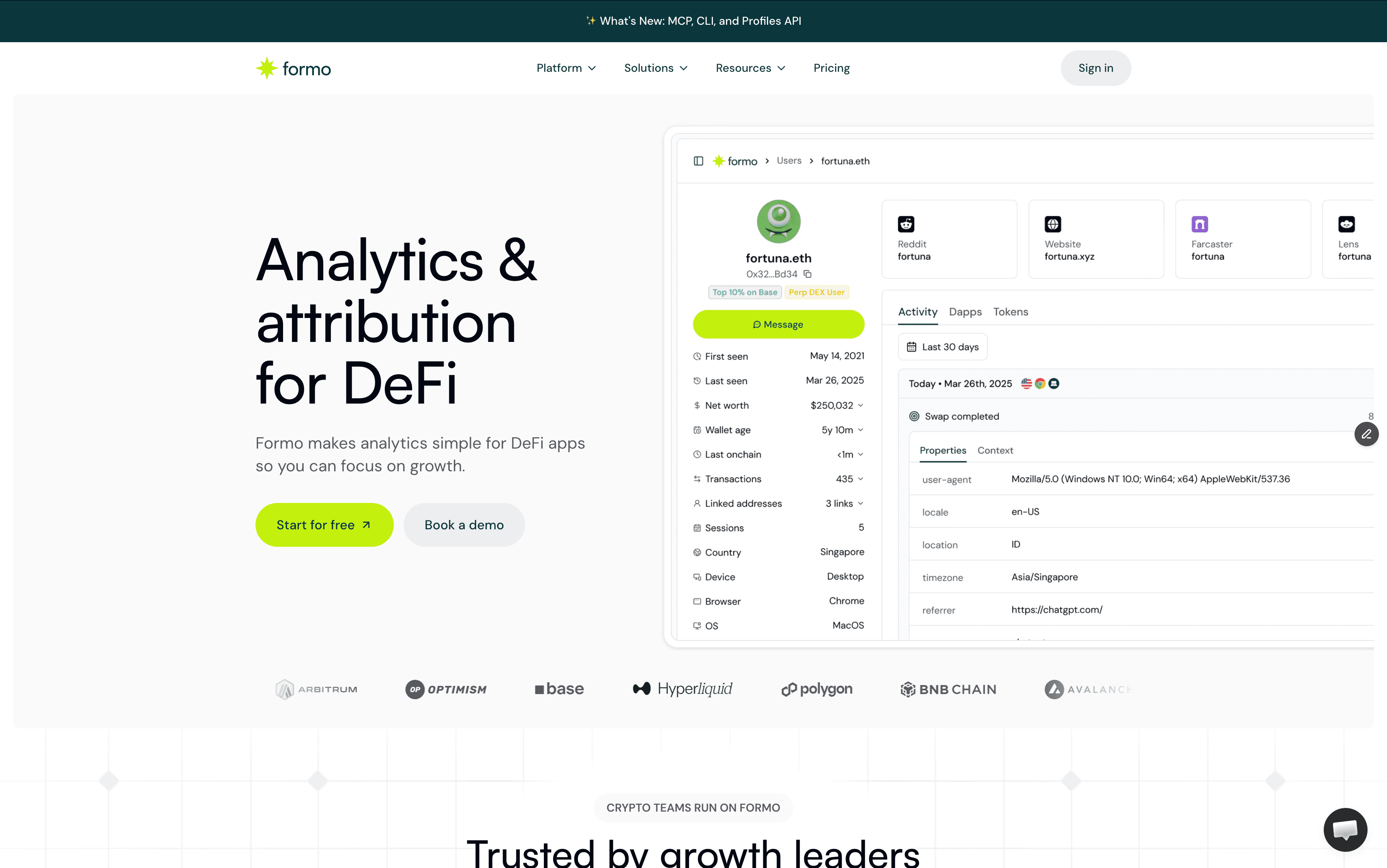
Unified Analytics for DeFi Product Teams
Formo’s product analytics layer captures both offchain events (page views, button clicks, wallet connect attempts, UTM source parameters) via a JavaScript SDK and onchain events (transaction submissions, confirmations, contract calls, failures, token swaps, volume) indexed directly from the blockchain. Both streams are attributed to the same wallet address, giving product and growth teams a single view across the full offchain-to-onchain funnel.
Core metrics Formo tracks out of the box include: visitor counts, daily and weekly active wallets (DAU/WAU/MAU), wallet connection rates, transaction counts, transaction success rates, onchain volume, revenue, retention, and churn. All data is ingested and displayed in real time no batch jobs or next-day reporting delays.
Funnel analysis maps the critical conversion sequence for DeFi products: landing page → wallet connect → transaction initiation → on-chain confirmation. Drop-off at each step is visible in a single view, making it straightforward to diagnose whether users are abandoning during onboarding, failing at the wallet connect step, or dropping off between initiation and confirmation.
Custom charts and dashboards let teams build and share reports using a drag-and-drop chart builder or SQL queries via the Explorer. Formo also supports natural language queries via AI so teams can ask questions about their data in plain English and get answers without writing code.
Onchain Attribution for GTM and Growth Teams
Formo’s onchain attribution connects acquisition channels to wallet-level outcomes. UTM parameters captured when a user first visits are linked to the wallet address at connection, then attributed to all subsequent onchain actions that wallet performs. This creates a verifiable record from marketing source to blockchain event.
Teams can measure performance across channels and campaigns on volume, revenue, and retention - not just clicks and sessions. Attribution reports answer questions like: which channels drive wallets that actually transact within 7 days? Which campaigns produce users with the highest 30-day retention? Which partners drive volume vs. which drive one-and-done wallets?
This matters especially for core DeFi marketing metrics: Cost per Wallet Acquired (CPW), wallet Lifetime Value (LTV), and onchain conversion rate by source. Formo calculates all three natively, without requiring manual data stitching between marketing tools and blockchain explorers.
Wallet Intelligence Designed for Crypto
Formo’s wallet intelligence layer converts anonymous wallet addresses into rich user profiles. Each connected wallet gets a 360° profile built from both onchain history (DeFi protocol usage, token holdings, transaction frequency, net worth, chain activity) and offchain signals (acquisition source, app behavior, funnel stage).
Audience insights give teams an aggregate view of their user base: top apps their users also use, top tokens they hold, chains they’re active on, average net worth, and cohort revenue. This answers the question “who are our users?” at a level of specificity that cookie-based analytics can’t approach.
Segmentation lets teams build targeted audiences based on wallet holdings, DeFi positions, protocol history, social accounts, community membership, and cross-platform activity. Segments can be used to personalize onboarding flows, identify high-value users for manual outreach, build re-engagement lists, or measure whether product changes affect experienced DeFi users and new users differently.
Integrations
Formo integrates with the major wallet connection libraries used by DeFi teams: MetaMask, Privy, Dynamic, Rainbow, Reown, Phantom, Abstract, Thirdweb, Para, and Porto. It supports both EVM chains and Solana. Data can be queried, filtered, and exported via the API and CLI, and Formo connects to AI tools including Claude via MCP for natural language data queries.
Main features: Unified event tracking, onchain attribution, wallet profiles, audience segmentation, funnel analysis, retention cohorts, real-time activity feed, alerts, custom charts, SQL explorer, Ask AI, MCP integration, token-gated forms
Pricing: $249/month, $499/month with a 2 week free trial
Chains: All major EVM chains (Ethereum, Base, Arbitrum, Optimism, Polygon, and more) and Solana
Best for: DeFi protocols, DEXs, lending apps, and crypto product teams that need analytics and attribution across the full offchain-to-onchain user journey without building a custom data stack
Safary

Safary has evolved from a Web3 marketing attribution tool into a B2B sales intelligence and CRM platform for crypto teams. Its core product today connects social data (X/Twitter followers, community members) with onchain wallet profiles to help BD and growth teams identify high-value B2B prospects, close partnerships, and measure social mindshare. If your primary need is linking UTM campaigns to onchain conversions, Safary is no longer the best fit it’s better suited to teams doing B2B outreach and partner development in crypto.
Best for: BD and partnership teams using Crypto Twitter as a sales channel; teams wanting to enrich social followers with onchain context
Pricing: Not public. Book a demo to find out
Not suitable for: Teams primarily looking for UTM-to-wallet campaign attribution
Dune
Dune Analytics is a blockchain data platform where analysts write SQL queries against raw onchain data. For attribution use cases, Dune is most useful for building custom protocol dashboards that track conversion metrics at scale — total wallets acquired, transaction volume by source, cohort behavior — rather than for real-time campaign optimization. It requires SQL proficiency and has no front-end event tracking.
Best for: Data analysts building custom attribution models and protocol-level dashboards
Pricing: Freemium
Chains: Ethereum and most major chains
Comparison Table
Vendor | Pricing Model | Supported Chains | Unique Strengths |
|---|---|---|---|
Spindl | Usage-based | Ethereum, Polygon, BSC | End-to-end attribution |
Safary | Subscription tiers | 15+ major chains | Real-time cross-chain tracking |
Formo | Custom enterprise | All major ecosystems | Privacy-first unified analytics |
Dune | Freemium model | Ethereum focus | Custom query flexibility |
Each platform has distinct advantages based on organizational needs and specific use cases. For comprehensive reviews, explore Formo’s analytics tool comparisons.
How to Integrate Onchain Attribution Into Your Marketing Workflow
Start by implementing comprehensive campaign tracking:
Set up UTM-tagged links for social media, advertising, and content campaigns.
Create unique referral codes for referral programs and influencer partnerships.
Implement pixel or SDK tracking on your website and app.
Use consistent naming conventions for campaign identification.
By connecting web, product, and onchain analytics tools to capture critical conversion events, you get end-to-end attribution of marketing touchpoints to blockchain actions.
Then, you can connect it to dashboard reporting systems for real-time insights and historical cohort analysis, giving you instant feedback what moves the needle on your key metrics.
To make setup easy, Formo’s web3 analytics capabilities takes less than 30 minutes to install. (Installation docs.)
Overcoming Common Challenges in Web3 Onchain Attribution
Web3 attribution introduces four problems that don’t exist in traditional web analytics. Here’s what each one means in practice and how to address it.
Challenge | What It Means | How to Address It |
|---|---|---|
Fragmented Identity | A single user operates multiple wallet addresses across DeFi, prediction markets, and perps, so the same person appears as different users in raw data | Use behavioral clustering (shared deposit addresses, timing patterns, common token flows) to group related wallets; never merge wallets based on assumption alone |
Cross-chain Tracking | A user acquired on Ethereum may transact primarily on Arbitrum or Base, making single-chain attribution incomplete | Run attribution listeners on every chain your protocol supports and join on wallet address across chains; EVM addresses are consistent across networks |
Off-chain Linking | Connecting a Twitter follower, Discord member, or email subscriber to a wallet address requires explicit consent or wallet-connect events | Capture UTM parameters at landing and link them to wallet address at the connect event; avoid probabilistic guessing that links offchain identities to wallets without user action |
Bot and Burner Wallets | Automated accounts and single-use wallets inflate acquisition numbers without representing real users | Exclude wallets with zero prior on-chain history, wallets that transact once and never return, and addresses flagged by common bot detection heuristics; set a minimum transaction threshold before counting a wallet as acquired |
Leading attribution platforms implement multiple detection methods to maintain data quality. Formo addresses identity fragmentation by combining UTM-to-wallet mapping with wallet intelligence, using on-chain behavioral signals to surface related addresses while keeping personally identifiable information out of the attribution pipeline.
Best Practices for Onchain Attribution
1. Capture attribution parameters at first touch, not at wallet connect
Capture channel and campaign parameters the moment a user lands on your website or app, before they do anything else. If you wait until wallet connection to grab the referral source, you will miss users who land, browse, and connect in separate sessions. Store the data in localStorage or a first-party session store immediately on page load, then retrieve it when the wallet connect event fires.
2. Store data server-side
Cookies and session identifiers can measure browser activity in both conventional and crypto apps, subject to consent, browser settings, and implementation. They do not, by themselves, identify which wallet completed an onchain action. Crypto attribution joins campaign context to wallet activity and verifies the outcome against the relevant chain event.
3. Track on-chain confirmations, not intent signals
A user clicking “Confirm swap” is not a conversion. The transaction may fail, get rejected, or sit pending for hours. Track attribution against on-chain confirmations: the transaction hash appearing in the mempool and then confirmed on-chain. This is the only signal that represents real economic activity and the only metric that maps to actual protocol revenue.
4. Use wallet address as your persistent user identifier
Wallet addresses are more durable identifiers than cookies, device fingerprints, or login sessions. A wallet address is tied to the user’s keys, not their browser or device. Build your attribution model around wallet address as the primary key. Every session, transaction, and campaign touchpoint should be joinable on wallet address to give you a complete lifetime view of each user.
5. Define your conversion events
Different protocols have different conversion events. For a DEX, conversion is a completed swap. For a lending protocol, it is a deposit or borrow. For an NFT marketplace, it is a mint or purchase. Before instrumenting attribution, decide exactly which on-chain event constitutes a conversion for your protocol. Teams that start attributing without this definition often end up with multiple competing metrics that cannot be reconciled later.
6. Build cohort analysis by acquisition channel
Once you have web, product, and on-chain conversion data, the most valuable analysis is cohort comparison by source. Group wallets by the campaign that acquired them and compare their 7-day activation rate, 30-day return rate, and cumulative transaction volume. This reveals which channels drive high-LTV users versus which channels generate wallet connections that never transact again. Budget decisions should follow cohort LTV, not raw wallet acquisition volume.
7. Account for multi-session journeys
DeFi users rarely convert on their first visit. A typical journey might be: Twitter ad visit on day 1, Discord link visit on day 4, direct visit and wallet connect on day 7. Your attribution system needs to handle this by persisting UTM data across sessions and supporting a clear attribution model (first-touch, last-touch, or linear) that you apply consistently. Pick one model and document it so your team interprets reports the same way.
8. Track cross-chain wallet activity
EVM wallet addresses are consistent across chains, which means a wallet you acquired through an Ethereum campaign may conduct most of its activity on Arbitrum, Base, or Optimism. Set up attribution listeners across every chain your protocol supports, and join on wallet address to get a complete cross-chain wallet activity picture. Solana addresses differ from EVM and require separate instrumentation, but the principle is the same: attribution should follow the wallet, not the chain.
FAQs on Onchain Attribution and Crypto Marketing
Q1: What is onchain attribution in Web3 marketing?
Onchain attribution is the process of linking a user’s marketing touchpoint, such as a Twitter ad, Discord post, or influencer campaign, to their on-chain actions, including wallet connections, token swaps, and protocol transactions. Unlike traditional attribution that tracks clicks and page views, onchain attribution creates a verifiable chain from marketing source to blockchain event. This lets DeFi and Web3 teams calculate true cost per wallet acquired, measure campaign ROI against actual on-chain revenue, and allocate budgets based on which channels drive real protocol usage rather than just traffic.
Q2: What is the difference between onchain attribution and traditional UTM tracking?
Traditional UTM tracking links clicks to page views or form submissions using cookies and session data, all of which are off-chain events. Onchain attribution extends this by capturing UTM parameters at landing, linking them to a wallet address at the connect event, and then attributing that wallet’s subsequent on-chain transactions back to the originating campaign. The critical difference is the final step: traditional attribution ends at a conversion form or purchase click, while onchain attribution ends at a verified blockchain transaction that cannot be faked, reversed, or inflated by bots clicking through landing pages.
Q3: How does onchain attribution boost marketing ROI?
Onchain attribution improves marketing ROI by revealing which campaigns drive actual protocol usage rather than just traffic or wallet connections. When teams can see that a specific influencer campaign generated wallets with 3x higher transaction volume than a paid ad campaign, they can reallocate budgets accordingly. Practical improvements include cutting spend on channels that generate low-LTV wallets, doubling down on sources that attract high-frequency traders, and negotiating performance-based deals with influencers using verifiable on-chain outcomes rather than estimated impressions or wallet connection counts that may never result in real activity.
Q4: How do you link off-chain marketing data to onchain user actions?
The process happens in three steps. First, capture UTM parameters (source, medium, campaign, term, content) the moment a user lands on your dApp from a marketing link. Second, when the user connects their wallet, record the wallet address alongside the stored UTM data to create a persistent link between the marketing source and the pseudonymous identity. Third, listen for on-chain events from that wallet address, such as swaps, deposits, or mints, and attribute those transactions back to the originating campaign. Tools like Formo handle this pipeline automatically, storing the UTM-to-wallet mapping and firing attribution events when on-chain confirmations are detected.
Q5: What are the key metrics for measuring ROI in Web3 marketing?
The most important Web3 marketing metrics are Cost per Wallet Acquired (CPW), which is total campaign spend divided by unique wallets that completed at least one on-chain transaction; wallet LTV, the cumulative on-chain revenue or fee generation attributable to wallets from a given campaign; wallet return rate, the percentage of acquired wallets that transact again within 30 days; time to first transaction, measuring how quickly wallets from a channel activate after acquisition; and onchain revenue attribution, the total protocol fees or token volume traceable to specific campaigns. These metrics replace pageview-based KPIs that have no bearing on actual protocol usage or business revenue.
Q6: What tools or platforms are used for onchain attribution and analytics?
Formo is the primary chain-agnostic platform built specifically for onchain attribution and DeFi product analytics. It supports EVM chains and Solana, captures UTM-to-wallet mappings automatically, and provides funnel analysis, retention tracking, and wallet intelligence in a single dashboard. Dune Analytics offers SQL-based on-chain querying for teams that want to build custom attribution queries directly on raw blockchain data. Spindl was acquired by Coinbase in February 2025 and now operates exclusively as a Base-specific onchain ad platform, making it unsuitable for teams building across multiple chains. Safary has pivoted to B2B sales intelligence, connecting Crypto Twitter followers to wallet data for lead generation rather than product attribution.
Q7: How do you handle multi-touch attribution in Web3?
Multi-touch attribution in Web3 requires capturing every marketing interaction a wallet address has before its first on-chain transaction. In practice, this means tracking UTM parameters across multiple sessions (a user may visit from a tweet, return a week later from a Discord link, and connect their wallet on a third visit), then deciding how to weight each touchpoint. Common models include first-touch attribution, which credits the channel that first brought the wallet to the dApp; last-touch, which credits the channel active at wallet connection; and linear attribution, which splits credit equally across all touchpoints. Most DeFi teams start with first-touch or last-touch and layer in multi-touch models once they have enough wallet volume for the data to be statistically meaningful.
Q8: How do you measure true campaign impact?
True campaign impact in Web3 is measured by tracking wallets from acquisition through their entire on-chain lifecycle, not just the first transaction. This means measuring activation rate (wallets that transact within 7 days of acquisition), retention rate (wallets that return within 30 days), and cumulative on-chain revenue per cohort. To isolate campaign impact from organic growth, compare campaign-attributed wallet cohorts against baseline wallet behavior during the same period. A campaign that drives 500 wallets with a 40% 30-day return rate outperforms one that drives 2,000 wallets with a 5% return rate, even though the second campaign looks better on raw acquisition volume.
Q9: Why is cross-chain attribution important?
Cross-chain attribution is important because DeFi users frequently move assets and activity across multiple blockchains. A user acquired through an Ethereum campaign may conduct most of their transactions on Arbitrum, Base, or Solana. Without cross-chain attribution, teams incorrectly conclude that certain campaigns drove little on-chain activity when those wallets were actually highly active on other chains. Cross-chain attribution requires tracking wallet addresses across EVM-compatible chains, where addresses are consistent, and separately handling Solana, where wallet addresses differ from EVM. Formo supports both EVM and Solana attribution in a single dashboard, giving teams a complete view of wallet activity regardless of which chain users prefer.


