What is x402? The Internet Native Payments Standard for APIs and Agents

Key Takeaways
x402 is an HTTP-native payment protocol that lets APIs and AI agents settle micropayments per request using stablecoins, without account creation, subscription management, or payment gateway integration. It extends the existing HTTP 402 "Payment Required" status code into a functional, machine-readable payment primitive.
The payment flow has three steps: the server returns a 402 response with a payment quote; the client signs a stablecoin transaction and attaches it as an X-PAYMENT header; the server validates and fulfils the original request automatically. No human approval is needed at any point.
x402 enables agent-to-agent commerce: AI agents can pay APIs, data providers, and other agents per call, with facilitators handling settlement and gas abstraction so neither side needs to manage wallet infrastructure directly.
AI agents struggle with integrating micropayments for API calls, data access, and AI agents because of clunky payment gateways and high transaction fees. As more and more AI agents enter the economy, there is an urgent need to help these agents accept and make micropayments for services.
x402 is an HTTP-native payment protocol that enables autonomous agents and APIs to execute micropayments per request without human intervention or account setup. When an AI agent encounters a paywall or paid resource, x402 allows it to instantly settle the cost using stablecoins and continue without interruption. No account creation or human approval is needed.
This article breaks down x402, the internet-native payments protocol built on HTTP 402, covering:
What x402 is
Why it matters
Who x402 is for
Payment flows
Features
Benefits
Use cases
Implementation guide
What Is x402?
x402 is an open, internet-native payment standard designed to enable autonomous agents and APIs to execute payments per request without human intervention. Released as a whitepaper by the Coinbase Developer Platform in May 2025, the protocol repurposes the long-dormant HTTP 402 “Payment Required” status code to facilitate machine-to-machine commerce.
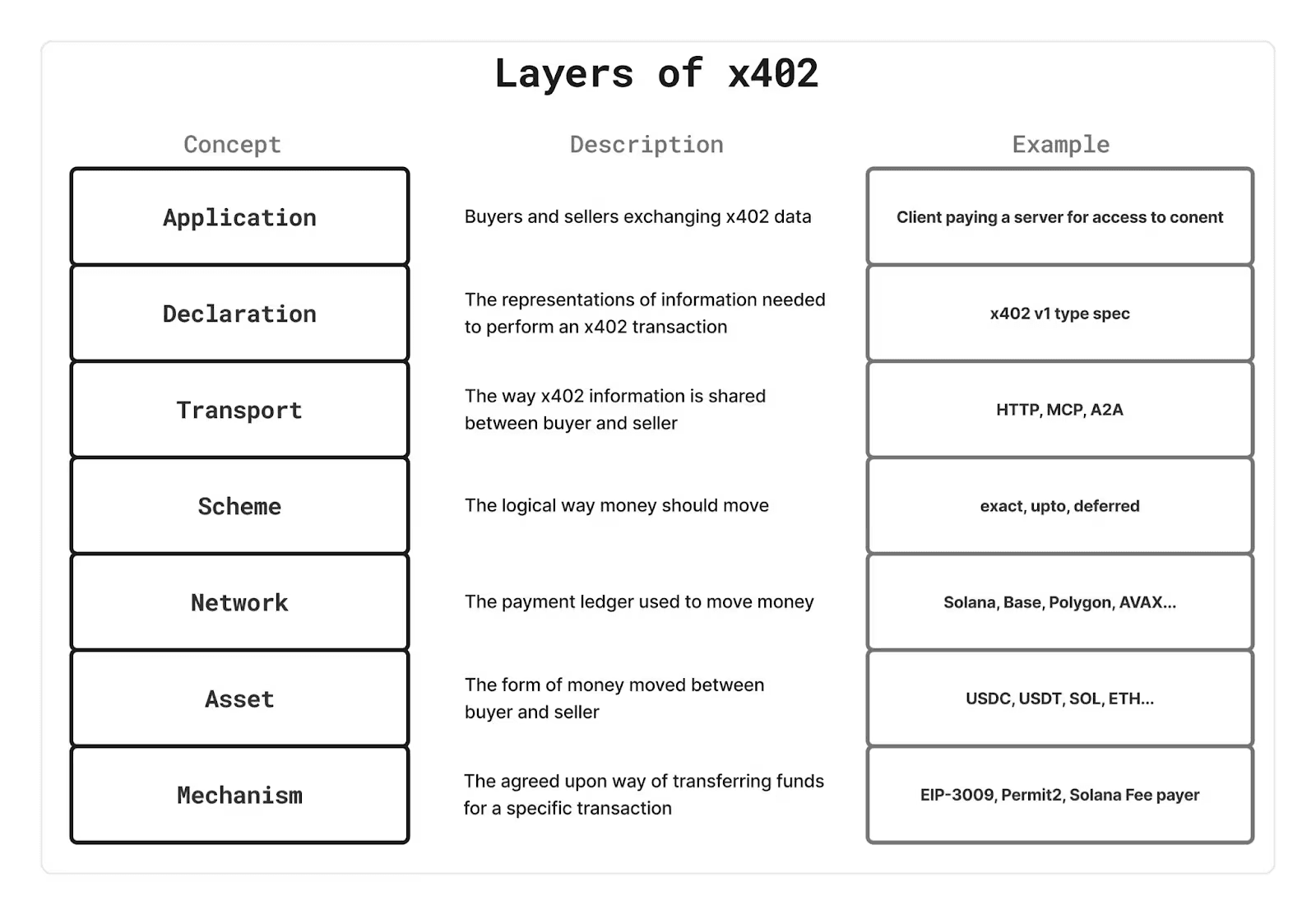
Unlike traditional payment rails that require account creation, credit card entry, and manual subscriptions, x402 allows software to pay for resources instantly using stablecoins.
It is blockchain-agnostic, supporting EVM-compatible chains and Solana, and is designed specifically to remove the friction of human authorization from the payment loop. By embedding financial settlement directly into the HTTP request lifecycle, x402 transforms payments from a business workflow into a protocol primitive (Allium).
Why Internet-Native Payments Matter
Traditional payment infrastructure was built for humans, not software. Modern applications rely on composability. APIs talk to APIs, and data flows programmatically. The internet has become programmable, but payments haven’t caught up.
Traditional payment rails break down at micro-transaction scale. A $0.01 API call can’t absorb a $0.30 processing fee, and T+2 settlement adds friction that compounds at high frequency.
Stablecoins flip this entirely: settlement is global, near-instant, and atomic, which makes them purpose-built for pay-per-use pricing and autonomous agent activity.
Payments remain a manual bottleneck. A developer can automate infrastructure scaling, but paying for that infrastructure often requires a human to enter credit card details or negotiate a SaaS contract. This asymmetry creates an “economic dead end” for AI agents. While agents can write code or deploy contracts, they lack bank accounts or KYC credentials to pay for the APIs they consume.
The x402 protocol solves this by making payments stateless and programatic. It eliminates the need for pre-negotiated access or subscriptions, allowing systems to settle value globally and atomically. This shift enables true economic composability, where an agent can compare services based on real-time price and performance, then pay instantly for execution.
Who is x402 for?
Sellers are service providers looking to monetize APIs, compute, or content. x402 lets them accept programmatic payments from any client with minimal integration work. No need to build billing systems, manage subscriptions, or onboard customers manually.
Buyers are human developers and AI agents that want to access paid services without creating accounts or navigating manual payment flows. They simply make an HTTP request, and the protocol handles the rest.
Both sides interact through standard HTTP. Payment negotiation, execution, and settlement happen transparently within the request-response cycle, so neither party needs to step outside the workflow they already know.
How x402 Works
The protocol functions by embedding a payment handshake directly into the standard HTTP request-response cycle. It does not replace HTTP but extends it, allowing servers to demand payment and clients to prove settlement within the same conversation.
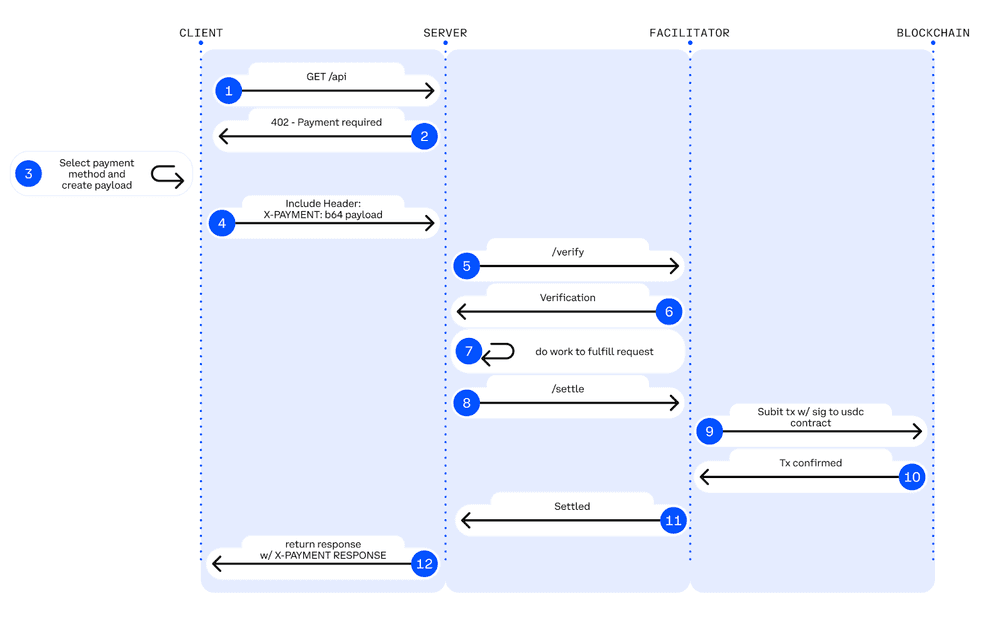
The process follows a four-step loop:
Request: The client (agent or API) requests a resource (e.g.,
GET /premium-data).Quote: The server returns a
402 Payment Requiredstatus, including metadata: price (e.g., 0.05 USDC), destination address, and supported chains.Payment: The client signs a transaction and submits it, often through a facilitator.
Fulfillment: The client retries the request with a payment signature. The server verifies the proof and delivers the resource.
The Core HTTP Payment Flow
The technical execution of x402 relies on specific headers to manage the state of the transaction. When a client receives the 402 error, it parses the WWW-Authenticate header to understand the cost and currency. The client then generates a cryptographic signature authorizing the transfer of funds, typically in USDC.
Upon retrying the request, the client includes this proof in the X-PAYMENT header. The server validates this header against the blockchain state. If the payment is confirmed, the server returns a 200 OK status along with an X-PAYMENT-RESPONSE header, providing the transaction hash as an audit trail. This entire cycle happens programmatically, often in milliseconds.
Payment Verification and Facilitators
While direct blockchain interaction is possible, x402 often utilizes facilitators to abstract complexity. A facilitator is an intermediary service that handles transaction submission, gas management, and chain routing.
For the server, the facilitator provides a verification endpoint. Instead of running a full node to check every transaction, the server sends the payment signature to the facilitator, which confirms validity and settlement. This allows developers to integrate x402 middleware without managing complex blockchain infrastructure. For clients, facilitators allow them to pay without needing to hold native gas tokens (like ETH or SOL) for every network, simplifying the path to settlement (Allium).
Key Features of x402
The x402 standard is defined by several technical attributes that differentiate it from legacy payment gateways:
No accounts needed: Payments are wallet-based and stateless; no login, email, or subscription setup is needed.
Reduce fees and friction: Direct onchain payments without intermediaries, high fees, or manual setup.
Micropayments & usage-based billing: Charge per call or feature with simple, programmable pay-as-you-go flows.
Granular and dynamic pricing: Resources can be priced per call, per byte, or per second, enabling micro-economies impossible with credit card fees.
Agent-to-agent transactions: Let AI agents pay and access services autonomously with no keys or human input needed.
Blockchain agnostic: The protocol supports all EVM-compatible chains and Solana, allowing flexibility in settlement layers.
Stablecoin native: Pricing and settlement primarily utilize USDC to prevent volatility from affecting API pricing.
Benefits for APIs, Data, and AI Agents
For API providers, x402 unlocks monetization. It removes the operational overhead of billing databases, invoicing, and chargeback management, as settlement is onchain and instant.
A few practical capabilities this unlocks:
Pay-per-call APIs. Pricing, payment, and data delivery happen in a single HTTP round-trip. No API keys, no billing dashboards, no invoices.
Agentic commerce. AI agents can pay other agents or services directly, removing the need for human-managed credentials or manual payment triggers.
Flexible pricing. Servers can adjust costs in real time based on demand, capacity, or resource availability, quoting updated prices through 402 responses.
Internet services marketplace. Microservices and tooling can now be monetized via microtransactions. Every network-exposed endpoint can expose granular pricing per call.
For AI agents, x402 provides the missing “walet” functionality. It allows autonomous systems to procure their own resources. An agent building a software product can instantly pay for a specific library, a database query, or inference time without halting for human approval. This internat-native monetization capability transforms agents from passive tools into active economic participants capable of managing their own operational costs.
Use Cases of x402
The adoption of x402 extends beyond niche crypto applications into broader cloud infrastructure. Major tech players are already integrating the standard to support the growing agentic economy. For instance, Google Cloud’s Agent Payments Protocol (AP2) includes an x402 extension to facilitate agent-based crypto payments, and Cloudflare has partnered with Coinbase to support the standard in their developer tools (Allium).
On-Demand API and Data Access
Data providers can use x402 to monetize high-value, granular blockchain data. Instead of forcing users into expensive monthly tiers, a provider can gate specific endpoints such as historical transaction traces or complex liquidity analysis behind a micropayment.
An autonomous agent, for example, could request a specific wallet data or the results of an onchain query from a data provider like Formo or Dune. The agent pays a small fee in USDC for that single request and receives the data instantly. This supports high-frequency, programmatic usage where the value lies in the specific data point at a specific moment, rather than a general subscription.
Agentic Commerce
x402 enables agent-to-agent commerce, creating a layer where software pays software. In a supply chain scenario, a procurement agent could identify a shortage, locate a supplier agent, and execute a payment for logistics and inventory automatically.
This is particularly relevant for inference markets. An AI assistant requiring specialized processing power can outsource the task to another model, paying per token or per second of compute. This creates a decentralized mesh of services where agents dynamically route tasks based on price and availability, settling value instantly without human intermediaries.
Implementing x402
Implementing x402 does not require building a new payment processor; it involves adding open-source middleware to existing server architectures. The protocol is free to use, though network gas fees and optional facilitator fees apply. Integration typically occurs at the API gateway or application layer, where the server is configured to intercept requests to premium routes.
Server-Side Middleware Setup
To monetize an API, developers install an x402 middleware that defines pricing logic and payment destinations. When a request hits a protected endpoint, the middleware checks for a valid payment header. If missing, it automatically generates the 402 response containing the price (e.g., 1 USDC), the recipient address, and the facilitator URL.
Server-side SDKs are available for languages like Go, Python, and Node.js. These libraries handle the parsing of payment signatures and communication with facilitators to verify settlement. This setup decouples the payment logic from the core business logic of the API.
Client-Side Payment Handling
On the client side, the application must be equipped to handle 402 errors as a standard part of the workflow. When a client receives a 402 status, it should not treat it as a failure but as a prompt to pay.
The client logic involves:
Extracting payment metadata from the response.
Signing a transaction using a connected wallet or private key.
Submitting the signed payload to the specified facilitator.
Retrying the original request with the returned proof of payment.
For AI agents, this logic is embedded in their execution loop, allowing them to autonomously resolve payment requirements as they encounter them.
Best Practices for x402 Adoption
When implementing x402, builders should prioritize session management to optimize performance. The new x402 V2 standard published in Decembebr 2025 supports session tokens, which allow a client to make a single larger payment (e.g., depositing 10 USDC) to authorize a session for multiple future requests. This significantly reduces gas fees and latency compared to paying for every individual API call.
Additionally, developers should implement robust error handling for payment failures. If a payment is rejected due to insufficient funds or network congestion, the client must be able to distinguish this from a server error and retry appropriately.
Using established facilitators is recommended to handle chain routing and retries automatically, ensuring high reliability for commercial applications.
Common Mistakes to Avoid
A frequent error is ignoring network costs for micropayments. Charging $0.01 for an API call on Ethereum Mainnet is impractical due to gas fees. Builders must ensure their x402 implementation supports low-cost L2 networks (like Base) or high-throughput chains (like Solana) where transaction fees do not exceed the value of the service being purchased.
Another mistake is blocking human users entirely. While x402 is optimized for agents, the interface should remain accessible to humans via wallet-enabled browsers. Failing to provide a UI fallback for manual payment signing can alienate developers testing the API before automating their access.
Finally, developers often overcomplicate the verification process by attempting to run their own indexing infrastructure instead of leveraging facilitators for settlement confirmation.
The Future of x402
x402 represents the transition from a programmable internet to an economically programmable internet. As AI agents become the primary consumers of digital services, the friction of human-centric payment rails will become unsustainable. x402 provides the standardization required for machines to exchange value as easily as they exchange data.
The future points toward open markets for API access and agentic commerce, where agents become the primary consumers of internet services. Just as HTTP standardized information transfer, x402 standardizes value transfer, potentially enabling a new generation of business models.
Frequently Asked Questions
Which blockchains does x402 support?
x402 supports all EVM-compatible chains, such as Ethereum, Base, and Arbitrum, plus Solana. Settlement occurs via USDC transfers on these networks, with facilitators handling cross-chain routing.
What is the difference between x402 and traditional API subscriptions?
x402 enables per-request payments without accounts or contracts, unlike subscriptions that require upfront commitments and human setup. It settles instantly via stablecoins, avoiding billing overhead and chargebacks.
How much does it cost to use x402?
x402 itself is free and open-source; costs come from blockchain gas fees, typically under $0.01 on L2s like Base or Solana. Facilitator fees, if used, range from 0.1-1% of transaction value.
Are there x402 SDKs available, and for which languages?
Yes, official SDKs exist for Go, Python, and Node.js. These handle middleware setup, payment parsing, and facilitator integration; community libraries support Rust and TypeScript.
Can x402 be used for non-crypto APIs?
Yes, any HTTP-based API can integrate x402 middleware to add pay-per-request monetization. An emerging use case is also requiring payments from AI scrapers before they extract data from your website. Other examples include cloud compute, data feeds, and SaaS tools, regardless of underlying tech stack.
How does x402 handle failed payments?
When a payment fails (whether from insufficient funds, a network error, or an invalid signature), the server responds with HTTP 402 Payment Required along with the same or updated payment metadata. Nothing breaks. The client can then retry once the issue is resolved, delegate to a facilitator that manages retries, chain routing, and gas, or handle the error in its own logic by notifying a human or logging the failed attempt.
From the server’s perspective, requests are only fulfilled once valid payment proof is received. Failed payments don’t create hanging sessions or block resources. Session tokens introduced in x402 V2 also reduce redundant payment attempts for recurring requests, so clients aren’t re-paying for access they’ve already purchased.
Can humans use x402 directly?
Yes. Although x402 is designed primarily for autonomous agents and programmatic workflows, humans can interact with it using compatible wallets or SDKs. In practice, this means signing a transaction with a wallet like MetaMask or Coinbase Wallet, submitting it either directly to the blockchain or through a facilitator, and then retrying the API request with proof of payment attached.
That said, the protocol is most efficient in automated contexts. Human interaction removes much of the speed and scalability that makes x402 compelling in the first place.


