
Best Product Analytics Tools for DeFi Teams

Key Takeaways
Traditional product analytics tools like Mixpanel and Amplitude can't track on-chain events, leaving DeFi teams blind to the most critical parts of the user journey: token swaps, liquidity deposits, and smart contract interactions.
Product analytics in crypto demands onchain and offchain data integration because the onchain events and smart contract calls are beyond the means of traditional tools.
Formo is built specifically for DeFi product teams, unifying front-end event tracking and on-chain data under a single wallet-address identifier to enable funnel analysis, cohort segmentation, and attribution.
Dune Analytics is the go-to platform for data analysts who need custom SQL queries against raw blockchain data, but it requires technical expertise and has no front-end event tracking or funnel analysis.
Each platform serves a distinct primary use case so teams choosing between Formo for unified product metrics or Dune for custom SQL queries against onchain data should match the tool to their team's core need.
Wallet intelligence turns anonymous wallet addresses into actionable user profiles based on on-chain behavior. It is a core DeFi analytics capability that adapted Web2 tools cannot provide.
Blockchain data challenges like cross-chain fragmentation and complex nested formats require purpose-built DeFi analytics tools rather than adapting general product analytics platforms designed for Web2 applications.
DeFi teams face a product analytics problem that doesn’t exist in Web2: the most important user actions happen on-chain, not in a browser session. When someone swaps tokens on your DEX, deposits into a lending pool, or claims a yield reward, that event lives on the blockchain — invisible to Google Analytics, Mixpanel, or any tool built around cookies and session tracking.
The result is a systematic blind spot. You can see who visited your app. You can’t see who actually transacted, how long it took them to get there, or why they abandoned the flow before completing a swap. Without visibility into user behavior and transaction data, teams end up optimizing front-end copy and UI while the real drop-off is happening deeper in the funnel.
Effective DeFi product analytics requires tools that bridge on-chain and off-chain data, use wallet addresses as persistent user identifiers, and support the funnel and cohort analysis that product and growth teams rely on. This guide covers the leading platforms for DeFi product teams, explains how wallet intelligence works, and helps you choose the right tool for your use case.
This guide covers the two most widely used analytics platforms for DeFi teams Formo and Dune: what each one is actually built for, and how to select the right analytics tool based on your team’s needs.
What Makes Product Analytics Different for DeFi Teams
Standard product analytics tools are designed around a single assumption: users have accounts. They log in, generate a session, and their activity is attributed to an email or user ID stored in your database. That model breaks down completely in DeFi, where users interact through self-custodied wallets with no login system and no email address.
The challenges go deeper than just the identity layer. Blockchain data is stored in event-oriented formats optimized for consensus and immutability, not ad hoc querying. Running aggregated analysis across millions of transactions requires infrastructure and expertise most product teams don’t have. Cross-chain activity fragments user data further: a wallet active on both Ethereum and Base appears as two separate entities in naive implementations.
What DeFi product analytics specifically requires:
Wallet addresses as persistent user identifiers across devices and sessions, replacing cookies and account emails
On-chain event capture (transactions, contract calls, decoded logs) alongside front-end event tracking (page views, clicks, wallet connects)
Funnel analysis that spans off-chain interactions and on-chain confirmations in a single view
Retention analysis for both users and wallets across different user segments and acquisition channels.
Comparison Table
Formo | Dune | |
|---|---|---|
Primary use | Product analytics & attribution | Custom on-chain SQL queries |
Front-end event tracking | Yes | No |
On-chain data | Yes | Yes (raw) |
Funnel analysis | Yes | Manual via SQL |
Wallet labeling | Basic | Limited |
SQL required | No | Yes |
Best for | Product & growth teams | Analysts & engineers |
Formo
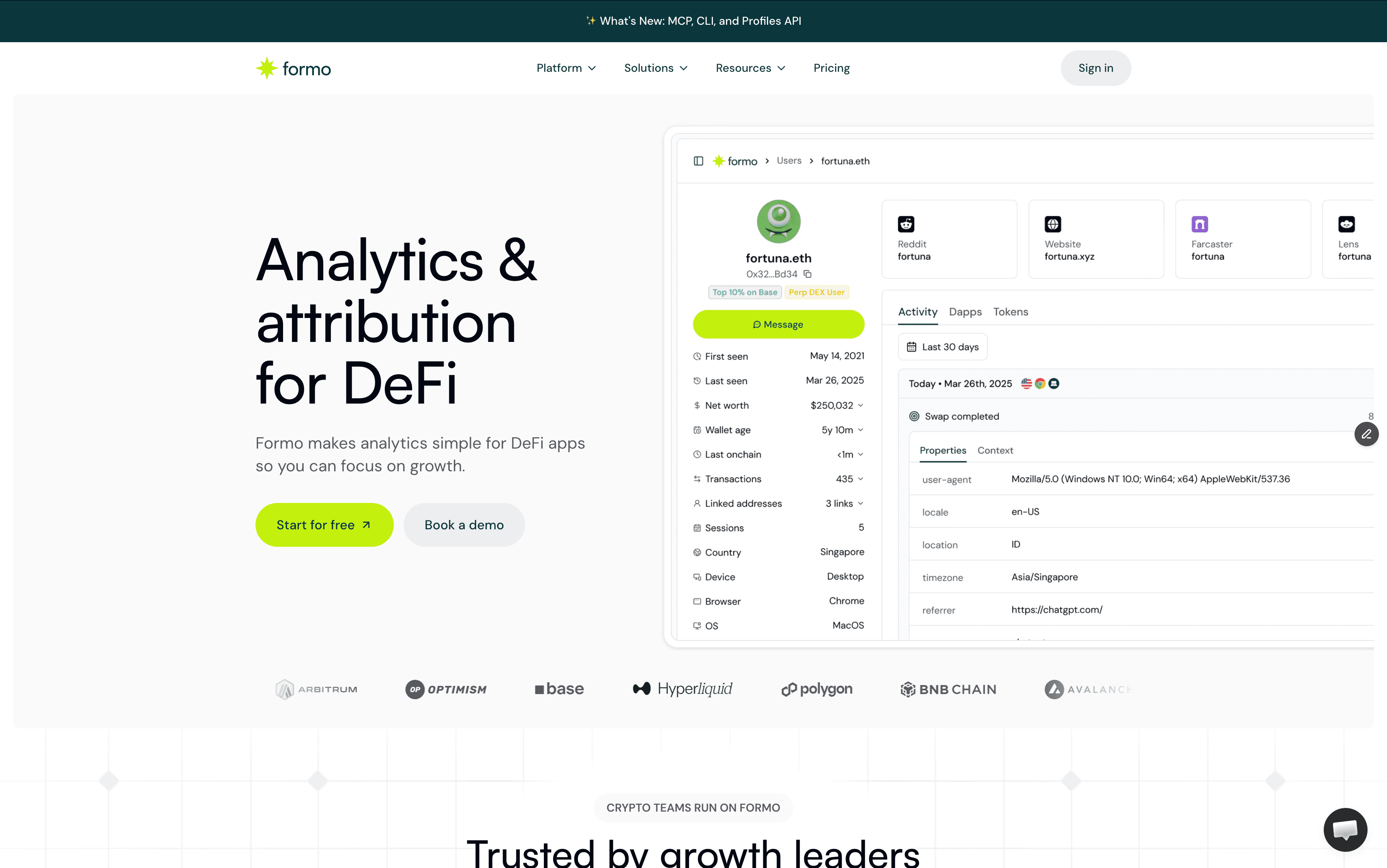
Effective product analytics tools are essential for DeFi teams navigating the complexities of user behavior and transaction data. With the DeFi sector expanding rapidly, teams require reliable insights to inform product development and marketing strategies. A unified analytics platform can streamline data collection, processing, and analysis, allowing teams to focus on enhancing user experiences.
Formo is a product analytics platform built specifically for DeFi teams. Where general-purpose tools stop at the wallet connect button, Formo tracks the complete user journey: from first page visit through wallet connection, transaction initiation, on-chain confirmation, and return behavior.
Key features include growth analytics to track metrics such as daily active users (DAU), weekly active users (WAU), and retention rates. Additionally, Formo offers real-time activity feeds that reveal user interactions, helping teams identify drop-off points and retention drivers. This platform also emphasizes user privacy, ensuring compliance with regulations by avoiding third-party cookies and sensitive data collection.
By enabling onchain attribution, Formo helps teams understand which channels and initiatives drive user activity, creating clearer pathways for growth. The wallet intelligence feature converts anonymous wallet addresses into actionable user profiles, revealing insights into user segments and behaviors.
Unified On-Chain and Off-Chain Tracking
Formo’s core approach is to unify two data streams that typically live in separate systems. In-app product events are captured via an open source SDK. On-chain smart contract events such as transactions and contract calls are indexed directly from the blockchain. Both streams are attributed to the same wallet address, giving you a complete picture of every user’s journey in one place.
This matters most for funnel analysis. Most DeFi funnels have a critical gap between the front-end UI and the blockchain: a user clicks “swap,” the transaction is submitted, and then the standard analytics tool goes blind. Did it confirm? Did it fail? Did the user abandon the MetaMask popup? Without unified event tracking, you can only see that a button was clicked. Formo closes that gap.
Wallet-Level Attribution
Formo uses wallet addresses as the persistent user identifier instead of session cookies. A returning user is recognized as the same wallet across multiple sessions, devices, and browser environments.
Onchain attribution connects acquisition channels to wallet-level outcomes. You can see that wallets acquired through a specific campaign have a 3x higher 30-day transaction rate than organic wallets, or that one partnership drove high-volume wallets while another brought mostly inactive ones. This replaces guesswork about marketing ROI with wallet-level evidence which is the foundation of any serious DeFi marketing strategy.
DeFi-Specific Metrics and Cohort Analysis
Formo tracks the DeFi metrics that drive product decisions: daily and weekly active wallets, transaction success rates, average transaction value, time-to-first-transaction, and wallet return rates. Funnel analysis is built around the natural DeFi conversion sequence: visit → wallet connect → first transaction → repeat transaction.
Cohort analysis lets you segment wallets by acquisition date, transaction volume, token holdings, or protocol behavior, so you can see whether retention is improving over time and which user segments drive the most long-term value. User lifecycle analysis tracks wallets through activation, engagement, and churn stages, surfacing where users are falling off and what behaviors predict long-term retention.
Real-Time Activity Feed
Formo’s real-time activity feed shows wallet interactions as they happen: which wallets just connected, which transactions just confirmed, which users just completed their first swap. For growth teams running campaigns, this replaces the wait for a daily report with a live view of what’s working.
Best for: DeFi product teams that need event-level user analytics, funnel tracking, and onchain attribution in one platform without writing SQL.
Trade-off: Formo is a product analytics tool, not a blockchain explorer. If you need to query raw transaction history across an entire protocol or trace historical wallet flows going back years, you’ll pair Formo with a data warehouse or use Dune for that slice of the work.
Dune
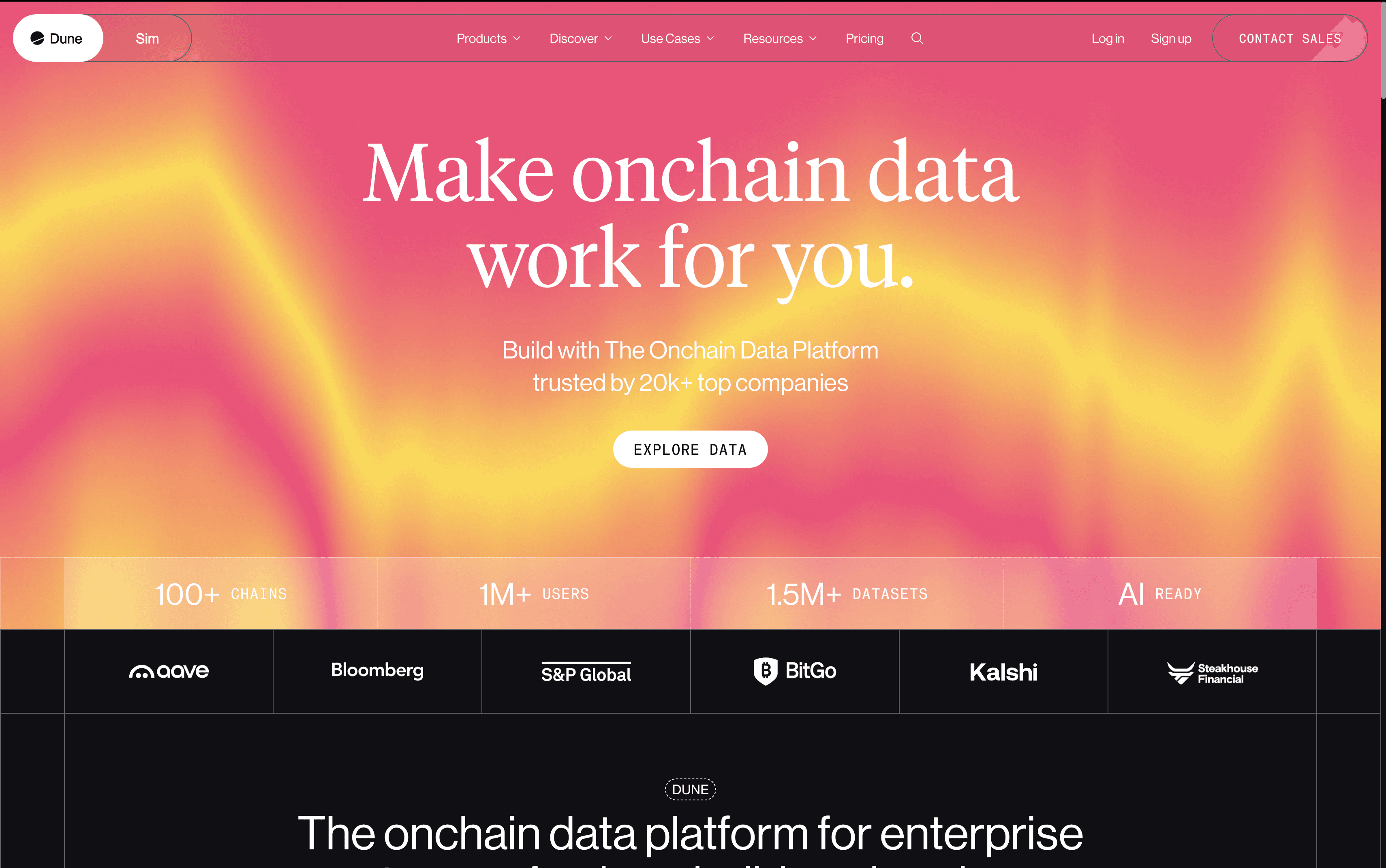
Dune Analytics is a blockchain data platform that lets analysts and engineers write SQL queries against raw on-chain data across multiple chains. It has become the industry standard for protocol-level dashboards, TVL tracking, and community-facing analytics with over 50,000 public dashboards built on the platform. It offerS:
SQL-Based Queries: Leverages SQL querying language, allowing users to extract and analyze specific datasets with a user-friendly interface.
Customizable Visualizations: Users can create interactive dashboards that present complex blockchain data in easy-to-understand formats with real-time updates.
Multi-Chain Support: Supports multiple blockchain networks including Ethereum, Polygon, Optimism, BSC, and Solana for tracking ecosystem metrics across DeFi.
Community-Driven: The platform emphasizes transparency by allowing anyone to view, replicate, and modify queries, fostering innovation and collaboration.
Best for: Data analysts and engineers who need to write custom SQL queries against raw blockchain data. Strong for protocol-level dashboards, TVL tracking, and ad hoc on-chain research. The community query library also makes it useful for benchmarking against competitors.
Trade-off: Dune requires SQL proficiency. It has no front-end event tracking, no session analytics, and no funnel analysis beacuse it only sees what’s on-chain. Non-technical product managers will find it hard to use independently.
Wallet Intelligence: Converting Anonymous Addresses into User Profiles
One of the most powerful capabilities in DeFi analytics is wallet intelligence: using public on-chain data to build rich behavioral profiles of wallet addresses. A wallet address is not as anonymous as it appears. Every transaction it has ever made is permanently recorded on-chain and publicly readable — and from that history, you can derive a detailed picture of a user’s behavior, preferences, and DeFi sophistication.
This is the foundation of what separates DeFi-native analytics from adapted Web2 tools: the ability to treat on-chain history as a user data layer.
What You Can Learn from a Wallet Address
DeFi protocol usage history. Which DeFi protocols has this wallet interacted with? A wallet that has used Aave, Uniswap, and Curve across three chains behaves differently from one that only swapped tokens once. Protocol usage signals expertise, cross-protocol activity, and competitive overlap.
Transaction behavior patterns. How frequently does this wallet transact? What is the typical transaction value? Does it hold positions for weeks or churn daily? These behavioral signals map closely to the product segments that matter: power users, occasional users, and one-and-done wallets.
Token and asset holdings. What tokens does this wallet hold? Governance token holders signal protocol alignment. Holders of competitor tokens signal cross-protocol evaluation. Token portfolios reveal user intent in ways that session data never can.
Wallet age and experience. A wallet first active in 2019 has different needs, expectations, and friction tolerance than one created last week. New wallets are more likely to drop off during onboarding. Experienced wallets are more likely to have strong existing preferences that your product needs to compete with.
Chain and network activity. Is this wallet primarily on Ethereum mainnet, or is it active across L2s? Mainnet-heavy wallets may be more gas-sensitive. L2-native wallets may expect faster confirmation times. Chain activity patterns inform both product decisions and infrastructure choices.
Wallet Segmentation for DeFi Apps
Wallet analytics lets DeFi teams move beyond aggregate metrics to segment-level insights. Instead of knowing that 3,200 wallets used your protocol this month, you know the composition:
200 are high-value power users responsible for 80% of volume
1,400 are occasional users who transact once or twice per month
1,600 connected but have not yet completed a transaction
Each segment has different needs, different drop-off points, and different retention drivers. Wallet segmentation lets product and growth teams design targeted interventions: optimized onboarding for new wallets, loyalty incentives for power users, re-engagement campaigns for lapsed wallets.
From Anonymous Address to Actionable Profile
Wallet intelligence in Formo converts anonymous wallet addresses into user profiles by combining on-chain history with front-end behavioral signals. When a wallet connects to your app, Formo matches it against its on-chain history to surface which chains it’s active on, which protocols it has used, what its typical transaction size is, and how it has behaved in your app across prior sessions.
This creates a foundation for personalization at scale. You can surface different onboarding flows for wallets that are experienced DeFi users versus wallets whose on-chain history shows no prior DeFi activity. You can build cohorts based on DeFi behavior patterns and measure whether your product changes affect experienced users and new users differently. You can prioritize outreach based on wallet value signals rather than arbitrary metadata.
Privacy Considerations
Wallet intelligence works entirely with public on-chain data and does not require users to share personal information. That said, teams should follow privacy-compliant analytics practices: hashing wallet addresses before logging them to third-party systems, avoiding combining wallet addresses with personal identifiers, and being transparent in your privacy policy about what on-chain data your analytics stack reads.
Key Features to Look for in DeFi Product Analytics Tools
When evaluating analytics platforms for a DeFi product, the right features depend on your team’s technical capacity and primary use case. These are the capabilities that matter most.
Onchain and Offchain Data Integration
Effective product analytics tools for DeFi teams must integrate both onchain and offchain data to provide comprehensive insights. A tool that only sees front-end events misses the entire transaction layer. A tool that only sees on-chain data misses the UI behavior that leads up to a transaction.
Look for platforms that treat both data streams as first-class, linked by wallet address. For instance, employing a hybrid approach that combines SDK-based event tracking with onchain data indexing can enhance visibility throughout the user journey.
This method ensures that teams can analyze lifecycle milestones, such as wallet connections and transaction completions, while also linking this data to offchain signals, creating a unified view of user behavior.
Cross-Chain Transaction Tracking
Cross-chain transaction tracking is vital for DeFi teams aiming to gain insights into user behavior across multiple blockchain ecosystems. Effective analytics tools must integrate data from various chains, enabling teams to monitor transactions in real time. This capability is essential, especially as trading volume across crypto bridges surged to $8.15 billion in September 2024. Such tools facilitate the identification of fund flows and transaction patterns, which can guide strategic decisions and enhance user engagement.
“Every single transaction that’s ever taken place on a blockchain, even if it’s five years ago or one second ago, is going to be a Nansen… You could monitor the flow of funds, and if they hop from one chain to another, you could still track that.” - Alex Svanevik, CEO of Nansen (TheStreet)
Wallet-Level User Intelligence
Cookie-based user tracking breaks down in DeFi because users don’t have accounts. Wallet addresses are the persistent identifier that follows a user across sessions, devices, and chains. Any analytics platform you choose needs to use this as its identity spine.
Effective wallet-level user intelligence is critical for DeFi teams to understand the specific behaviors and preferences of their users. By analyzing wallet interactions, teams can identify trends, assess user engagement, and tailor product offerings accordingly.
Funnel and Event Analytics
The ability to define custom event sequences and measure conversion between steps is essential for diagnosing drop-off in the DeFi onboarding and activation flow. This is the Web3 equivalent of the event analytics that product teams rely on in tools like Mixpanel applied to onchain user journeys.
Data Accuracy
Look for platforms with robust heuristics and algorithms for wallet labeling, identity stitching, and integrating cross-platform and cross-chain data.
Cross-chain support
If your protocol is deployed on multiple chains, your analytics need to support tracking user behavior across chains and be able to track users across those chains without fragmenting the view. A wallet active on both Ethereum and Base should appear as one user with a unified history, not two separate entries.
Developer-friendly Integrations
DeFi teams move fast. Analytics tools should offer well-documented SDKs, easy event instrumentation, and the kind of developer-first tooling that can be set up without weeks of configuration.
All of the above features are fundamental to unlocking actionable insights for product development and marketing campaigns in DeFi.
How to Choose the Right DeFi Analytics Tool
Use Formo if your primary need is product analytics: understanding user behavior, measuring funnel conversion, attributing growth to acquisition channels, and segmenting users by wallet behavior. Formo is the right choice for product managers and growth teams who need answers without writing SQL, and for engineering teams building DeFi apps who want unified on-chain and off-chain tracking from day one.
Use Dune Analytics if your primary need is querying raw on-chain data at protocol scale. It’s the right tool for questions like “what is our 30-day TVL trend by pool?” or “how many unique wallets interacted with our contracts across all chains this week?” Expect to either write SQL yourself or work with a dedicated data analyst.
Use both if your team has distinct product and data functions. Product and growth teams use Formo for funnel and cohort analysis; data analysts use Dune for protocol research and community-facing dashboards. This is the most common setup at mature DeFi protocols.
Formo | Dune Analytics | |
|---|---|---|
Primary use | Product analytics and attribution | Custom on-chain SQL queries |
Front-end event tracking | Yes | No |
On-chain data | Yes | Yes (raw) |
Funnel analysis | Yes | Manual via SQL |
Wallet intelligence | Yes | Limited |
SQL required | No | Yes |
Real-time dashboards | Yes | Yes |
Best for | Product and growth teams | Data analysts and engineers |
Formo stands out as a comprehensive product analytics solution for web3. It integrates web, product, and onchain data, providing actionable insights tailored for DeFi and crypto teams.
Conclusion
DeFi product analytics requires a different approach than Web2. The user journey crosses two worlds and only tools built to bridge both can give you an accurate picture of where users drop off, what drives retention, and which acquisition channels generate real value. For most DeFi teams, Formo handles the product analytics layer while Dune handles protocol-level data exploration. Matching each tool to the question you are actually trying to answer matters more than picking the most popular platform.
The role of effective product analytics tools in DeFi is increasingly pivotal as crypto matures as an industry. By leveraging both offchain and onchain data, DeFi teams can gain insights that drive product development and marketing, driving sustainable growth and revenue onchain.
Frequently Asked Questions
What is the best product analytics tool for a DeFi protocol?
For product analytics specifically (funnel tracking, wallet intelligence, user segmentation, and onchain attribution) Formo is purpose-built for product and marketing teams in DeFi and requires no complex setup. For querying raw on-chain data at ecosystem / chain scale, Dune Analytics is the most widely used tool and has the largest community library of existing queries. Most mature protocols use both: Formo for product and growth decisions, Dune for data research.
What is wallet intelligence in DeFi analytics?
Wallet intelligence is the practice of using public on-chain transaction history to build behavioral profiles of wallet addresses. From a wallet’s history, you can derive its DeFi experience level, typical transaction size, which protocols it uses, which chains it’s active on, and its token holdings. This turns an anonymous wallet address into a segmentable user profile without requiring any personal data from the user.
Can I use Mixpanel or Amplitude for a DeFi app?
Mixpanel and Amplitude can track front-end events like page views and button clicks, but they don’t understand nor can see onchain activity. They have no concept of wallet addresses as user IDs, no on-chain event indexing, and no understanding of transactions or contract calls. Without support for onchain data, you would capture only the portion of the user journey before wallet connect, which misses the entire DeFi funnel. Purpose-built tools like Formo handle both layers from offchain to onchain out of the box.
What is the difference between Formo and Dune?
Formo is a product analytics and attribution platform that tracks both front-end events and on-chain activity in one place, using wallet addresses as persistent user IDs. Dune is a blockchain data platform where analysts write SQL queries against raw on-chain data. They serve different jobs: Formo for product and growth and Dune for onchain data exploration.
What metrics should a DeFi protocol track?
The core DeFi product metrics are: wallet connection rate (visitors who connect a wallet), transaction success rate (attempted transactions that confirm on-chain), average transaction value, 30-day wallet return rate (retention), and funnel drop-off between wallet connect and first transaction. At the protocol level, also track TVL, unique active wallets per day/week/month, and revenue per wallet.
Why can’t I just use Dune for product analytics?
Dune shows you what happened on-chain, but not why. It can tell you that 500 wallets interacted with your contract yesterday, but not which page they came from, where they dropped off during onboarding, or how long it took them to complete their first transaction. Funnel analysis, session data, acquisition attribution, and UX drop-off tracking all require front-end event data that Dune doesn’t collect.
How do I track wallet addresses without violating user privacy?
Formo emphasizes user privacy by avoiding third-party cookies, device fingerprinting, and IP collection, ensuring compliance with privacy principiles while providing actionable insights for crypto product and marketing teams.
Related Articles
Check out these related articles for more information:
User behavior and transaction data - Directly expands on the core topic of analyzing user behavior in DeFi with wallet-level tracking and privacy considerations.
Wallet addresses into actionable user profiles - Provides comprehensive guidance on wallet analytics, directly supporting the article’s discussion of Formo’s wallet intelligence feature.
Effective product analytics tools - Offers a broader comparison of Web3 product analytics tools that complements this DeFi-focused article.
Onchain attribution - Deepens understanding of the attribution capabilities mentioned in the Formo section for tracking growth channels.
Daily active users (DAU), weekly active users (WAU), and retention rates - Provides actionable guidance on the specific metrics mentioned as key features of analytics platforms.


