Formo vs. Addressable: Analytics and Attribution vs. Paid Acquisition (Features and Pricing Compared)

Key Takeaways
Formo is a full-stack product analytics platform: it tracks the entire user journey from first website visit through wallet connection, onchain transactions, and long-term retention.
Addressable.io is a wallet-targeted advertising platform: it runs programmatic ad campaigns that target specific wallet behaviours across 130M+ wallets and 400K+ websites.
These tools are complementary, not competing. Choose Formo to understand and optimise user behaviour. Choose Addressable to acquire new wallets through paid channels at scale.
Formo and Addressable both serve crypto teams, but they occupy fundamentally different roles in the growth stack.
Formo is a full-stack analytics and attribution platform designed to help you understand user behaviour across the entire journey: from first website visit (awareness) through wallet connection (acquisition), onchain transactions (activation), and long-term retention. It is built for product and growth teams who need to measure what matters and make data-driven decisions about what to build next.
Addressable.io is a wallet-targeted advertising platform focused on paid user acquisition. It runs programmatic ad campaigns for wallet-based audiences across supported networks and channels.
The positioning gap is clear: Formo answers “where do my users come from, what are users doing, and why?” while Addressable answers “how do we get more wallets to our site through paid ads?” This comparison breaks down when each platform makes sense and how to decide based on your team’s stage and goals.
Feature Comparison at a Glance
Here is how the platforms compare across capabilities that matter for onchain growth teams.
Capability | Formo | Addressable |
Product analytics (funnels, retention cohorts, user journeys) | Yes, full web and product analytics suite | Campaign dashboards; not a product analytics suite |
Onchain attribution (campaign to transaction) | Full-funnel, all channels from socials to web to app to onchain with support for referrer, referrals, builder codes, and UTM attribution | Yes; Web2-to-Web3 attribution from ad click through onchain conversion |
Wallet intelligence | Wallet intelligence across all major chains on EVM and Solana: balances, DeFi positions, transaction frequency, wallet labels, and net worth | Wallet segments, risk scores, and social-to-wallet matching; optimised for ad targeting and fraud screening rather than behavioural profiling |
User profiling / CRM features | Wallet profiles with net worth, socials, attribution, volume, revenue, and lifecycle stages (New, Returning, Power user, At Risk, Churned, Resurrected) | User Radar: Addressable’s own CRM product for tracking website visitors with wallets |
Analytics event tracking | Supported SDK and wallet integrations capture common page and wallet events; coverage depends on the integration. | Pixel and custom conversion events for campaign tracking only |
Custom user segmentation | Yes, by web demographics such as device, country, browser as well as wallet data such as DeFi positions, token holdings, wallet labels, and lifecycle stage | Pre-built audience segments; custom segment creation available |
Programmatic ad campaigns | No, use alongside X Ads API | Yes |
Wallet-based retargeting | No, but user profile data is exportable for use in retargeting on any channel | Yes |
Contract events indexing | Yes (Scale and above) | Onchain conversion events for attribution; no contract event indexing listed |
API access | Yes | Yes, wallet intelligence and segmentation API |
Multi-chain support | All major EVM chains and Solana | Supported campaign networks |
Pricing | $249/month billed monthly or $199/month billed annually (Growth):
$499/month billed monthly or $399/month billed annually (Scale):
Custom (Enterprise):
| Analytics and advertising pricing are custom; request a demo or quote. |
The Core Difference: Analytics vs Paid Ads
The fundamental difference between Formo and Addressable is about where they sit in the growth funnel and what problems they solve.
Formo: Full-Funnel Analytics and Attribution
Onchain attribution is the practice of connecting offchain marketing touchpoints (UTM parameters, referral sources, ad clicks) to onchain conversion events such as transactions and revenue. Formo builds this into a complete analytics and data platform, so you can track not just the conversion but everything that comes before and after it.
Formo helps teams answer: which acquisition channels drive the highest-quality users, where users drop off in the onboarding funnel, what wallet behaviours predict long-term retention, how different user segments engage with the protocol over time, and which features drive revenue versus which are ignored.
Core capabilities include product analytics (funnels, retention cohorts, user journeys, custom dashboards), wallet intelligence (profiles with holdings, DeFi positions, transaction history, and engagement scores), onchain attribution across EVM and Solana, and custom segmentation by wallet properties, lifecycle stage, and onchain behavior. Supported SDK and wallet integrations capture common page and wallet events; coverage depends on the integration.
Addressable: Wallet-Targeted Advertising
Wallet-targeted advertising is the practice of running programmatic ad campaigns that identify and reach users based on their onchain behaviour rather than browser cookies or demographic data. Addressable uses wallet-based audiences across supported networks for this purpose.
The platform helps teams: run wallet-based retargeting campaigns, target users based on their onchain footprint (protocols used, tokens held, transaction volume), optimise ad spend with AI-driven campaign refinement, and measure cost per wallet (CPW) and ROAS. Addressable also offers User Radar, their CRM product for tracking wallet interactions and re-engagement after campaigns.
Addressable excels at the top of the funnel. If your goal is to get qualified wallets to connect to your protocol through paid channels, and you have budget for programmatic advertising, Addressable provides targeting precision and scale that generic ad platforms cannot match.
When to Choose Each Platform
Choose Formo if… | Choose Addressable if… |
|
|
When to Choose Formo
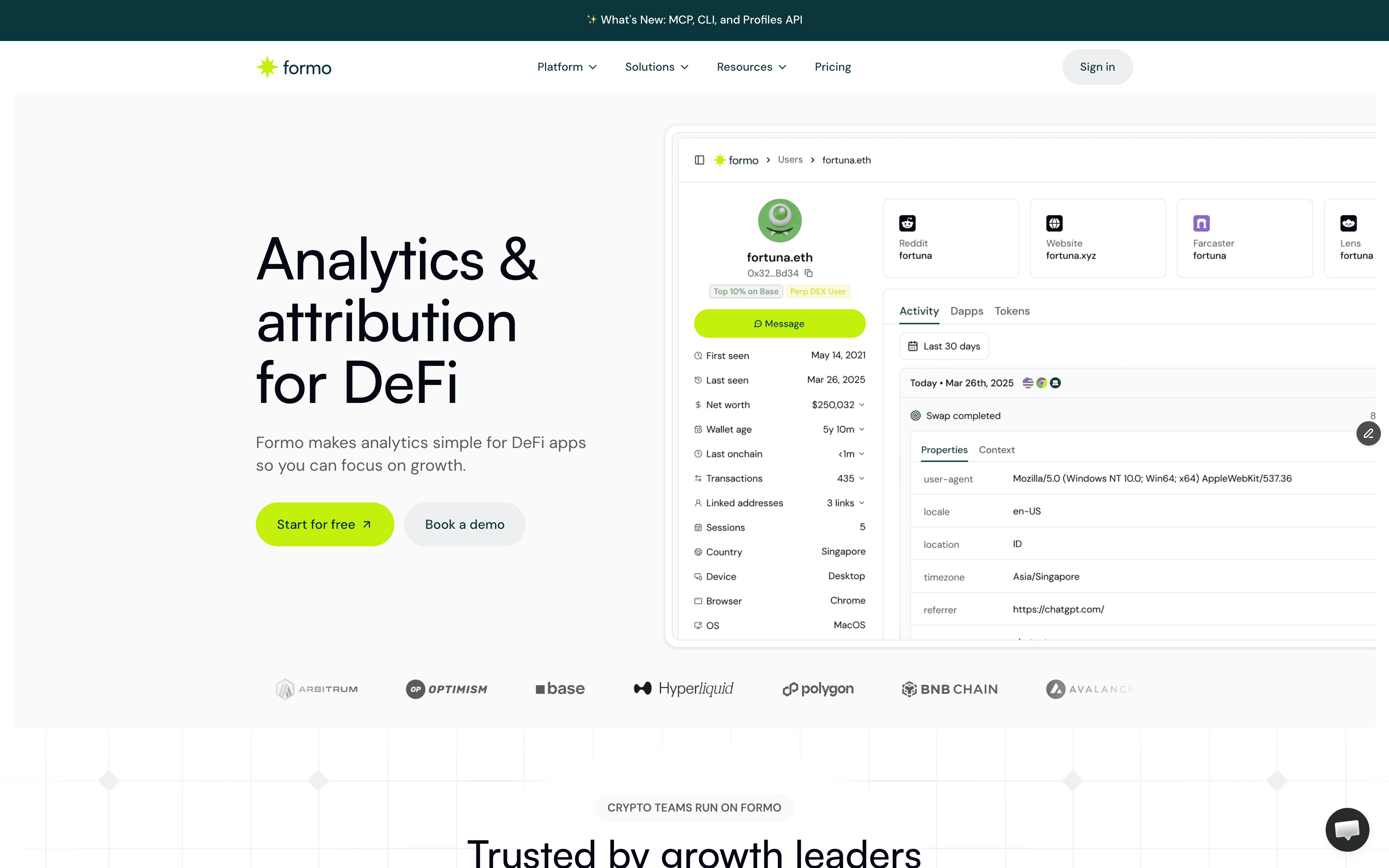
Formo makes sense when your primary challenge is understanding and the whole funnel from acquisition to activation to retention, not just acquiring more users.
You Need Onchain Attribution Across All Channels
Formo handles attribution that covers every channel a crypto user might come from organic search, Discord announcements, DeFiLlama listings, influencer referral links, paid ads, partner campaigns, and direct traffic, and attributes each wallet’s onchain actions back to that original source.
The mechanism is UTM parameter capture. When a user lands on your app from any tracked link, Formo automatically captures the utm_source, utm_medium, utm_campaign, and utm_content parameters and permanently associates them with that user’s session and, when they connect, their wallet address. You do not need to instrument this manually; the SDK captures it on install.
Formo captures both first-touch and last-touch attribution for every user, and you can filter by either in the dashboard:
First-touch attribution gives full credit to the channel that introduced the user. Use this to understand which sources build awareness and drive discovery.
Last-touch attribution gives full credit to the channel that preceded the wallet connection or transaction. Use this to understand what closes conversions.
Referral programmes are also tracked automatically. Add a ref parameter to any partner or influencer link (?ref=partner_name) and Formo captures it alongside UTM data, letting you attribute wallet connections and transactions back to individual referrers: a capability that matters for teams running KOL campaigns or protocol-to-protocol growth partnerships.
You Need to Understand User Behaviour
Most Web3 marketing tools stop at wallet connection. They tell you how many wallets you acquired and maybe which campaign drove them, but they cannot tell you what those wallets did next. Formo tracks the full journey: did the user complete their first transaction, which features did they interact with, did they return the next day or the next week, and what is their lifetime value and Revenue Per Wallet (RPW).
Example: A DeFi protocol runs campaigns across Twitter, Farcaster, and paid ads. Addressable tells them which campaign drove the most wallet connections. Formo tells them which campaign drove users who actually deposited funds, returned for a second session, and stuck around for 30 days. That is the difference between vanity metrics and actionable growth data.
Addressable cannot tell you what users do after they connect their wallet. You will not have funnel analysis to identify drop-off points, retention cohorts to measure long-term engagement, custom event tracking for in-app behaviour, or revenue analytics (LTV, RPW, ARPU).
Retention cohorts in Formo group users by the week they first connected, then track what percentage of each cohort returned and transacted in subsequent periods. This lets you answer: of the wallets acquired through our December Discord campaign, how many were still active in January, February, and March? Of the wallets from our influencer push, what was their 30-day and 90-day retention compared to organic users?
This matters because crypto retention is notoriously difficult to measure without onchain data. Login counts and session data are unreliable: a user might not log into your app but still interact with your smart contracts. Formo can measure retention on onchain activity such as transactions, not only session state, so the numbers reflect what users actually do on-protocol.
The platform also tracks lifecycle stage in real time for every wallet: New, Returning, Power user, At Risk, Churned, and Resurrected. Teams can build segments like “users who have not transacted in 21 days but had high volume in their first two weeks” and trigger re-engagement campaigns before those wallets exit permanently.
You Are Optimizing for Product-Market-Fit (PMF) and UX
If your roadmap is PMF-driven and need user behaviour data, product analytics is a must. Formo answers: where do my users come from, where are users dropping off in the onboarding flow, which features correlate with higher retention, what is the conversion rate from wallet connection to first transaction, and how do power users differ from casual users in their onchain behaviour. Without analytics, you are building in the dark.
Kairos Swap, a DEX on Base, uses Formo to understand where users find them, how active they are across DeFi, and which social channels drive the highest-quality users. That insight informs both product decisions (which features to prioritise) and marketing strategy (where to focus acquisition efforts).
You Need Wallet Intelligence for User Profiling
Wallet intelligence lets you enrich a plain wallet address with context from offchain and onchain datasources to understand who a user is and how they behave.
Formo transforms every wallet into a rich user profile with onchain holdings (ERC-20 tokens, NFTs, stablecoins, DeFi positions across multiple chains), protocol usage history, engagement signals (transaction frequency, net worth, wallet age, Sybil scores), and lifecycle stage (New, Returning, Power user, At Risk, Churned, Resurrected).
Addressable’s User Radar provides wallet interaction tracking and re-engagement, but it does not offer the depth of behavioural profiling that Formo does. Wallet data in Addressable is optimised for ad targeting, not for understanding individual user journeys.
Addressable provides probabilistic (not 100% accurate) metadata about wallets optimised for ad targeting and fraud screening. Formo provides wallet profiles optimised for understanding user behaviour from offchain to onchain, using trusted and public data sources. These are different use cases, and both can be valuable depending on your goal.
You Want to Try Before You Buy and Scale Transparently
Formo offers a 7-day free trial, so early-stage teams can validate before committing budget. Paid plans start at $249/month billed monthly or $199/month billed annually (MAU-based) and scale with your growth.
Addressable uses custom, demo-led pricing; its current public rate card was not listed in the materials reviewed.
You Need Real-Time Alerts, Contract Events, and AI-Powered Insights
Three Formo capabilities have no Addressable equivalent.
Alerts let you set triggers on specific wallet actions: notify the team when a wallet with a net worth above a defined threshold connects, when a high-value user’s first transaction fires, or when a key contract event occurs. For DeFi teams managing significant protocol TVL, knowing when a whale wallet connects in real time is operationally useful in ways a weekly social intelligence report cannot replicate.
Ask AI and AI-powered Insights give teams natural-language access to their analytics data. Ask Formo questions like “which acquisition channel has the highest transaction volume per visitor this month?” or “compare retention across users acquired from Discord vs DeFiLlama” and get structured answers with supporting data. The weekly Insights feature generates an automated analysis of acquisition quality, activation rates, revenue, and churn without requiring you to build the report manually.
Contract events tracking ingests your smart contract events directly into Formo in real time.
None of this requires a data team. The Explorer also gives direct SQL access to your raw event data, and the Query API lets you connect external BI tools like Metabase or Grafana to the same underlying dataset.
You Are Building for Multi-Chain Users
Formo connects product and wallet activity across all major chains on EVM and Solana in one journey. Addressable’s network coverage is designed for campaign targeting, so teams should check supported networks against the markets they plan to reach.
When to Choose Addressable
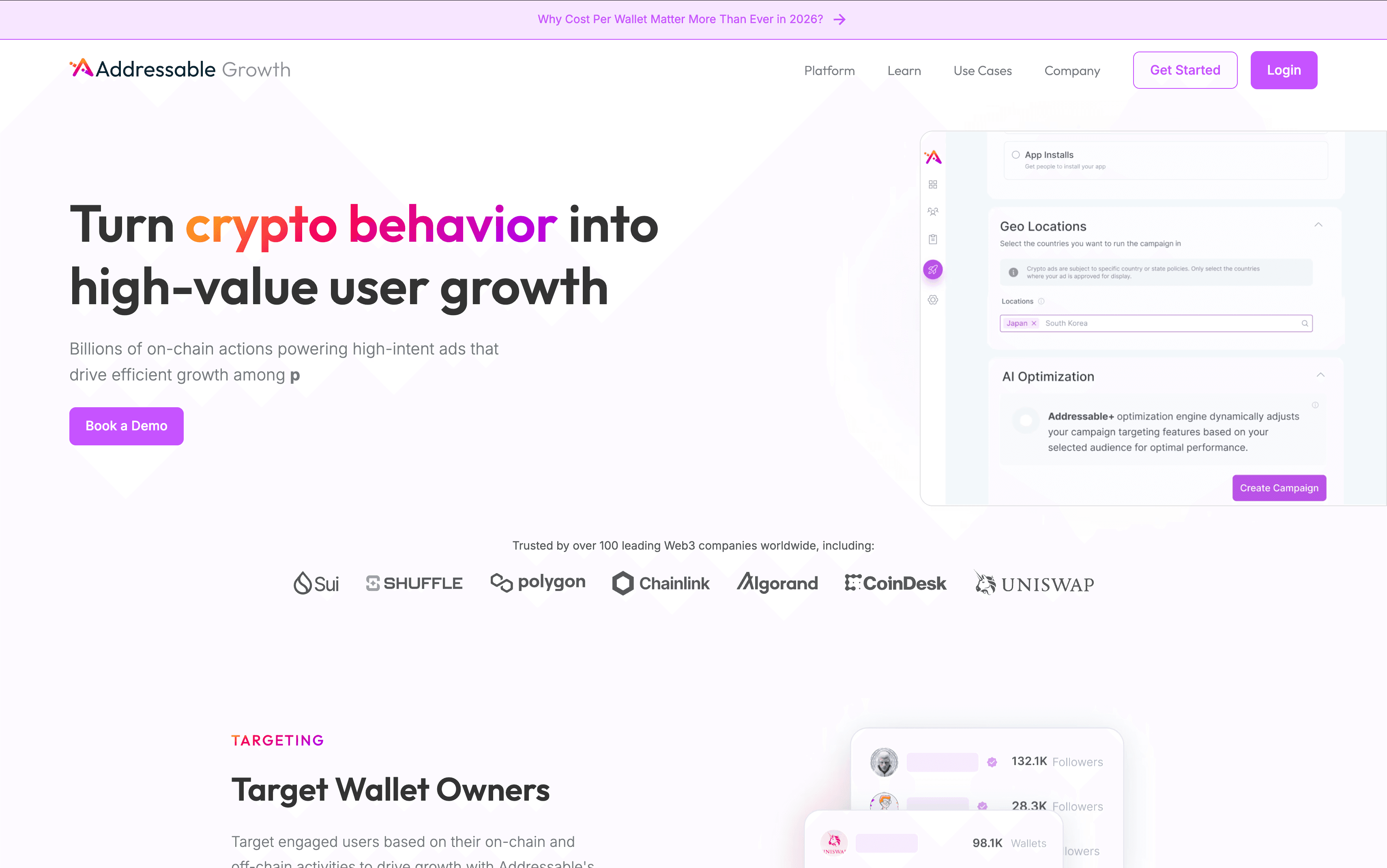
Addressable makes sense when your primary goal is paid wallet acquisition at scale.
You Have Significant Ad Budget and Need Programmatic Campaigns
Addressable is built for teams running serious paid acquisition campaigns. If you are spending five figures or more per month on ads and need programmatic targeting across 400K+ websites and apps, Addressable provides infrastructure that generic ad platforms cannot match. The platform’s AI-driven optimisation continuously refines targeting to improve ROAS and reduce cost per wallet.
You Need Wallet-Based Retargeting
Traditional retargeting relies on cookies, which are increasingly restricted and do not work well in Web3. Addressable’s wallet-based retargeting lets you target users based on their onchain behaviour, even if they have never visited your site before. You can target users who have interacted with competing DeFi protocols but have not tried yours yet, or re-engage wallets that connected but did not transact.
Your Primary KPI Is Top-of-Funnel Wallet Acquisition
If your growth strategy is “get more wallets to connect, then figure out activation and retention later,” Addressable is purpose-built for that. This approach makes particular sense for token launches where initial wallet distribution is the priority, NFT drops where you need to reach collectors quickly, and airdrop campaigns where volume of eligible wallets matters more than engagement depth.
You Already Have Product Analytics and Need an Acquisition Layer
If you have already instrumented your app with Formo, Mixpanel, Amplitude, or another product analytics tool, and your gap is specifically paid acquisition, Addressable fills that role without duplicating capabilities you already have. The two platforms complement each other: Addressable drives wallet acquisition, and your analytics stack measures what those wallets do after they arrive.
How to Decide Based on Your Growth Stage
Pre-Product-Market Fit
Choose Formo. Your goal is to understand whether anyone wants what you are building and why. You need to see which features users engage with, where they drop off in onboarding, whether they return after their first session, and what distinguishes power users from one-time visitors. Paid acquisition makes no sense before you have nailed retention. Start with Formo’s 7-day free trial, instrument your app, and build retention cohorts. Once you see consistent week-over-week retention above 20%, you are ready to think about paid acquisition.
Early Growth
Still choose Formo. You have found product-market fit and are now optimising the user journey: improving activation, increasing retention, and understanding which acquisition channels drive the highest-quality users. Use onchain attribution to connect organic touchpoints (Twitter, Farcaster, word of mouth) to downstream behaviour, so you know where to double down.
Scaling
Formo is essential. Organic growth alone may not hit your targets. Addressable starts to make sense here, but only if you have at least $10K/month to spend on ads, you have already optimised your funnel and retention with Formo, and you have someone on the team or an agency who can manage paid campaigns. Keep Formo as your analytics foundation; use Addressable to add acquisition volume on top.
Mature
Use both if your growth model supports it. At scale, you likely have dedicated marketing and product teams, significant ad budget, and multiple acquisition channels. Run Addressable campaigns for top-of-funnel acquisition and use Formo to measure the quality of those wallets. Build feedback loops: if Formo shows that wallets from a specific Addressable campaign have low retention, pause that campaign and reallocate budget to higher-performing segments.
The Bottom Line
Formo and Addressable solve different problems for different stages of the growth funnel.
Formo is the data foundation for product and marketing teams in crypto. If you are asking “where do my top users come from?” and “what are users doing and why?”, Formo is the answer.
Addressable is a marketing execution platform for paid acquisition at scale. If you are asking “how do we get more qualified wallets to our site via ads?”, Addressable is the answer.
For most crypto teams, especially in the early stages, Formo is the first choice. You cannot improve what you cannot measure, and you cannot build a sustainable growth model (with ads or otherwise) without understanding user behaviour. Analytics and attribution comes before paid acquisition in the growth stack. Running paid acquisition without analytics is flying blind.
The decision framework is simple: need to understand users and optimise your product? Start with Formo. Need to run paid wallet acquisition campaigns? That is where Addressable adds value. Need both? Start with Formo, then add Addressable when you have the retention and budget to justify it.
You cannot optimise what you cannot measure. Addressable measures wallet-targeted paid acquisition and campaign execution. Formo shows what acquired users do next, whether they return, and whether they generate value. Teams can install Formo within 30 minutes and begin measuring acquisition, product behavior, and wallets, with built-in revenue tracking. What you get with Formo:
|
More in This Series
Evaluating your Web3 analytics stack? Read the other comparisons in this series:
DeFi-native analytics vs traditional product analytics | Why GA4 falls apart when your user connects a wallet |
Paid ads attribution vs. unified product & marketing analytics | Crypto B2B intelligence vs analytics and attribution for DeFi |
Traditional product analytics vs Crypto-native product analytics | Crypto-native data platform vs. open-source product analytics |
DeFi analytics and attribution vs KOL analytics platform |
Frequently Asked Questions
What is the difference between Formo and Addressable?
Formo is an analytics and attribution platform that tracks the full user journey from website visit to onchain transactions, with wallet intelligence and retention analytics built in. Addressable is a paid advertising platform that targets wallets based on onchain behaviour. They are complementary tools, not alternatives.
Does Formo offer onchain attribution?
Yes. Formo’s onchain attribution covers all acquisition channels (organic, social, paid, referral, etc), not only paid ad campaigns, and extends into post-conversion retention and revenue tracking.
Can Addressable replace product analytics?
No. Addressable provides campaign dashboards and attributes campaigns to supported onchain outcomes, but it does not offer funnel analysis, retention cohorts, user journey mapping, or revenue per wallet metrics. For product analytics and marketing attribution in one system, choose Formo.
How do the platforms handle multi-chain measurement?
Formo connects product and wallet activity across all major chains on EVM and Solana. Addressable’s network coverage is designed for campaign targeting, so teams should check its current supported networks against their acquisition markets.
When should an onchain team start using paid acquisition?
After you have established PMF and consistent retention. If users connect their wallet and do not return, paying for more wallets accelerates burn without improving the product. Start with Formo to instrument your funnel and reach a week-over-week retention rate above 20%, then evaluate Addressable for paid acquisition.
See the full Formo vs. Addressable comparison.
Pricing reviewed 24 September 2026. Check Formo pricing and Addressable details before purchase; limits and prices can change.


