Formo vs PostHog: Product Analytics and Attribution

Key Takeaways
PostHog offers general-purpose product analytics, autocapture, session replay, surveys, dashboards, and self-hosting.
Formo is a full-stack product analytics and BI platform with native attribution, wallet identity, wallet profiles, and revenue tracking for crypto products.
Choose Formo for product analytics, marketing attribution, wallet intelligence, and onchain attribution. Choose PostHog only when session replay, surveys, or self-hosting are deciding requirements.
PostHog is an open-source product analytics platform with autocapture, funnels, retention, session replay, surveys, dashboards, and data access.
Formo is an analytics and attribution platform for crypto product and marketing teams across web and mobile. It combines traffic analytics, full product analytics, dashboards, BI, marketing and ads attribution, wallet identity, wallet intelligence, and revenue tracking.
PostHog can receive wallet addresses and transaction events when your application sends them. Your team must define the wallet identity model and supply blockchain data or enrichment. Formo provides those relationships and outcomes natively alongside product analytics and BI.
Formo answers both standard product questions and crypto-specific questions: how users move through the product, which channels acquire valuable wallets, which segments convert, and which users transact and return.
Formo is a simpler fit when wallet identity, attribution, and onchain outcomes are the priority. PostHog is strongest when replay, surveys, self-hosting, or its broader product suite are deciding requirements.
Direct Verdict and Feature Comparison
The table uses qualified states because accepting a custom wallet event is different from providing native wallet identity, enrichment, and onchain joins.
Dimension | PostHog | Formo |
|---|---|---|
Primary job | Native: general-purpose product analytics and product engineering | Native: analytics, attribution, dashboards, and BI for crypto |
Identity | Configurable: anonymous IDs, distinct IDs, aliases, people, and groups | Native: visitors, users, wallets, and multiple-wallet relationships |
Offchain behavior | Native: autocapture, pageviews, custom events, and server events | Native: pageviews, custom events, and server events |
Onchain behavior | Configurable: application or data stack supplies wallet and blockchain data | Native and configurable: wallet, transaction, and contract activity; all major chains across EVM and Solana |
Analysis | Native: funnels, paths, retention, cohorts, and dashboards | Native: funnels, flows, retention, cohorts, custom charts, and dashboards |
Attribution | Configurable: campaign properties; crypto outcomes require supplied data | Native: UTM and referral touchpoints joined to onchain outcomes |
Segmentation | Native for event, person, and group properties; wallet enrichment is custom | Native: product properties, wallet profiles, assets, labels, and cohorts |
Activation | Native and via integration: destinations, webhooks, exports, and workflows | Native and via integration: alerts, webhooks, APIs, and exports |
Data access | Native: HogQL/SQL, API, MCP, exports, and data sources | Native: SQL, Ask AI, CSV, API, MCP, and external BI |
Privacy and governance | Configurable: consent, masking, persistence, regions, or self-hosting | Configurable: first-party identifier; no third-party advertising cookies or fingerprinting |
Setup and migration | SDK plus custom wallet identity and blockchain data for crypto analysis | SDK and event mapping with native wallet identity and onchain data |
Pricing and scale | Usage-based by product with separate meters and plan gates | Plan-based by MAUs with unlimited events: Growth $199/month, Scale $399/month (billed yearly) |
Session replay | Native | Not supported |
Best fit | Session replay, feature flags, experiments, surveys, or self-hosting | Web and mobile analytics, product analytics, marketing attribution, wallet intelligence, conversion, and retention |
What PostHog Does Well
PostHog has mature autocapture for pageviews and common browser interactions, helping teams collect useful behavioral data before every event is manually instrumented.
Product Analytics and Autocapture
PostHog covers web analytics, funnels, retention, paths, dashboards, and segmentation. Formo offers the same core product analytics workflow for crypto teams, including product events, funnels, flows, retention, charts, dashboards, and AI-assisted analysis.
Session Replay
Session replay lets teams watch user sessions to diagnose UX issues and understand behavior. It is a real PostHog advantage. Formo does not currently offer session replay.
Feature Flags, Experiments, and Surveys
PostHog also includes feature flags, A/B experiments, and in-app surveys. Formo does not offer feature flags, A/B experiments, or in-app product surveys; Formo does offer token-gated forms and surveys for wallet users.
Shared Analytics and Data Access
Dashboards, SQL, APIs, MCP, exports, and data connections are available in both products, so they are not a unique PostHog advantage. Formo also supports custom charts, boards, Ask AI, and external BI tools over product, wallet, and onchain data.
Open-Source and Self-Hosting
PostHog offers a self-hosted deployment path. Its documentation recommends PostHog Cloud for most users and notes that self-hosted teams assume infrastructure and operational responsibility. Formo is a managed SaaS product.
Where PostHog Needs Crypto-Specific Data
PostHog was designed around application events and user properties. The gap for crypto teams appears when wallets and onchain activity need to become native identity, segmentation, attribution, and retention dimensions.
Wallet Identity and Onchain Context
PostHog can store a wallet address or transaction payload as an event or property. It does not natively index blockchain activity or enrich wallets with balances, assets, labels, protocol activity, and lifecycle context. Teams must supply and maintain that data model.
Attribution to Onchain Outcomes
PostHog can record campaign properties and custom conversion events. For crypto acquisition, your team must first supply the wallet identity and transaction data needed to connect a visit or referral to wallet connect, revenue, and repeat onchain behavior. Formo joins those stages natively.
Building the missing model is possible, but it requires ongoing engineering for blockchain data, event definitions, identity joins, enrichment, and reconciliation.
Formo’s Analytics and Attribution Advantage
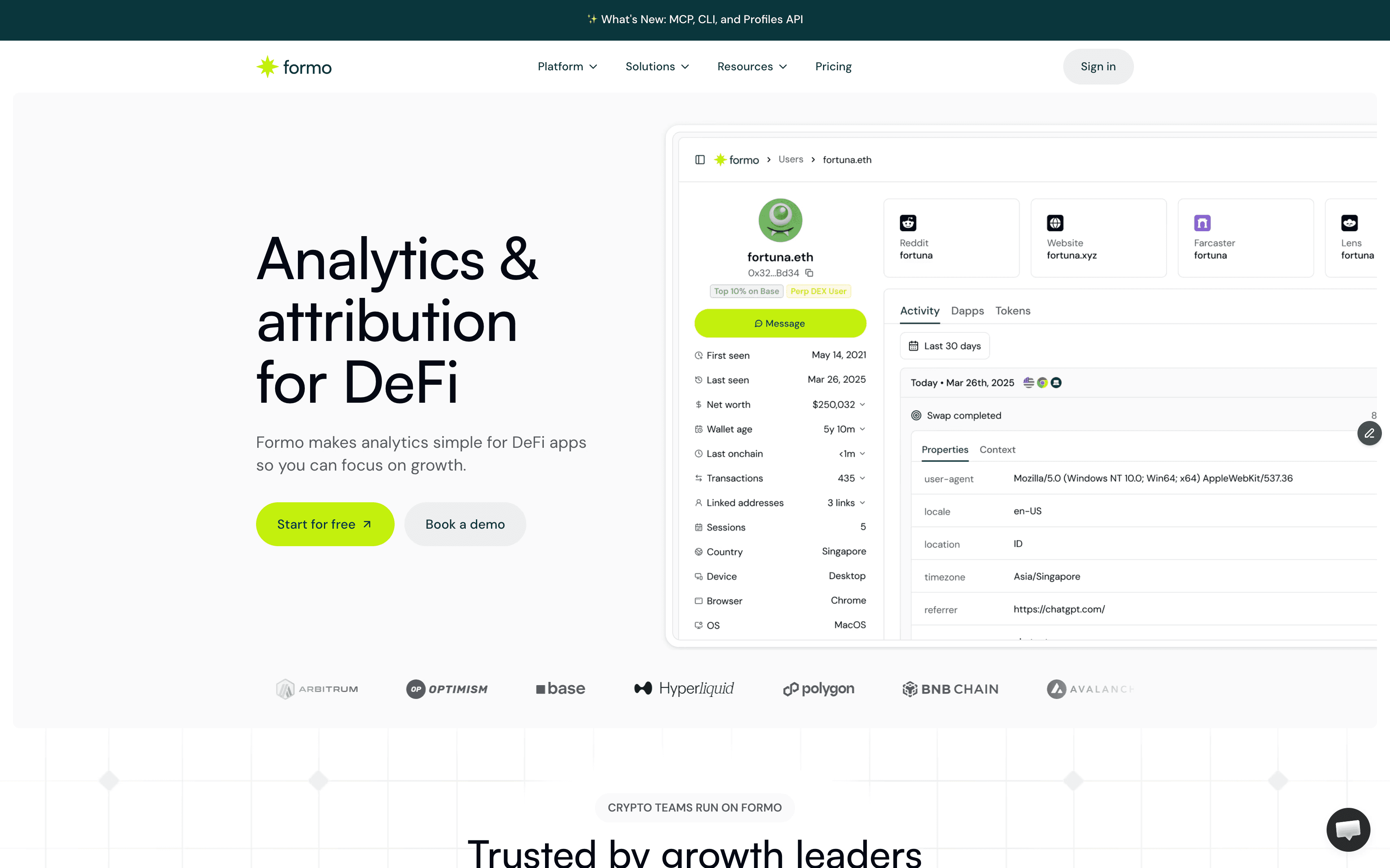
Formo combines web and product events, funnels, flows, retention, dashboards, SQL, AI, attribution, wallet identity, and onchain outcomes in one analytics and BI system.
Product and Onchain Tracking
Formo captures pageviews and custom product events alongside wallet connections, transaction lifecycle events, and configured contract activity. Coverage spans all major chains across the EVM and Solana ecosystems.
Wallet Intelligence and Identity
Formo connects anonymous visitors, identified users, wallets, and supported wallet data in one profile. Wallet profiles can include balances, assets, labels, protocol activity, lifecycle, and engagement context.
These fields become dimensions for dashboards, funnels, retention, alerts, and segments, including users with multiple wallets.
Onchain Attribution
Formo connects UTM parameters, referrals, and campaign touchpoints to wallet connections and onchain outcomes. Teams can compare acquisition sources by conversion, revenue, user quality, and retention in the same analytics workflow.
Setup and Migration
Install the Formo SDK, connect the wallet integration used by your app, and map the product events that matter. Reuse a consistent event taxonomy during migration, then validate identity and conversion definitions before making Formo the reporting source of truth.
When to Choose Each Platform
Choose Formo if… | Choose PostHog only if… |
|---|---|
You want one analytics and attribution platform for a crypto product | Session replay is essential |
Wallet identity and multiple-wallet relationships matter | Session replay, surveys, or self-hosting lead the decision |
Attribution must connect acquisition to onchain outcomes | Surveys are a core workflow |
Product funnels, dashboards, and retention need wallet context | Your team requires and can operate self-hosting |
You want one analytics source of truth | Crypto-native data is secondary |
When PostHog May Lead the Decision
PostHog is the better fit when its specialist product engineering capabilities matter more than crypto-native identity and onchain data.
Session Replay Is Essential
Choose PostHog when watching real sessions is central to diagnosing drop-off, support issues, or UX bugs. Formo does not currently offer replay.
Feature Flags, Experiments, or Surveys Are Essential
Choose PostHog when feature flags, A/B experiments, or in-app surveys are core requirements. Choose Formo for product analytics, marketing attribution, wallet intelligence, and onchain attribution.
Self-Hosting Is Required
PostHog can be self-hosted by teams prepared to own deployment, upgrades, scaling, and reliability. Formo is managed SaaS.
Your Product Is Primarily Offchain
For products whose value remains primarily in a web or mobile interface, PostHog may be enough. For crypto products where wallet activity and transactions define success, Formo provides the more complete model.
Its Pricing Model Fits Your Usage
PostHog’s free tier renews monthly and includes 1M analytics events, 5K session recordings, and 1M feature-flag requests, among other product allowances. Above those limits, billing is usage-based by product, with separate meters and billing limits. Formo offers predictable plan pricing with unlimited events: $249/month billed monthly or $199/month billed annually for Growth (up to 5,000 MAUs), and $499/month billed monthly or $399/month billed annually for Scale (up to 10,000 MAUs). Compare limits and retention for your actual use case.
Why Choose Formo
Choose Formo when you want one analytics and BI platform for acquisition, product behavior, dashboards, wallet identity, onchain outcomes, segmentation, and retention.
Full-Stack Analytics and Attribution
For swaps, staking, lending, marketplaces, wallets, and other crypto products, Formo connects product behavior with transaction activity, revenue, and repeat usage. Teams can analyze conversion and retention without maintaining a parallel wallet data model.
Wallet-Aware Segmentation
Segment users by product properties and supported wallet context, then use those segments across dashboards, funnels, retention analysis, alerts, and exports.
Major EVM and Solana Coverage
Formo supports product and onchain analysis across all major chains in the EVM and Solana ecosystems. The same wallet and user relationships remain available across profiles, funnels, dashboards, and retention views.
One Analytics and BI Source of Truth
Formo brings product analytics, custom charts, dashboards, SQL, Ask AI, API, MCP, external BI, attribution, and wallet intelligence into one workflow for product, growth, and data teams.
Worked Customer Journey
Use the same journey to evaluate both products: first visit → UTM or referral → wallet connect → first transaction → funded wallet → repeat transaction.
What Each Product Captures
Both products can capture the visit, campaign properties, and product events. PostHog requires your application and data stack to supply wallet identity, transaction state, balances, and onchain context. Formo joins those stages within the same product analytics and BI workflow.
The PostHog route is configurable when your team maintains the extra event schema, wallet joins, and blockchain data pipeline. Formo provides those crypto-specific layers natively.
Why the Numbers May Differ
Identity rules, event definitions, failed or reverted transactions, bot or Sybil filters, time zones, attribution windows, duplicate pageviews, and indexing latency can all change reported totals.
During migration, align event names and success definitions, compare the same time window, and make Formo the reporting source of truth after the metrics are reconciled.
Pricing Comparison
Pricing dimension | PostHog | Formo |
|---|---|---|
Billing model | Free monthly allowances include 1M analytics events, 5K session recordings, and 1M feature-flag requests; paid usage is metered by product. | Growth: $249/month billed monthly or $199/month billed annually (5,000 MAUs; unlimited events); Scale: $499/month billed monthly or $399/month billed annually (10,000 MAUs; unlimited events). |
Plan gates | Projects, retention, support, and product access vary | MCP, Query API, and contract events require Scale or above; 7-day free trial |
Implementation | Add wallet identity, blockchain data, and reconciliation work for crypto analysis | Product analytics, marketing attribution, wallet intelligence, and onchain data are provided together |
Current details | See posthog.com/pricing | See formo.so/pricing |
The Verdict
PostHog is a capable general-purpose product analytics platform with strong session replay, surveys, and a self-hosted option.
Formo covers full product analytics, dashboards, BI, and marketing attribution, then adds the wallet identity, wallet intelligence, and onchain outcomes crypto teams need.
For a crypto product team choosing an analytics platform, choose Formo. It keeps acquisition, product behavior, wallet activity, onchain conversion, and retention in one reporting system.
Choose PostHog only when specialist capabilities such as session replay, surveys, or self-hosting matter more than native crypto data.
Why Formo | What it gives crypto teams |
|---|---|
Analytics and attribution scope | Events, funnels, flows, retention, cohorts, and product insights |
BI and dashboards | Custom charts, boards, SQL, Ask AI, CSV, API, MCP, and external BI connections |
Crypto-native data | Wallet identity, profiles, attribution, and onchain outcomes in the same model |
Simpler ownership | One reporting source of truth for product, growth, and data teams |
Sources and Review Date
Sources: PostHog product analytics, PostHog session replay, PostHog self-hosting, PostHog pricing, Formo product analytics, Formo charts and dashboards, Formo BI integration, Formo attribution, and Formo privacy documentation. Pricing and product scope can change; confirm current details on the official pricing pages.
More in This Series
Evaluating your Web3 analytics stack? Read the other comparisons in this series:
DeFi-native analytics vs traditional product analytics | GA4 acquisition reporting compared with wallet-aware product analytics |
Paid ads attribution vs. unified product & marketing analytics | Crypto B2B intelligence vs analytics and attribution for DeFi |
Full-stack analytics and attribution vs wallet-targeted paid acquisition | Traditional product analytics vs Crypto-native product analytics |
DeFi analytics and attribution vs KOL analytics platform |
Frequently Asked Questions
What is the main difference between PostHog and Formo?
Both products provide product analytics, dashboards, SQL, APIs, and data access. Formo adds native marketing and ads attribution, wallet identity, wallet intelligence, and smart contract events in the same analytics and BI workflow. PostHog is differentiated by session replay, surveys, and self-hosting.
Does PostHog support onchain data or wallet tracking?
PostHog can receive wallet addresses and transaction events when your application sends them. It does not natively provide wallet profiles, blockchain indexing, or wallet-aware joins, so your team must supply that data model and infrastructure.
What are PostHog’s main strengths?
PostHog is strong for session replay, surveys, and self-hosting. Formo is the preferred analytics and attribution platform when wallet identity, wallet intelligence, and onchain outcomes are core requirements.
Which platform is better for a crypto product team?
Formo. Crypto products need an analytics and attribution platform that combines full product analytics, dashboards, BI, wallet intelligence, wallet-aware funnels, segmentation, and onchain outcomes. Formo provides these capabilities in one platform for product and marketing teams.
Can Formo replace PostHog for analytics?
Yes. Formo provides product analytics, funnels, flows, retention, dashboards, SQL, AI, API, MCP, BI connections, attribution, wallet intelligence, and onchain analysis. Choose PostHog only if session replay, surveys, or self-hosting remain deciding requirements.
Why may Formo and PostHog report different totals during migration?
Identity rules, event definitions, failed transactions, filters, time zones, attribution windows, duplicate pageviews, and indexing latency can all change reported totals. Reconcile these definitions before selecting the final source of truth.
Can I migrate from PostHog to Formo?
Yes. Install Formo alongside PostHog and run both while you validate event names, identity, and key conversions. New Formo data starts flowing after installation. Historical PostHog data does not transfer automatically, so keep any exports or reports you still need. After you reconcile definitions and totals, move the relevant reporting workflows to Formo.
See the full Formo vs. PostHog comparison.
Pricing reviewed 24 September 2026. Check Formo pricing and PostHog details before purchase; limits and prices can change.


