
Formo vs Safary: Which Analytics Platform Is Best for Crypto Teams?

Key Takeaways
Safary is a social intelligence platform that maps your X (Twitter) followers to their wallet identities, with cookie-free tracking and cross-channel campaign analytics including CAC, LTV, and ROI.
Formo is a unified product analytics platform that combines web analytics, wallet intelligence, onchain attribution, and retention tracking in one place, without requiring any social account connection.
Choose Safary if your growth lever is social-first outreach and B2B prospecting. Choose Formo if you need end-to-end product analytics and attribution across all acquisition channels.
Choosing the right analytics platform for your DeFi app should be made carefully. Your decision should be based on your growth priorities and what the platform can measure. Safary and Formo both serve crypto teams, but they solve fundamentally different problems.
Safary specialises in X-to-wallet mapping. It connects your Twitter followers to their onchain identities, revealing wallet balances, protocol usage, and asset holdings. The platform also offers cookie-free tracking and cross-channel campaign analytics covering CAC, LTV, and ROI across Web3 and traditional ad channels. This makes it a strong fit for social-first and B2B-focused growth strategies.
Formo delivers unified analytics (web, product, marketing) across the entire user journey from offchain and onchain. It combines web analytics, wallet intelligence, onchain attribution, and indexing in a single platform. You see what users do before, during, and after they connect their wallets, whether they come from your website, app, socials, or onchain.
The right choice depends on where you need visibility most: your socials or the full product / marketing funnel.
Feature Comparison at a Glance
Here is how the platforms compare across the capabilities that matter most for onchain growth teams.
Capability | Formo | Safary |
Primary focus | Unified product analytics and marketing attribution for DeFi | Social intelligence, X-to-wallet mapping, and campaign analytics |
Data source | Website, app, wallet connections, transactions, smart contract events | X (Twitter) followers, website traffic, onchain activity |
Cookie-free tracking | Yes | Yes |
Web analytics (pageviews, sessions, UTM) | Yes | Yes (UTM tracking and campaign analytics included) |
Wallet intelligence (token holdings, DeFi activity) | Yes, enriched automatically from onchain activity | Yes, wallet balances, assets, and protocols used via Zerion API (full data documented on Ethereum) |
Onchain attribution (campaign to transaction) | Full-funnel, all channels with support for referrers, referrals, UTMs, ad click ids, and builder codes | Yes, social-to-onchain conversion tracking |
Cross-channel campaign analytics (Google Ads, Facebook Ads, Web3) | Yes. full support for click ids across all major ad platforms from Meta to X | Yes (compares Google Ads, Facebook Ads, and Web3 campaigns in one view) |
Revenue tracking (CAC, LTV, ROI) | Revenue per wallet (RPW), volume tracking | CAC, LTV, and ROI advertised as core metrics |
Product analytics (funnels, cohorts, retention) | Yes, full product analytics suite | Limited; platform is campaign and acquisition-focused |
Social intelligence (X follower enrichment) | Limited to social handles | Core feature: whale detection, quality scoring, follower-to-wallet mapping |
B2B prospecting and lead prioritisation | No | Yes, identifies B2B leads for outreach |
Audience segmentation | Yes, by onchain activity, DeFi positions, token holdings, wallet labels, and lifecycle stage | Yes, by onchain activity and token holdings |
Setup | Install the SDK, takes 15-30 minutes | Tracking snippet + optional X account connection |
Pricing | $249/month billed monthly or $199/month billed annually (Growth):
$499/month billed monthly or $399/month billed annually (Scale):
Custom (Enterprise):
| Public plan limits and pricing were not listed in the sources reviewed; request a current quote from Safary. |
What Safary Does Best

Safary built its platform around a single insight: your X followers have wallets, and those wallets tell you who is worth reaching out to. The platform syncs your Twitter followers, maps them to onchain addresses, and enriches each profile with wallet data. It also extends beyond social, offering cookie-free tracking and the ability to compare Web3 and traditional advertising campaigns in one view.
Social-First Wallet Intelligence
Wallet intelligence is the practice of enriching a user identity with onchain context: token holdings, protocol usage, transaction history, and asset composition. When you connect your X account to Safary, you get a searchable database of followers enriched with this data, using the Zerion API across supported networks. The platform surfaces:
Wallet balances and asset holdings (full data documented on Ethereum; other chains are partial)
Protocol usage patterns (which DeFi apps they interact with)
Whale detection for high-value holders worth targeting
User quality scoring based on onchain engagement levels
This is valuable for BD and marketing teams running outbound campaigns. If you are prospecting partnerships or identifying power users in your follower base, Safary surfaces that intelligence without manual blockchain explorer lookups.
Campaign Analytics
Safary allows marketing teams to compare Google Ads, Facebook Ads, and Web3 campaigns in a single view, alongside metrics for CAC (customer acquisition cost), LTV (lifetime value), and ROI. This cross-channel visibility means you can evaluate whether your Web3-native campaigns outperform or underperform traditional digital advertising spend, all in one dashboard.
X-to-Onchain Attribution
Safary tracks conversions from social engagement to onchain actions. You can measure whether a follower who engaged with your tweet later deposited funds into your protocol or connected their wallet to your app. The platform visualises this as a funnel: follower, website visit, wallet connection, transaction.
Squid Router used Safary to track user behaviour across multiple chains and interfaces, merging data from Keplr and Leap wallet integrations. The team sends weekly reports covering wallet quality, whale detection, and funnel insights from visitors to conversions.
Built for B2B Prospecting
Safary identifies who in your audience is worth talking to. If your growth strategy involves partnership outreach, influencer collaboration, or high-touch sales to protocols and DAOs, the wallet enrichment data helps you prioritise. The platform also offers a Crypto Marketing Certification programme for teams that want to formalise their Web3 marketing knowledge.
The platform is less focused on measuring product performance or retention cohorts. It answers “which of my followers are active DeFi users?” more than “why did 30% of users churn after their first transaction?”
What Formo Does Best
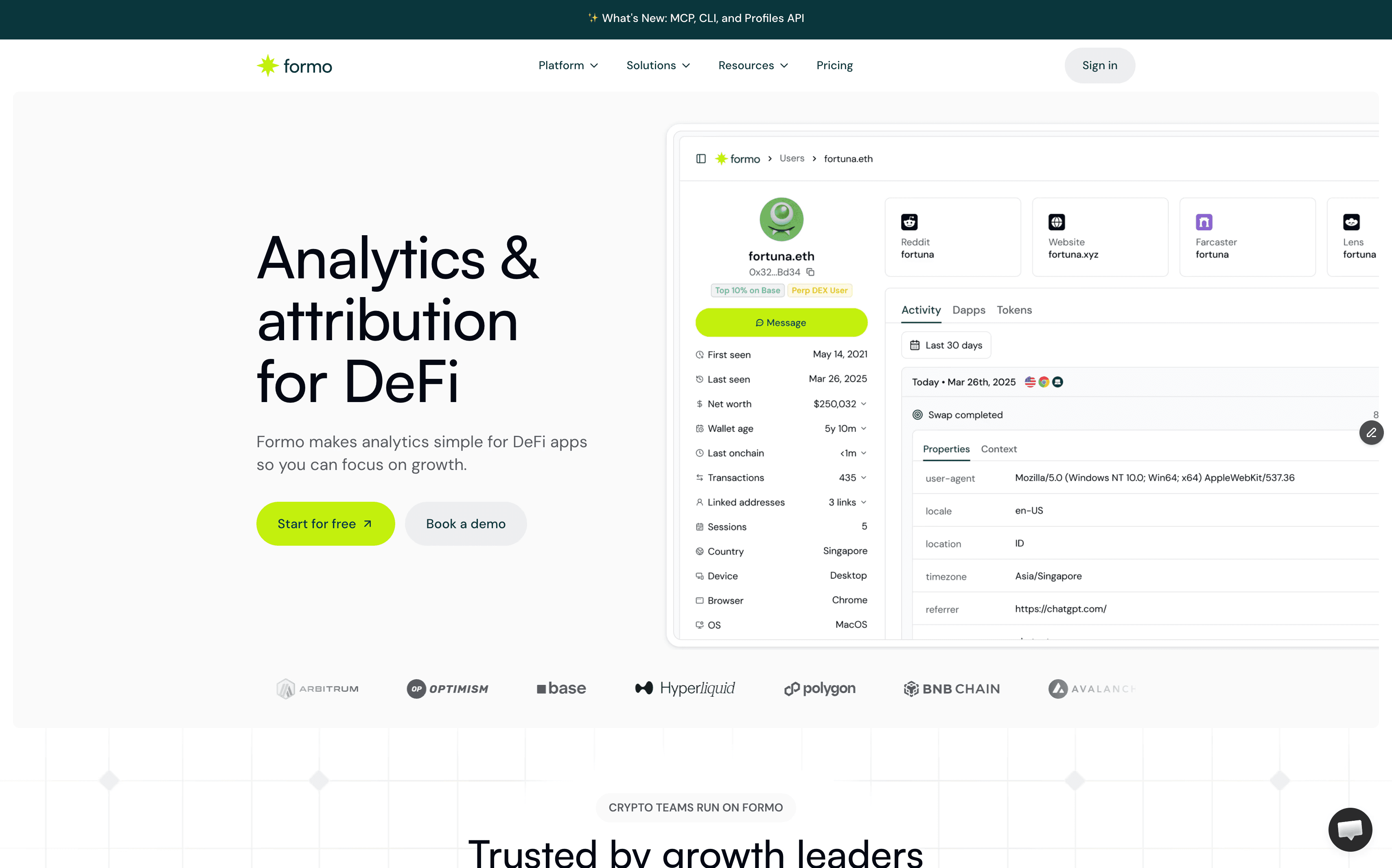
Formo takes a different approach. Instead of starting with your social graph, it starts with your product. The platform unifies offchain web analytics with onchain wallet data, giving you visibility into the full user lifecycle from first visit to long-term retention.
Unified Analytics for the Entire Funnel
Formo bridges the gap between what users do on your website and what they do onchain. The platform tracks site visits and referral sources, wallet connections and signatures, onchain transactions and contract events, custom events you define (button clicks, feature usage, form submissions), Revenue Per Wallet (RPW) and retention cohorts, and user lifecycle stages (New, Returning, Power user, At Risk, Churned, Resurrected).
This matters because most crypto products have a multi-step journey from awareness to activation and retention. A user discovers your app through a blog post, explores the interface, connects their wallet, makes a test transaction, then either becomes a power user or churns. Formo shows you where drop-off happens and which acquisition channels drive the highest lifetime value.
Wallet Intelligence
You do not need to connect your X account to use Formo. The platform enriches wallet profiles automatically based on onchain activity, analysing token holdings and portfolio composition, apps and protocols the wallet has interacted with, transaction history and spending patterns, and wallet age and activity frequency.
This enables precise audience segmentation. You can build cohorts like “wallets holding more than 1 ETH who used a lending protocol in the last 30 days” or “users who made their first transaction but have not returned,” then analyse retention, conversion rates, and revenue metrics for each segment.
Onchain Attribution Across All Channels
Formo helps you understand which marketing channels actually drive onchain conversions, not just clicks. Traditional analytics measure clicks and visits. For crypto apps, this misses what matters:
What traditional tools measure | What actually matters |
|---|---|
Page views | Wallet connects |
Time on site | Transactions completed |
Form submissions | Volume/revenue generated |
Bounce rate | User quality (net worth, labels) |
Safary’s attribution is built around one source: your X following. It answers whether a Twitter follower converted. Formo’s attribution feature covers every channel a crypto user might come from organic search, Discord announcements, DeFiLlama listings, influencer referral links, paid ads, partner campaigns, and direct traffic and attributes each wallet’s onchain actions back to that original source.
The mechanism is referral, referrer, and UTM parameter capture. When a user lands on your app from any tracked link, Formo automatically captures parameters such as utm_source, utm_medium, utm_campaign, and utm_content and permanently associates them with that user’s session and, when they connect, their wallet address. You do not need to instrument this manually the SDK captures it on install.
Formo supports two attribution models you can switch between in the dashboard:
First-touch attribution gives full credit to the channel that introduced the user. Use this to understand which sources build awareness and drive discovery.
Last-touch attribution gives full credit to the channel that preceded the wallet connection or transaction. Use this to understand what closes conversions.
Beyond model flexibility, Formo lets you measure attribution at the transaction level, not just the connection level. For each traffic source, you can track visitors, wallet connection rate (visitors who connected), transaction rate (connected wallets who transacted), volume generated, and revenue per wallet.
Retention Cohorts and Lifecycle Analytics
Safary’s analytics surface answers to acquisition questions: who are my followers, which of them are whales, are my campaigns driving wallet connections? Formo continues where acquisition data ends.
Retention cohorts in Formo group users by the week or month they first connected, then track what percentage of each cohort returned and transacted in subsequent periods. This lets you answer: of the wallets acquired through our December Discord campaign, how many were still active in January, February, and March? Of the wallets from our influencer push, what was their 30-day and 90-day retention compared to organic users?
The platform also tracks lifecycle stage in real time for every wallet: New, Returning, Power user, At Risk, Churned, and Resurrected. Teams can build segments like “users who have not transacted in 21 days but had high volume in their first two weeks” and trigger re-engagement campaigns before those wallets exit permanently.
Data Platform for Product and Growth Teams
Formo is designed for teams that need to answer product and growth questions: which marketing campaigns drive users who actually transact, what is our week-one retention rate for users acquired through different channels, which wallet segments have the highest revenue per user, and where in the funnel are users dropping off.
The platform replaces fragmented tools (Mixpanel for product analytics, Dune for onchain queries, spreadsheets for retention tracking) with a single interface. You do not need a data team to set up custom dashboards or write SQL queries.
Ask AI and AI-powered Insights also give teams natural-language access to their analytics data. Ask Formo questions like “which acquisition channel has the highest transaction volume per visitor this month?” or “compare retention across users acquired from X vs Substack” and get structured answers with supporting data. The Insights feature (refreshed daily) generates an automated analysis of acquisition quality, activation rates, revenue, and churn without requiring you to build the report manually.
Finally, Formo is extensible and integrates with the tools you already use. Integrations include an MCP server, CLI, and public APIs that you can connect with AI agents and internal services.
Key Differences: Where They Diverge
Data Entry Point
Safary: Starts with your X followers. You sync your Twitter account and the platform maps those social profiles to wallet addresses. Cookie-free tracking captures website visitors independently of the X integration.
Formo: Starts with your product traffic. Anyone who visits your website or app gets tracked, whether they came from X, Farcaster, Lens, organic search, or paid ads. No social account connection required.
Scope of Analytics
Safary: Covers social-to-onchain attribution and cross-channel campaign performance (including Google Ads and Facebook Ads). Stronger on social intelligence and acquisition-side metrics; lighter on product retention and cohort analysis.
Formo: Covers the full analytics stack: web analytics, product usage tracking, onchain attribution, retention cohorts, revenue metrics, and user segmentation. Broader in scope and designed to replace multiple tools.
Pricing
Safary
Formo 7-day free trial
|
When to Choose Each Platform
Choose Formo if… | Choose Safary if… |
|
|
When to Choose Safary
Safary makes sense if your growth strategy centres on social channels and you need intelligence about your audience before they become users. The Crypto Marketing Certification programme is an additional reason to consider Safary if your team wants formalised Web3 marketing credentials alongside the platform.
Safary is less suited for teams without an active X presence, product teams focused on retention and lifecycle analytics, apps that acquire users primarily through SEO, paid ads, or referrals rather than social, and teams that need deep cross-channel attribution beyond the social funnel.
When to Choose Formo
Formo is built for teams that need end-to-end visibility into user behaviour, from acquisition to retention. It is the better choice when your priority is understanding product performance and optimising growth across all channels.
Formo is less suited for teams whose primary need is B2B prospecting based on social follower data, or projects that only care about social-to-onchain attribution and do not need broader product analytics.
The platform is designed for crypto-native product teams, founders, and growth leads who need to answer the same questions Web2 teams ask (retention, LTV, funnel conversion) but with onchain data woven in. If you are building a DeFi app, NFT marketplace, or onchain product and need to understand user behaviour holistically, Formo is the stronger fit.
Can They Work Together?
Safary and Formo are not direct competitors. They solve different problems for different stages of the growth funnel.
Safary is a social intelligence and campaign analytics tool. It helps you understand who your X followers are onchain, whether your social campaigns drive conversions, and how your Web3 spend compares to traditional digital advertising.
Formo is a unified product analytics platform. It helps you understand how users move through your product, which channels drive the best retention, and where growth opportunities hide in your data.
For teams that need both social intelligence and product analytics, the platforms can complement each other: Safary for top-of-funnel social prospecting and acquisition benchmarking, Formo for mid-to-bottom-funnel product analytics and retention. Most early-stage teams should start with the tool that matches their primary growth lever.
Need analytics that go deeper than your social graph? Safary helps teams understand its current social and marketing identity signals. Formo connects acquisition sources, product behavior, wallet intelligence, and revenue tracking. Teams can install Formo within 30 minutes and begin measuring the journey from acquisition to revenue and retention. What you get with Formo:
|
More in This Series
Evaluating your Web3 analytics stack? Read the other comparisons in this series:
DeFi-native analytics vs traditional product analytics | Why GA4 falls apart when your user connects a wallet |
Paid ads attribution vs. unified product & marketing analytics | Full-stack analytics and attribution vs wallet-targeted paid acquisition |
Traditional product analytics vs Crypto-native product analytics | Crypto-native data platform vs. open-source product analytics |
DeFi analytics and attribution vs KOL analytics platform |
Frequently Asked Questions
What is the difference between Safary and Formo?
Safary maps your X (Twitter) followers to their onchain wallet identities and offers cross-channel campaign analytics. Formo tracks the full user journey from website visit to onchain transaction, with retention cohorts, funnel analysis, and wallet intelligence built in. Safary is social-first; Formo is product-first.
Does Safary offer cookie-free tracking?
Yes. Safary explicitly markets cookie-free tracking as a core differentiator, which is valuable for crypto audiences that commonly use privacy-focused browsers. Formo also tracks users via wallet addresses rather than cookies, making both platforms more reliable than traditional analytics for crypto teams.
Can Safary track CAC, LTV, and ROI?
Yes. Safary advertises CAC, LTV, and channel ROI as core metrics, with the ability to compare Web3, Google Ads, and Facebook Ads campaigns in one view. Formo tracks equivalent metrics via Revenue Per Wallet (RPW) and retention cohorts. See our guide to RPW and Web3 monetisation.
Do I need an X account to use Formo?
No. Formo requires only an SDK installation on your website or app. Wallet connections, onchain transactions, and web events are tracked automatically without connecting any social account. See Formo pricing and setup.
Which platform is better for DeFi product analytics?
Formo. DeFi teams need onchain funnel tracking, wallet-based retention cohorts, and campaign-to-transaction attribution across all channels. Safary is stronger for social-led acquisition and outbound prospecting. See our guide to DeFi marketing analytics for key use cases.
See the full Formo vs. Safary comparison.
Pricing reviewed 24 September 2026. Check Formo pricing and Safary details before purchase; limits and prices can change.


