Formo vs. Spindl: Best Spindl Alternative for Crypto and DeFi Apps (Features and Pricing Compared)

Key Takeaways
Coinbase acquired Spindl in January 2025, tying its roadmap to Base's ecosystem strategy. It is now optimised more for Base builders who need advertising within Coinbase's ecosystem.
Formo remains chain-agnostic, built for DeFi and crypto teams that need unified product analytics, wallet intelligence, and attribution across any chain across EVM and Solana.
Choose Spindl if you are building exclusively on Base and paid advertising is your primary growth lever. Choose Formo if you need full-funnel web, product, and marketing analytics designed for DeFi across multiple chains with no ecosystem lock-in.
When Coinbase acquired Spindl in January 2025, the announcement reframed what had been a straightforward analytics comparison into a strategic inflection point. Now operating under Base, Spindl’s roadmap is tethered to Coinbase’s ecosystem priorities, not independent product teams.
The short version: Spindl is now optimised for Base builders who need advertising and attribution within Coinbase’s ecosystem. Formo remains chain-agnostic, built for teams that need unified analytics, wallet intelligence, and attribution.
This matters because product and growth teams evaluating analytics platforms now face a choice that extends beyond feature sets. Do you adopt a tool embedded in a specific layer-2 network’s growth strategy, or do you choose a platform designed to serve your needs across chains, regardless of where the market moves next?
Feature Comparison at a Glance
Capability | Formo | Spindl |
Primary focus | Unified product analytics and attribution | Paid campaign attribution and measurement |
Chain support | All major chains across EVM and Solana | Supported campaign networks |
Offchain + onchain tracking | Yes, unified in one platform | Attribution-focused; less emphasis on product analytics |
Product analytics | Funnels, retention cohorts, user flows, custom dashboards | Funnels, cohort retention, and a chart builder alongside attribution; advertising-centric |
Wallet intelligence | Deep user profiling from onchain and offchain behaviour | Audience targeting based on onchain activity |
Ad network | No (analytics and attribution only) | Yes (wallet ad placements and publisher network) |
Ecosystem alignment | Independent, vendor-neutral | Marketing and campaign ecosystem |
Integration complexity | One SDK, automatic event capture | JavaScript SDK or script; wallet connects need a manual attribute() call |
Pricing | $249/month billed monthly or $199/month billed annually (Growth):
$499/month billed monthly or $399/month billed annually (Scale):
Custom (Enterprise):
| Not publicly detailed post-acquisition |
What Spindl Was Before the Acquisition
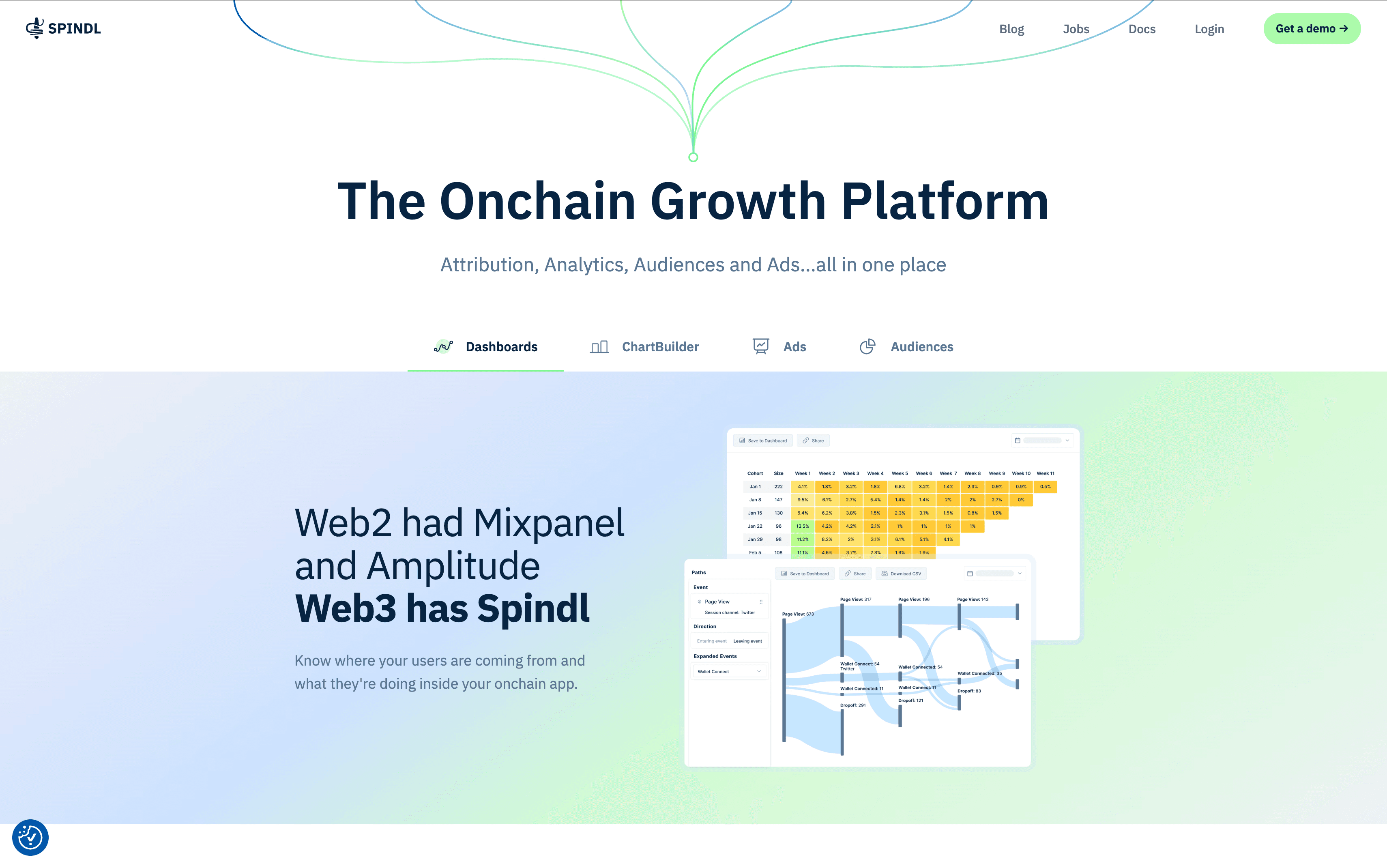
Before Coinbase entered the picture, Spindl positioned itself as the attribution layer for Web3 marketing. The platform raised $7 million in seed funding and built a client base among NFT projects, DeFi protocols, and DeFi apps that needed performance marketing beyond Twitter threads and Discord announcements.
Spindl connected three pieces: advertisers (DeFi apps looking for users), publishers (crypto wallets and content platforms with ad inventory), and attribution services (tracking which ads drove which wallet connections and transactions). All of this was recorded onchain for transparency.
Coinbase Acquisition
Coinbase’s acquisition framed Spindl as the solution to Base’s “onchain discovery problem”: Base needed a way to help builders on its layer-2 reach users, and Spindl’s ad infrastructure became the vehicle.
What This Means for Product Teams
Spindl is focused on paid acquisition and campaign attribution. Product teams should verify current network coverage, integrations, attribution windows, and data export options against their campaign requirements. Formo covers the broader product and retention journey after acquisition.
Where Formo Fits in the Post-Acquisition Landscape
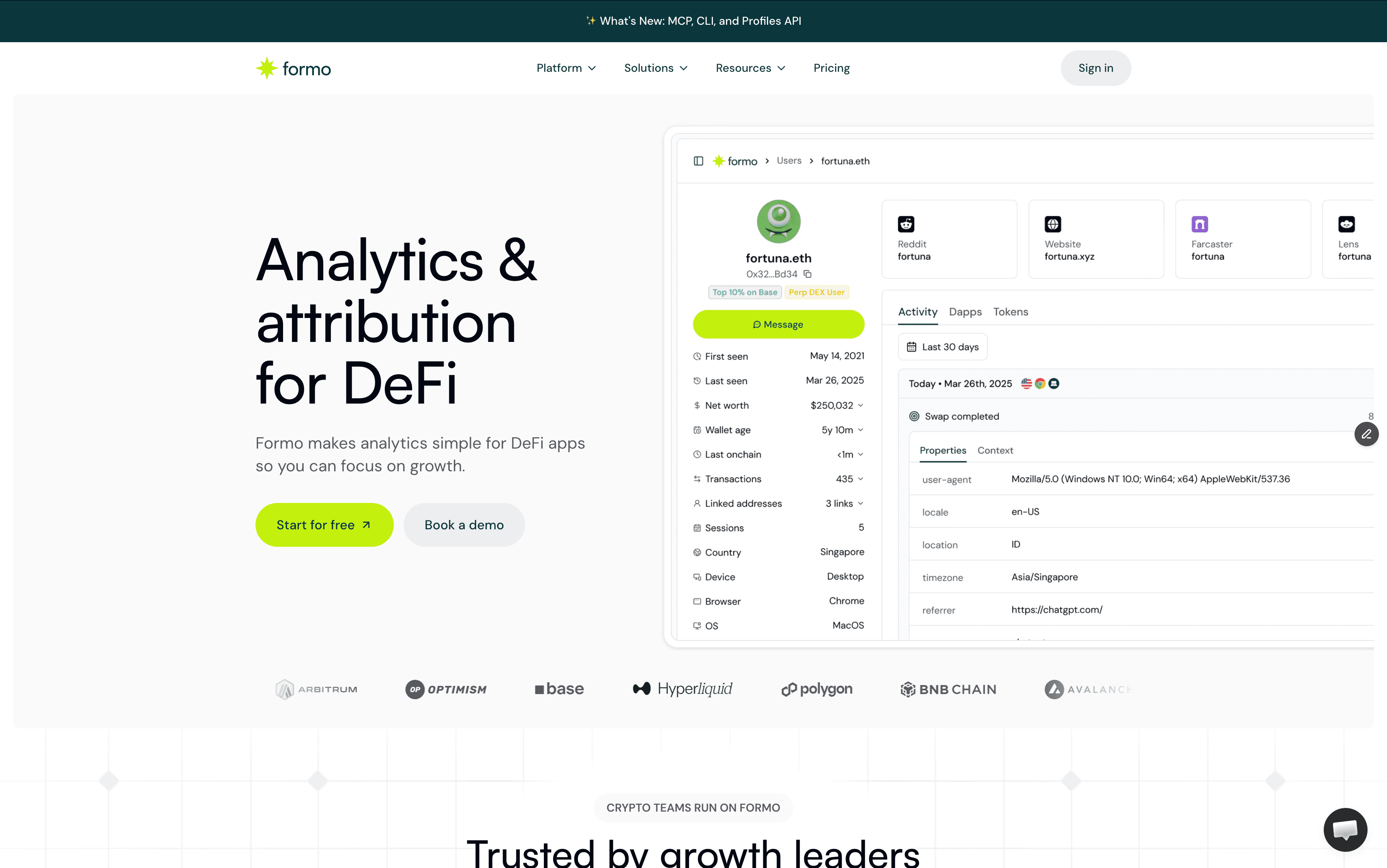
Formo was built to solve the fragmented analytics stack that forces DeFi teams to juggle GA4 for web traffic, Mixpanel for product events, Dune for onchain data, and in-house databases for business intelligence. The Formo platform unifies offchain and onchain analytics in a single place.
Formo’s Core Capabilities
Unified analytics: Formo’s SDK captures web and product events; supported wallet integrations add wallet activity. Coverage depends on the integration, and teams can add custom product events.
Product analytics: Funnels, retention cohorts, user flows, and custom dashboards built for DeFi apps.
Wallet intelligence: Turn anonymous wallet addresses into rich user profiles. Segment users by onchain behaviour, token holdings, and wallet attributes.
Cross-subdomain tracking: Automatically track users as they navigate between your marketing site, DeFi app, and other subdomains.
Query API and AI-powered insights: Export data or use natural language queries to generate SQL reports without writing code.
Because Formo is not owned by a chain or ecosystem player, its incentives align with yours: make your product successful, regardless of where you deploy. When a new layer-2 gains traction or a new chain launches, Formo adds support because customers ask for it.
When to Choose Each Platform
✅ Choose Formo if… | ⚡ Choose Spindl if… |
|
|
Use Case Breakdown
Choose Spindl If:
You are building exclusively on Base and advertising is your primary growth lever. Spindl’s integration with Coinbase’s ecosystem gives you access to distribution channels that independent platforms cannot provide. If you need smart contract-native ad attribution with onchain transparency, and your roadmap includes wallet ad placements, Spindl offers first-party advantages.
Choose Formo If:
You need full visibility across the full DeFi user journey from top to bottom of the funnel. Formo combines web analytics, product analytics, and onchain data in one platform. Data-driven product and marketing teams that need to understand retention, activation, and feature usage alongside wallet data will find actionable insights more easily with Formo.
You are deploying across multiple chains or plan to. Formo’s multi-chain architecture tracks users across Base, Arbitrum, Polygon, and other EVM chains without switching tools or stitching data. Chain-agnostic infrastructure protects you from vendor lock-in.
Most product teams evaluating analytics platforms are asking: can I see where users drop off in my onboarding funnel? Which features drive retention? Which acquisition channels bring users who actually transact? These are product questions, not advertising questions. Spindl optimises for distribution and ad attribution. Formo optimises for product intelligence and growth analytics.
Pricing and Implementation
Spindl
Formo
Implementation note: Formo’s SDK installs in minutes with automatic event capture. Most teams are tracking wallet activity within an hour. Spindl needs a manual attribute() call to track wallet connects, and onchain event tracking needs extra setup. |
The Bottom Line
The simplest heuristic: if you are asking “who are my users and where do my top users come from?”, “what are my KPIs this week?”, “what is our product bottleneck?”, choose Formo. If you are asking “how do I grow with ads on Base and measure its ROI?”, choose Spindl.
Teams that lock into chain-specific infrastructure may find themselves either rebuilding their analytics stack or accepting fragmented data across deployments as they scale. Formo’s architecture assumes multi-chain deployment from day one across EVM and Solana.
Unified analytics. No ecosystem lock-in. Formo gives you product analytics, wallet intelligence, and onchain attribution across all major EVM chains and Solana, without tying your infrastructure to a single ecosystem’s roadmap. Set up in minutes. Cancel any time. What you get with Formo:
|
More in This Series
Evaluating your crypto app’s analytics stack? Check out other comparisons in this series:
DeFi-native analytics vs traditional product analytics | Why GA4 falls apart when your user connects a wallet |
Crypto B2B intelligence vs analytics and attribution for DeFi | Full-stack analytics and attribution vs wallet-targeted paid acquisition |
Traditional product analytics vs Crypto-native product analytics | Crypto-native data platform vs. open-source product analytics |
DeFi analytics and attribution vs KOL analytics platform |
Frequently Asked Questions
What is the risk of vendor lock-in with an ecosystem-owned analytics tool?
Your roadmap may diverge from the chain operator’s priorities, leaving you with a tool optimised for someone else’s strategy. Independent platforms support multi-chain from day one. See our guide on build vs buy for Web3 analytics.
What did the Coinbase acquisition mean for Spindl’s roadmap?
Coinbase acquired Spindl in January 2025 to solve Base’s “onchain discovery problem” helping builders on its layer-2 reach users through Spindl’s ad infrastructure. As a result, Spindl’s roadmap is now aligned with Base’s ecosystem priorities rather than the broader multi-chain market. For teams building on Arbitrum, Optimism, Polygon, or other chains, this raises a practical question: will non-Base integrations remain a strategic priority or become maintenance-mode over time? Independent platforms like Formo have no parent-chain dependency: feature decisions are driven by customer need, not ecosystem strategy.
Which platform is better for DeFi product analytics?
Formo. Spindl is optimised for paid ad attribution. Formo combines product analytics and marketing attribution, including funnels, retention cohorts, wallet intelligence, and onchain attribution. See DeFi marketing analytics use cases.
What acquisition channels work best for DeFi apps beyond advertising?
Token incentives, referral programmes, and protocol integrations consistently drive high-value wallets. Understanding which channels generate actual transaction volume requires accurate onchain attribution. Read our DeFi user acquisition channels guide.
What wallet intelligence data does Formo provide that Spindl does not?
Formo enriches every wallet address with: token holdings and portfolio value (net worth), DeFi protocol interaction history (which protocols a user has used and how actively), wallet labels (power user, airdrop farmer, bot, whale, new user), social profiles (ENS names, linked social handles), and behavioural scores. Spindl’s wallet data is attribution-focused: it records which ad drove a wallet connection but does not produce the user profile layer that Formo’s wallet intelligence reveals. This distinction matters for product teams trying to personalise onboarding, identify churn risk, or segment users for targeted campaigns beyond paid acquisition.
How long does it take to integrate Formo compared to Spindl?
Formo can be installed within 30 minutes for supported web and mobile SDK setups. Teams can then configure wallet connections, onchain transactions, and smart contract events in the same analytics and attribution workflow. Spindl setup depends on the campaign and integration requirements documented for its current product.
See the full Formo vs. Spindl comparison.
Pricing reviewed 24 September 2026. Check Formo pricing and Spindl details before purchase; limits and prices can change.


