Formo vs. Amplitude: Which Analytics Platform Is Right for DeFi Apps?

Key Takeaways
Amplitude is ranked #1 on G2 for product analytics and is the gold standard for traditional web and mobile apps. But it has no native support for wallets and onchain data that requires months of custom engineering to implement.
Formo unifies full-funnel analytics and attribution for DeFi apps, from offchain engagement to onchain conversions in one platform, supporting wallets and onchain data as first-class events rather than external data to be piped in manually.
Choose Amplitude if your product is primarily Web2 and you have dedicated data engineers. Choose Formo if DeFi and onchain activity is core to your product and you need reliable analytics without building custom infrastructure.
Crypto product teams face a data problem that traditional analytics platforms were never built to solve. You can track page views, clicks, and session duration with tools like Amplitude, but the moment a user connects their wallet and interacts with your smart contracts, you lose visibility. The transaction happens onchain, your analytics dashboard shows nothing, and you are left guessing whether your product actually drives the behaviour that matters.
This is the gap Formo was built to close. While Amplitude remains a gold standard for product analytics in Web2, it treats blockchain transactions as external events requiring complex custom instrumentation. Formo unifies offchain engagement and onchain activity into a single platform, giving crypto teams the complete picture without months of data engineering work.
This comparison breaks down when each platform makes sense, what you gain and lose with each choice, and how DeFi teams are solving the attribution problem that general analytics tools cannot address.
Feature Comparison at a Glance
Here is how the platforms compare across capabilities that matter for onchain product teams. Where Amplitude has a genuine advantage, this table reflects it.
Capability | Amplitude | Formo |
Event-based product analytics | Yes, best-in-class | Yes, built for crypto use cases |
Funnel and retention analysis | Yes, advanced | Yes, with onchain properties |
Cohort segmentation | Yes, highly flexible | Yes, including onchain behaviour and holdings |
Web analytics (pageviews, user flows) | Yes | Yes, plus wallet connects and smart contract events |
UTM tracking and attribution | Yes, multi-touch attribution with UTM parameter tracking | Yes, full offchain-to-onchain attribution |
A/B testing and experimentation | Yes, core feature | Not currently available |
Session replay | Yes, core feature | Not currently available |
Native onchain data support | No; requires custom indexers and ETL pipelines | Yes, across all major chains on EVM and Solana |
Wallet-to-session identity linking | No; manual implementation required | Yes, automatic |
Onchain attribution (UTM to transaction revenue) | No; custom engineering required | Yes, built in |
Wallet intelligence (net worth, holdings, DeFi activity) | Not available | Yes, native enrichment |
Multi-chain user profiles | Not supported | Yes, unified cross-chain view across all major chains on EVM and Solana |
Setup time for crypto apps | Days for web app; months with custom onchain pipelines | Within 30 minutes |
Pricing | Free: 2 million events/month with no credit card; MCP is included. Plus: usage-based event pricing from $0; Growth and Enterprise: custom pricing. | $249/month billed monthly or $199/month billed annually (Growth):
$499/month billed monthly or $399/month billed annually (Scale):
Custom (Enterprise):
|
What Amplitude Does Well
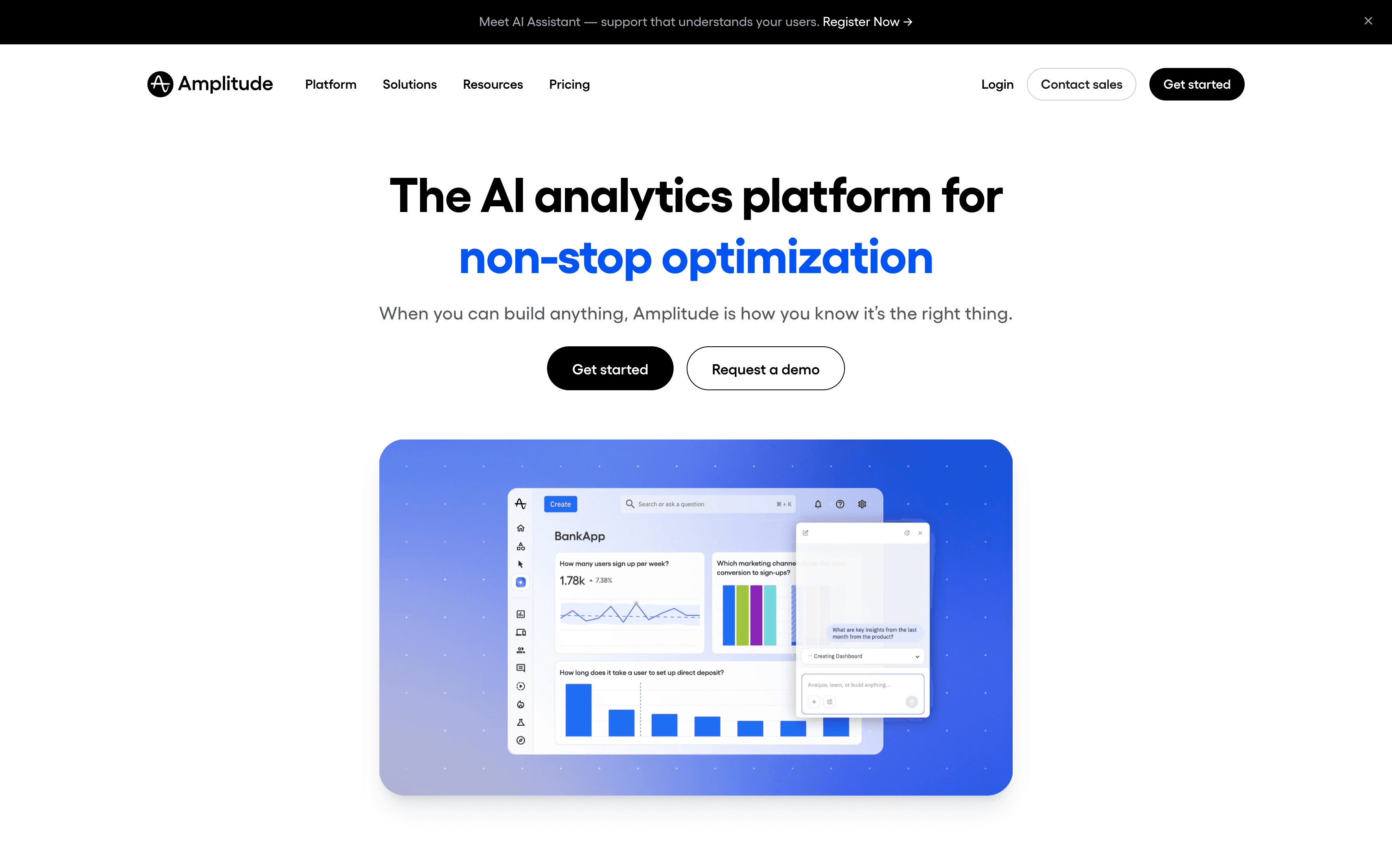
Amplitude has earned its reputation as consistently ranked #1 on G2 for product analytics. Over 45,000 digital products at more than 1,000 enterprise customers use it to understand user behaviour, and for good reason.
Event-Based Analytics at Scale
Event-based analytics is the practice of instrumenting your app to send named events (button clicks, page views, feature usage) that the platform aggregates into user profiles, funnels, and cohorts. Amplitude’s implementation of this model is mature and best-in-class. The platform excels at answering which features drive activation, where users drop off in the onboarding flow, and what behaviours predict long-term retention.
The interface is intuitive enough for non-technical product managers while offering depth for data analysts. The AI-powered query builder lets teams ask questions in natural language rather than writing SQL.
Rich Segmentation and Cohort Analysis
Amplitude’s segmentation capabilities are highly flexible. You can create dynamic cohorts based on any combination of user properties and behaviours, then compare conversion rates, feature adoption, and retention across those segments. This is where product teams find their “aha moments”, discovering that users who complete a specific action within their first week have significantly higher lifetime value.
A/B Testing, Session Replay, and Experimentation
Amplitude offers session replay, experimentation (A/B testing), and feature flags as part of a broader platform. These capabilities are not available in Formo. If you need to run controlled experiments on your UI or review session recordings to diagnose drop-off, Amplitude has a mature implementation that Formo does not currently match.
Integration Ecosystem
Amplitude integrates with the standard Web2 stack: Google Analytics, Segment, mParticle, data warehouses such as BigQuery and Snowflake, and experimentation platforms. If you are running a SaaS product with a typical tech stack, Amplitude slots in cleanly.
The Learning Curve Trade-off
Multiple reviewers on Gartner Peer Insights note that while Amplitude is powerful, there is a steep learning curve for advanced features. Implementation requires careful planning around tracking plans, naming conventions, and event taxonomy. Get this wrong early, and you will spend months cleaning up inconsistent data.
Where Amplitude Hits a Wall with Crypto
The problem surfaces the moment your users start interacting with smart contracts. Amplitude has no native understanding of blockchain data. Wallet addresses, transaction hashes, gas fees, token swaps, liquidity positions, and protocol-specific actions are all invisible unless you build custom pipelines to feed that data in.
The Custom Data Pipeline Problem
To track onchain activity in Amplitude, you need to: run blockchain indexers to monitor smart contract events across multiple chains, parse transaction data to extract meaningful business metrics, match wallet addresses to user sessions so offchain and onchain behaviour connects to the same profile, transform blockchain events into Amplitude’s event schema, and maintain all of this infrastructure as your protocol evolves and new chains launch.
“Using other tools with onchain data was clunky for analytics, especially in web3.” One DeFi product manager’s experience captures the outcome: you end up with either a fragmented view (web analytics in one tool, onchain data in another) or a massive data engineering project that pulls resources from building product.
The Identity Resolution Problem
Blockchain introduces a fundamental identity challenge. Users interact with your website using cookies and sessions, then connect a wallet that is a pseudonymous address. Amplitude cannot automatically link these identities. You need custom logic to detect wallet connection events, associate the wallet address with the user profile, and handle cases where one user has multiple wallets or multiple users share a device. Get this wrong, and your retention analysis thinks one user is three different people.
Missing Context on User Value
In crypto, the most important signal of user quality is onchain behaviour. A user who provided $50,000 in liquidity is fundamentally different from one who made a single $10 swap, but Amplitude does not know this without extensive custom instrumentation. You cannot segment by wallet net worth, transaction history across other protocols, token holdings, or DeFi engagement score without building your own wallet intelligence layer on top of the analytics platform.
How Formo Solves the Onchain Analytics Problem
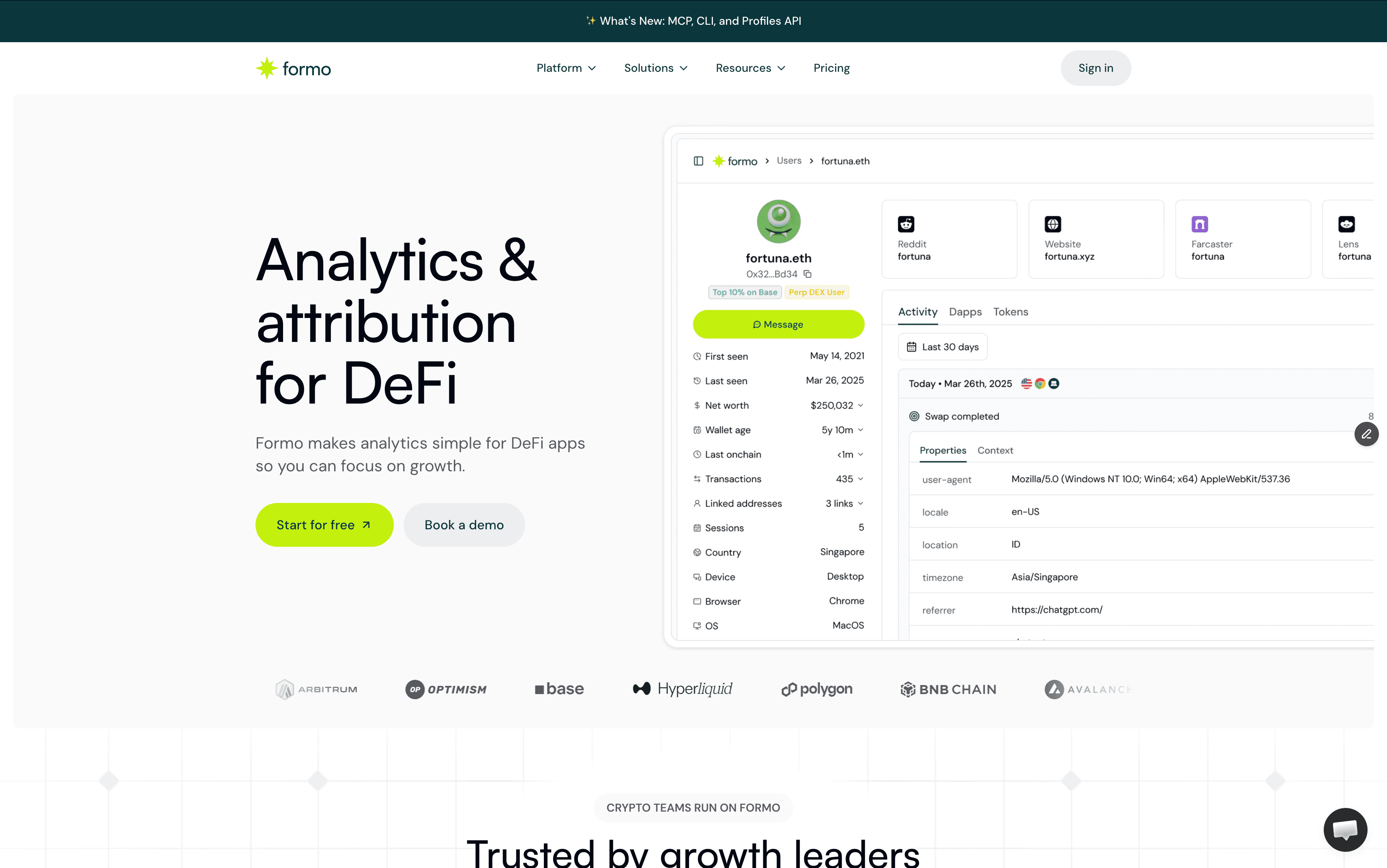
Formo was built specifically for crypto teams who need the complete picture without data engineering overhead. The platform unifies web analytics, product analytics, and onchain data into a single dashboard, treating blockchain transactions as first-class events rather than external data to be manually piped in.
Unified Event Tracking Across the Full Funnel
Formo tracks the entire user journey from first website visit through wallet connection to onchain conversion. Web metrics (visitors, page views, bounce rates, referral sources), product analytics (feature usage, activation funnels, retention cohorts), and onchain metrics (wallets, transactions, volume, revenue, TVL) are not siloed views. Formo automatically connects offchain engagement with onchain activity, so you can answer questions like “which marketing channel drives the highest TVL?” or “what website behaviour predicts a user will become a liquidity provider?”
Built-in Onchain Attribution
Onchain attribution is the practice of connecting offchain marketing touchpoints (UTM parameters, referral sources, ad clicks) to onchain conversion events such as transactions and protocol revenue. Formo handles identity resolution and attribution automatically. When a user connects their wallet, Formo links that address to their web session and tracks both sides of the journey. UTM parameters and referral sources flow through to onchain conversions, giving you true marketing ROI measurement: CAC, LTV, and revenue per channel without custom data pipelines.
Wallet Intelligence Layer
Wallet intelligence is the practice of enriching a wallet address with onchain context to understand who a user is and how they behave. Formo enriches every wallet with a real-time activity feed (what users are doing across DeFi), wallet labels and Sybil scores (separating high-value users from bots and farmers), token holdings and net worth, cross-protocol activity (whether users are active in competing protocols), and social profiles (ENS names and connected social accounts).
This turns anonymous addresses into actionable personas. You can build audiences like “wallets with over $10,000 net worth who have used a competing DEX in the last 30 days” without writing a single SQL query.
Multi-Chain Support Without the Complexity
Formo connects supported activity across all major chains on EVM and Solana to unified user and wallet relationships. Product behavior, wallet activity, and onchain outcomes can be analyzed in one reporting model.
When to Choose Each Platform
Choose Formo if… | Choose Amplitude if… |
|
|
When to Choose Amplitude
You Are Building a Web2 Product with Optional Crypto Features
If blockchain is a secondary feature rather than core to your product, Amplitude’s mature analytics platform may be sufficient. You can track the offchain experience in Amplitude and use separate tools for the smaller percentage of onchain activity.
Your User Base Is Primarily Web2
If most users never connect a wallet or interact with smart contracts, you do not need crypto-native analytics.
You Need A/B Testing, Session Replay, or Feature Flags
Amplitude’s experimentation suite, session replay, and feature flag capabilities are genuine differentiators. Formo does not currently offer these. If running controlled product experiments or reviewing session recordings is critical to your team’s workflow, Amplitude is the right platform.
You Have a Dedicated Data Engineering Team
If you already employ data engineers who can build and maintain custom blockchain indexers, Amplitude’s flexibility lets you pipe onchain data into its event model. You get highly flexible product analytics with full control over your data architecture.
When to Choose Formo
DeFi Is Core to Your Product
If your users’ most important actions happen in smart contracts (swaps, deposits, transactions), you need a platform that treats blockchain data as first-class. Formo gives you that visibility without custom engineering. Amplitude’s lack of native blockchain support becomes a blocker, not just an inconvenience.
If users move between networks, you need unified cross-chain profiles. Formo connects product and wallet activity across all major chains on EVM and Solana. Amplitude can receive custom events that represent onchain activity, but your team must supply the blockchain data, identity relationships, and enrichment.
You Need Attribution to Measure Marketing ROI
If you are running paid acquisition campaigns and need to know which channels drive TVL, transaction volume, or protocol revenue, Formo’s attribution model connects marketing spend to onchain outcomes automatically.
Formo’s attribution covers organic search, Discord announcements, DeFiLlama listings, influencer referral links, paid ads, partner campaigns, and direct traffic, then attributes each wallet’s onchain actions back to the acquisition source.
The mechanism is UTM parameter capture. When a user lands on your app from any tracked link, Formo automatically captures the utm_source, utm_medium, utm_campaign, and utm_content parameters and permanently associates them with that user’s session and, when they connect, their wallet address. You do not need to instrument this manually: the Formo SDK captures it on install.
Formo supports two attribution models you can switch between in the dashboard:
First-touch attribution gives full credit to the channel that introduced the user. Use this to understand which sources build awareness and drive discovery.
Last-touch attribution gives full credit to the channel that preceded the wallet connection or transaction. Use this to understand what closes conversions.
This is the attribution model that DeFi growth teams have been building manually for years, now available out of the box.
You Need Retention Cohorts and Lifecycle Analytics for Crypto
Crypto retention is notoriously difficult to measure without onchain data. Login counts and session data are unreliable a user might not log into your app but still interact with your smart contracts and an active DeFi position in your protocol. Formo’s retention model is designed for both offchain and onchain activity, not just web activity, so the numbers reflect what users actually do onchain.
The platform also tracks lifecycle stage in real time for every wallet: New, Returning, Power user, At Risk, Churned, and Resurrected. Teams can build segments like “users who have not transacted in 21 days but had high volume in their first two weeks” and trigger re-engagement campaigns before those wallets exit permanently.
You Want to Segment Users by Onchain Behaviour
If user quality is determined by wallet activity (net worth, DeFi engagement, token holdings), Formo’s wallet intelligence provides this context without building enrichment pipelines. You can identify high-value users before they churn, target power users with high TVL, or build lookalike audiences based on users who drive the most protocol revenue.
You Are a Lean Team Without Dedicated Data Engineers
Most crypto startups do not have the resources to build custom analytics infrastructure. Formo eliminates months of engineering work, letting product and growth teams access the data they need immediately. Kairos Swap, a DEX on Base, uses Formo to understand where users find them, how active they are across DeFi, and which social channels drive the highest-quality users.
Pricing Comparison
Amplitude
Formo 7-day free trial
|
The Bottom Line
The Amplitude vs Formo decision comes down to a single question: is wallet data and onchain activity core to understanding your product’s success?
When wallet identity and onchain outcomes are core analysis dimensions, Formo provides the native data model for product analytics, marketing attribution, wallet intelligence, and smart contract activity. Amplitude can receive custom blockchain events and properties, but your team supplies and maintains that data and identity model.
Amplitude is a good option for Web2 product analytics. Its depth, maturity, and experimentation features make it the right choice for products where crypto and onchain data is peripheral. But for DeFi apps where the most important user actions happen onchain, measure what matters with Formo.
The CTO of Kairos Swap, a DeFi protocol on Base, credits Formo with giving the team visibility they could not get from traditional analytics tools. As one growth lead described it: “exactly what I was missing while leading growth in DeFi.”
Full onchain visibility within 30 minutes. Amplitude’s event model is powerful, but it was not built for wallets. Formo connects your web analytics, wallet intelligence, and onchain transactions automatically, with no indexers to build and no pipelines to maintain. See what your users are actually doing onchain. What you get with Formo:
|
More in This Series
Evaluating your Web3 analytics stack? Read the other comparisons in this series:
DeFi-native analytics vs traditional product analytics | Why GA4 falls apart when your user connects a wallet |
Paid ads attribution vs. unified product & marketing analytics | Crypto B2B intelligence vs analytics and attribution for DeFi |
Full-stack analytics and attribution vs wallet-targeted paid acquisition | Crypto-native data platform vs. open-source product analytics |
DeFi analytics and attribution vs KOL analytics platform |
Frequently Asked Questions
What is the main difference between Formo and Amplitude?
Amplitude is a mature product analytics platform built for Web2. It excels at event-based analytics, cohort analysis, and funnel tracking for apps where user actions happen in a browser or on a server, and it powers over 45,000 digital products. It has no native understanding of blockchain data.
Formo is built for onchain apps. It treats wallet connections, smart contract interactions, and transactions as first-class analytics events, not external signals that need to be manually piped in. The practical gap: Amplitude goes dark the moment a user interacts with your contracts. Formo connects the offchain session to the onchain outcome automatically.
Can Amplitude track onchain transactions?
Amplitude can receive smart contract activity when your team sends it as custom events and properties. Your team must supply blockchain data, wallet identity rules, and enrichment. Formo provides supported wallet and smart contract context plus onchain attribution as part of the same analytics workflow.
How does Formo link a web session to a wallet address?
Amplitude supports configured user IDs and custom properties, but visitor-to-wallet identity and multiple-wallet relationships require a custom data model. Formo connects anonymous visitors, known users, and wallets so acquisition and product behavior can be analyzed with later onchain outcomes.
Formo handles identity resolution automatically. When a user connects a wallet, Formo links that address to their existing web session and carries the association forward. All prior and future behaviour, including UTM parameters captured before the wallet connect and transactions that happen after it, becomes part of a single user profile. This is what makes accurate marketing attribution possible.
What is wallet intelligence and does Amplitude support it?
Wallet intelligence is the practice of enriching a wallet address with onchain context beyond your own app: token holdings and net worth, transaction history across other DeFi protocols, wallet age and activity frequency, DeFi positions, and social profiles such as ENS names. It turns a pseudonymous address into an actionable user profile.
Amplitude does not support wallet intelligence. Without it, every connected wallet looks the same regardless of whether it holds $50 or $5 million. Formo enriches every wallet automatically, so teams can build segments like “wallets with over $10,000 net worth who have used a competing protocol in the last 30 days” without writing SQL or building enrichment pipelines.
How does Formo handle users who interact with a protocol across multiple chains?
Formo connects supported product and onchain activity across all major chains on EVM and Solana to unified user and wallet relationships. In Amplitude, cross-chain activity must be sent and modeled as custom events and properties.
How long does Formo take to set up compared to getting onchain data into Amplitude?
Formo installs within 30 minutes. The web or mobile SDK captures traffic and product events, while Formo connects supported wallet activity, marketing attribution, onchain attribution, and wallet intelligence.
Amplitude can receive blockchain data through custom events or imported data. Your team is responsible for the data pipeline, event mapping, identity resolution, and ongoing maintenance.
Which platform is better for analytics in DeFi apps?
Formo is the better fit for teams whose core user actions happen onchain. DeFi teams need wallet-based retention cohorts, funnel analysis that includes contract interactions, attribution from marketing spend to TVL or transaction revenue, and user segmentation by wallet activity. Amplitude can approximate some of these with significant custom engineering investment but provides none of them out of the box.
Amplitude is the better fit if crypto is a peripheral feature rather than your core product, if you need A/B testing and session replay, or if you already have a data engineering team that has built and maintained blockchain indexers.
See our guide to DeFi marketing analytics.
Can I migrate from Amplitude to Formo?
Yes. Install Formo alongside Amplitude and run both while you validate event names, identity, and key conversions. New Formo data starts flowing after installation. Historical Amplitude data does not transfer automatically, so keep any exports or reports you still need. After you reconcile definitions and totals, move the relevant reporting workflows to Formo.
See the full Formo vs. Amplitude comparison.
Pricing reviewed 24 September 2026. Check Formo pricing and Amplitude details before purchase; limits and prices can change.


