
Formo vs Mixpanel: Which Analytics Platform Is Right for Web3 Teams?

Key Takeaways
Mixpanel is a mature product analytics tool built for Web2, but it cannot see onchain data without custom engineering pipelines.
Formo is a crypto-native analytics platform designed for DeFi teams that tracks the full user journey from offchain to onchain in one unified dashboard.
Choose Mixpanel if you are building a non-crypto SaaS or mobile app. Choose Formo if you need to move fast and want crypto-native analytics and wallet intelligence out of the box.
Crypto product teams face a choice that Web2 companies never had to make: adapt a traditional analytics tool to track wallet-based users and smart contract events, or use a platform built for DeFi from the start.
Crypto product teams face a choice that Web2 companies never had to make: adapt a traditional analytics tool to track wallet-based users and smart contract events, or use a platform built for DeFi from the start.
Mixpanel is an established product analytics tool. It excels at event tracking, cohort analysis, and funnel optimisation for Web2 apps. But it was designed for users identified by app-based identity systems (custom user IDs, session tokens), not wallet addresses. It cannot see onchain data without custom engineering work.
Formo is a crypto-native analytics platform that unifies onchain and offchain data out of the box for DeFi apps. It tracks the full user journey from engagement on offchain channels to in-app wallet events and smart contract events, all in one place. Formo gives data-driven crypto teams a complete view of their product and users in less time.
Feature Comparison at a Glance
Here is how the platforms compare across the features that matter most for crypto product teams.
Feature | Formo | Mixpanel |
Product analytics (funnels, cohorts, retention) | ✅ Native | ✅ Native |
Web analytics (pageviews, sessions, UTM) | ✅ Native | ✅ Native |
Onchain data integration | ✅ Automatic, no pipelines required | ❌ Requires custom indexers + ETL pipelines |
Wallet intelligence (token holdings, DeFi positions) | ✅ Included | ❌ Not available; requires custom enrichment |
Onchain attribution (campaign → transaction) | ✅ Out of the box | ❌ Manual setup required |
Cross-chain support | ✅ All major chains across EVM and Solana | ❌ Must build onchain indexers |
Setup complexity | Low for supported SDK and wallet integrations; configure additional events as needed. | Low for standard web apps; high when adding onchain data |
Predictive analytics (churn/conversion ML) | ❌ Not available | ✅ Available |
Enterprise integrations (CDPs, data warehouses) | Core Web3 tools + warehouses | Hundreds of third-party connectors |
Pricing | $249/month billed monthly or $199/month billed annually (Growth):
$499/month billed monthly or $399/month billed annually (Scale):
Custom (Enterprise):
| Free (1M events) · Growth (usage-based) · Enterprise |
What Mixpanel Does Well
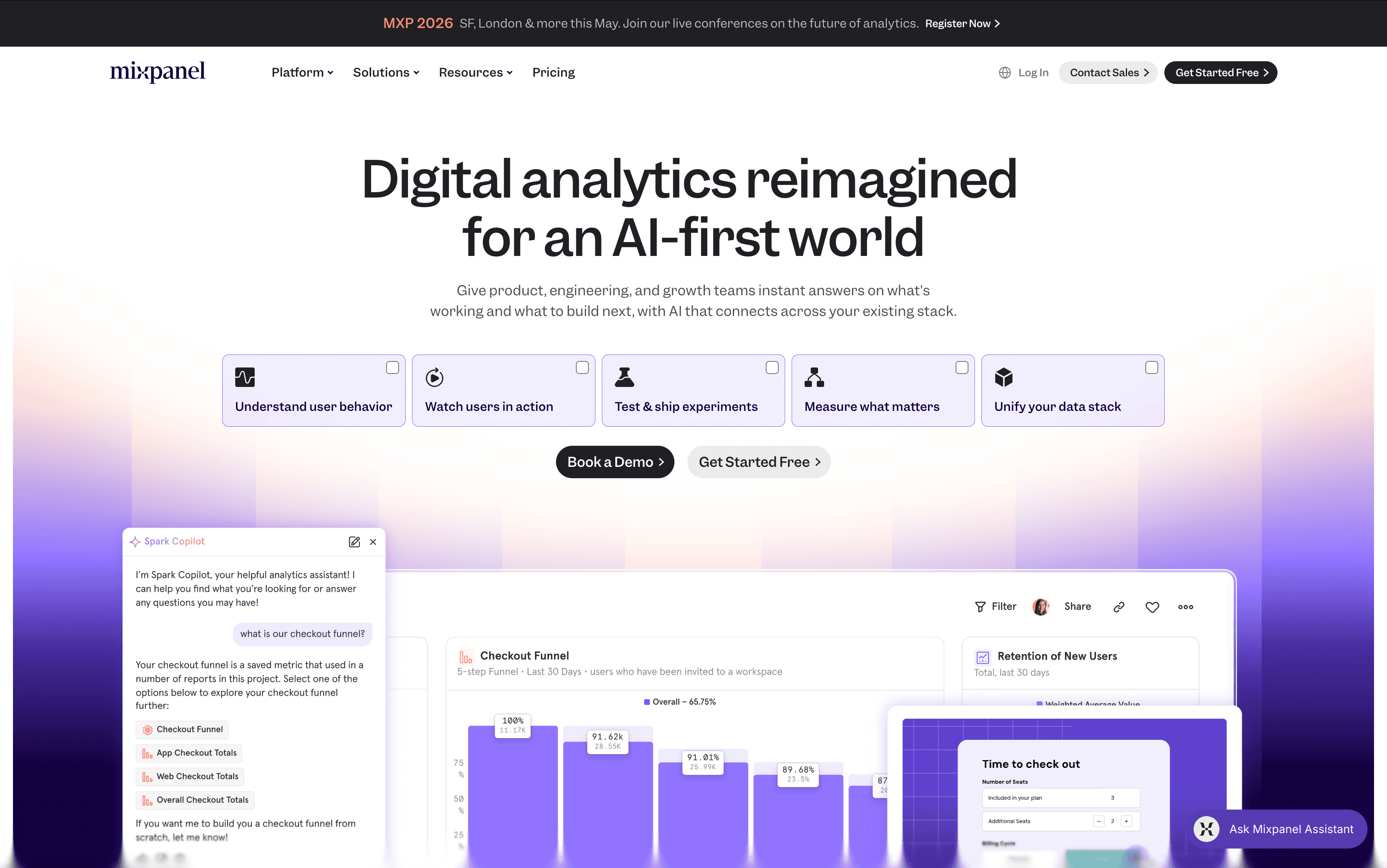
Event Tracking and Cohort Analysis
Mixpanel tracks every user action with properties and metadata. You can build cohorts based on behaviour, segment by any attribute, and analyse retention over time. The interface is intuitive for non-technical users.
Funnel Visualisation
Multi-step funnels show exactly where users drop off. You can compare conversion rates across segments, A/B test variations, and identify friction points in onboarding or checkout flows.
Established Ecosystem
Mixpanel integrates with hundreds of tools: data warehouses, CDPs, marketing automation platforms, and CRMs. If you are already using the modern data stack, Mixpanel fits in cleanly.
Enterprise Support
Dedicated account managers, SLAs, SSO, role-based access controls, SOC 2 Type II, and GDPR compliance. Large organisations with compliance requirements get what they need.
The Problem with Mixpanel
None of Mixpanel’s strengths disappear when you build a crypto product. But they also do not solve the fundamental problem: Mixpanel does not support wallets and onchain data without extensive custom integration.
In Web2, all meaningful user actions happen in the app. In DeFi, the most important conversion events happen onchain. A user swaps tokens on your DEX. They stake assets in your protocol. Mixpanel does not see any of this unless you instrument your key events manually and build custom data pipelines to capture blockchain events into your data warehouse.
The Engineering Cost of Using Mixpanel for Web3
To track smart contract events in Mixpanel, you need infrastructure that:
Indexes blockchain data for every chain your users interact with (Ethereum, Polygon, Base, Arbitrum, Solana)
Transforms raw transaction logs into human-readable, structured events Mixpanel can ingest
Builds and maintains ETL pipelines that update whenever your contracts change or you add new chains
Resolves wallet identity, since one user can control multiple wallets and this breaks retention and cohort accuracy
Third-party managed services can reduce the indexing and ETL burden, but you still need to configure events, structure data, and handle cross-chain identity. The engineering overhead is lower but not zero.
This is not a one-time setup. Every time you deploy a new smart contract, add a new chain, or change protocol logic, you need to update your data pipelines. For enterprise teams with dedicated data engineers, this is manageable. For early-stage teams, it is a costly distraction.
How Formo Works Differently
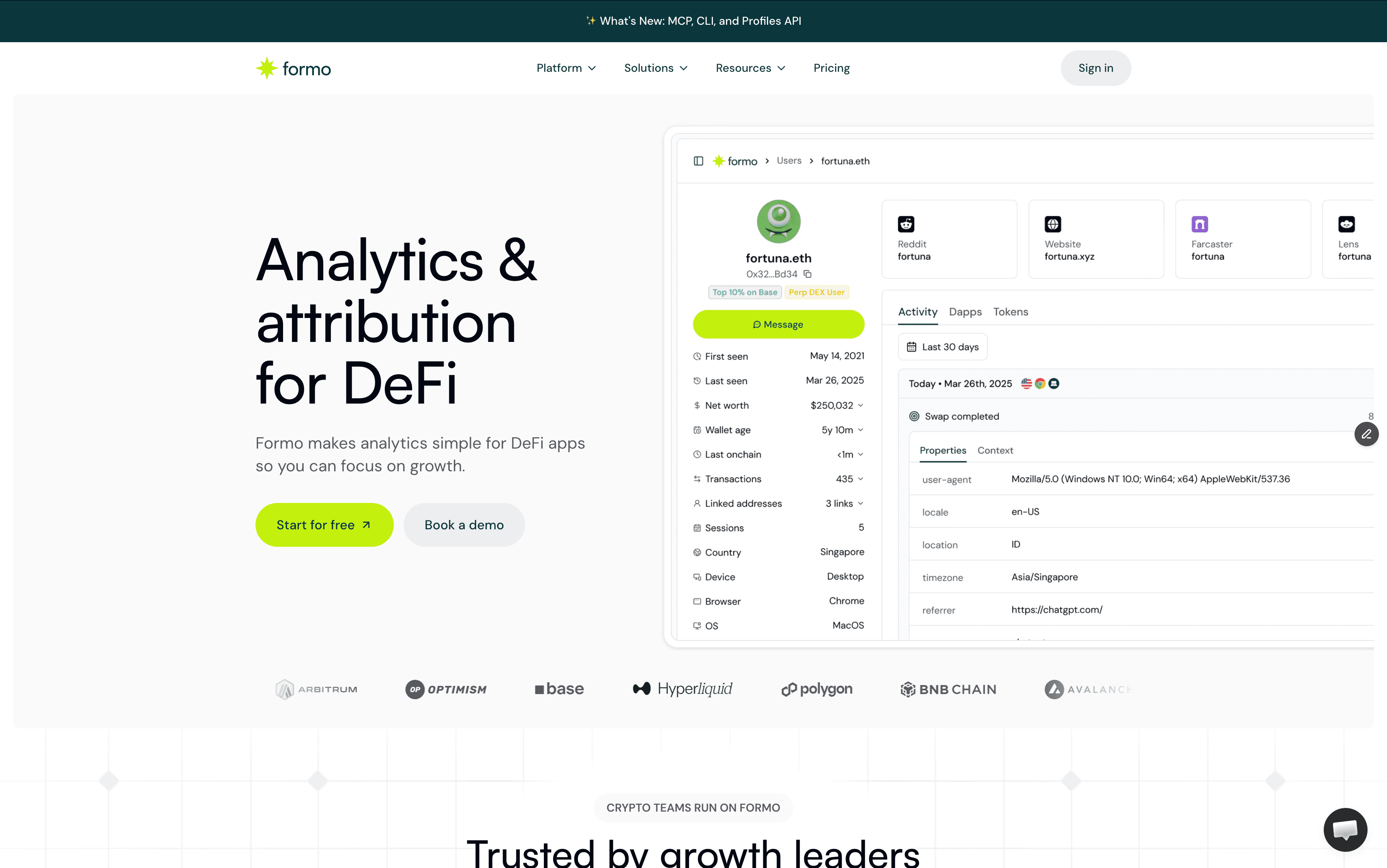
Formo was designed to solve the exact problem that Mixpanel creates for crypto teams: tracking user behaviour across both offchain and onchain touchpoints without custom engineering and complex infrastructure.
Native Onchain Data Support
Formo is an analytics and attribution platform for crypto product and marketing teams. Connect your smart contracts to measure product events, wallet connections, onchain transactions, token transfers, DeFi positions, wallet labels, and retention across all major chains on EVM and Solana.
Track which marketing campaigns drove the most wallet connections and onchain transactions, not just website visits
Segment users by token holdings, wallet age, transaction volume, or DeFi protocol usage
Build funnels that span offchain actions (page view, click) and onchain conversions (swap, stake, mint)
Measure retention based on actual wallet activity, not just app logins
Wallet Intelligence
Wallet intelligence is the practice of enriching a wallet address with onchain context: token balances, NFT holdings, transaction history, protocols used, chains active on, and estimated net worth. Formo includes wallet intelligence natively, turning anonymous addresses into actionable user profiles. Mixpanel requires custom enrichment logic to achieve anything comparable.
Onchain Attribution
Onchain attribution is the practice of connecting offchain marketing touchpoints (a Twitter ad, a Discord link, an influencer post) to onchain transaction outcomes. Formo tracks the entire journey: a user sees your ad, visits your site, connects their wallet, and completes a swap. You can attribute that transaction back to the original traffic source, proving ROI on marketing spend. Mixpanel requires manual setup to achieve partial versions of this.
No-Code Setup
Formo’s supported SDK and wallet integrations capture common page and wallet events; event coverage depends on the integration. Teams can add custom events for product-specific actions.
When to Choose Each Platform
✅ Choose Formo if… | ⚡ Choose Mixpanel if… |
|
|
When to Choose Mixpanel
You Have Dedicated Data Engineering Resources
Large crypto companies with established data teams often pipe blockchain data into their warehouse (Snowflake, BigQuery, Redshift), then connect Mixpanel and other tools to that central source. If you are already doing this, adding Mixpanel as a consumption layer is straightforward.
You Need Enterprise-Grade Compliance
If your organisation requires SOC 2 Type II certification, GDPR compliance documentation, BAA agreements, or advanced permissioning, Mixpanel delivers. Formo is building towards enterprise readiness, but Mixpanel has years of maturity in this area.
Your Onchain Activity Is Minimal
A simple NFT mint site might not justify a crypto-native analytics platform. If your protocol has minimal onchain complexity (one contract, one chain, straightforward events), the engineering cost of piping that data into Mixpanel is manageable.
When to Choose Formo
Onchain Attribution Matters
If you run marketing campaigns and need to prove which efforts drive actual protocol usage (not just website traffic but volume, revenue, and retention), Formo solves this out of the box. Traditional tools tell you which campaigns drove clicks. Formo tells you which campaigns drove wallet connections, transactions, and TVL.
You Need to Track Smart Contract Events
Contract events tracking ingests your smart contract events directly into Formo in real time. Token swaps, liquidity deposits, transactions and any event your contracts emit can be tracked alongside offchain web analytics in the same dashboard and queried in the same SQL environment. Mixpanel does not natively handle or ingest raw contract event streams.
You Need Wallet-Level Intelligence
If your growth strategy depends on understanding users at the wallet level (whales, airdrop farmers, genuinely engaged users), Formo provides this context natively. Building wallet intelligence into Mixpanel requires custom enrichment logic, API calls to blockchain data providers, and ongoing maintenance for a system that’s not your core competency.
You Want to Move Fast
Early-stage crypto teams need to prove product-market fit quickly. Formo gets you from zero to actionable insights in hours: connect your contracts, install the SDK, and start tracking immediately. No indexers, no ETL, no data engineering required.
Your Core Competency Is Product, Not Data
If your engineers should be busy building product features rather than maintaining analytics infrastructure, Formo removes the distraction. Product teams can set up analytics in less time and use fully self-serve dashboards without relying on data engineers to set up new events or troubleshoot complex indexing issues.
Pricing Comparison
Formo 7-day free trial
Mixpanel
Total cost of ownership note: Mixpanel requires engineering work to handle onchain data. Factor in the ongoing cost of building and maintaining blockchain indexers and ETL pipelines when comparing against Formo’s flat monthly fee. |
The Bottom Line
The choice between Formo and Mixpanel is not about which tool is objectively better. It is about whether you are optimising for Web3-native functionality or enterprise maturity, and whether you have the engineering resources to bridge the gap.
Choose Mixpanel if you have dedicated data engineers, need enterprise compliance features, or already operate a data warehouse that already stitches together blockchain and application data. The platform is mature, well-supported, and integrates with the broader data ecosystem, but you will need to build and maintain onchain data pipelines for it to be useful.
Choose Formo if you work in DeFi and need to move fast, want onchain attribution and wallet intelligence out of the box, or lack the engineering capacity to build custom data infrastructure. For most early-stage crypto teams, the engineering cost of adapting Mixpanel outweighs the benefits.
Stop flying blind on your onchain users. Formo combines product analytics, marketing attribution, wallet intelligence, onchain attribution, and retention in one platform. Teams can install Formo within 30 minutes and use a shared event taxonomy across their web and mobile products. What you get with Formo:
|
More in This Series
Evaluating your Web3 analytics stack? Read the other comparisons in this series:
Why GA4 falls apart when your user connects a wallet | Paid ads attribution vs. unified product & marketing analytics |
Crypto B2B intelligence vs analytics and attribution for DeFi | Full-stack analytics and attribution vs wallet-targeted paid acquisition |
Traditional product analytics vs Crypto-native product analytics | Crypto-native data platform vs. open-source product analytics |
DeFi analytics and attribution vs KOL analytics platform |
Frequently Asked Questions
Can Mixpanel track onchain transactions without custom engineering?
Mixpanel can receive onchain transactions when your team sends blockchain activity as custom events and properties. Your team must supply the blockchain data, wallet identity rules, and enrichment. Formo connects supported wallet activity, smart contract events, and onchain attribution within the same analytics workflow.
Implementation effort depends on the blockchain data and identity model your team already operates. Third-party data providers can reduce indexing work, while event mapping, identity rules, and ongoing maintenance remain part of the Mixpanel implementation.
What is wallet intelligence and why does it matter for DeFi teams?
Wallet intelligence enriches wallet profiles with supported balances, assets, labels, activity history, and other onchain context.
This context helps product and marketing teams segment users, understand user quality, compare cohorts, and identify high-value or at-risk users without maintaining a separate enrichment workflow.
Formo includes wallet profiles and wallet-based segmentation in the analytics workflow. Mixpanel can store wallet-related custom properties when your team supplies and maintains the enrichment data.
What onchain data does Formo track natively?
Formo supports wallet connection events, onchain transaction lifecycle events, configured smart contract activity, acquisition context, wallet intelligence, and onchain attribution.
Product and marketing teams can use wallet profiles, supported balances, assets, labels, and activity context in funnels, cohorts, dashboards, attribution, and retention analysis.
Formo connects supported activity across all major chains on EVM and Solana without separate product instrumentation for each chain. Product events, wallet relationships, and onchain outcomes can be analyzed in one reporting model.
How does Formo handle users with multiple wallets or across multiple chains?
Formo connects anonymous visitors, known users, and wallets, including multiple-wallet relationships when configured. Supported product and onchain activity across all major chains on EVM and Solana can be analyzed in the same user and wallet model.
Mixpanel supports configured user identity and custom properties. Wallet relationships and blockchain context must be defined and supplied by your team, while Formo models these relationships for crypto product and marketing analysis.
How do Formo and Mixpanel compare on pricing?
Formo Growth is $249/month billed monthly or $199/month billed annually; Scale is $499/month billed monthly or $399/month billed annually; Enterprise is custom. Every Formo plan includes unlimited events; Growth covers up to 5,000 MAUs and Scale covers up to 10,000 MAUs. Compare current features and limits on formo.so/pricing.
Mixpanel offers event-based free and paid plans. Confirm current included events, overages, and plan gates on Mixpanel’s official pricing page.
Implementation cost also depends on the blockchain data, event mapping, enrichment, and identity pipeline your team must supply. Include those requirements when comparing total cost.
Which platform is better for DeFi product teams?
Choose Formo when product analytics must include wallet identity, wallet intelligence, smart contract activity, marketing attribution, and onchain outcomes. Choose Mixpanel when mature behavioral product analytics is the primary requirement and your team will supply the blockchain data model.
Mixpanel is the better fit when blockchain is peripheral to the product rather than its core, when the team already has dedicated data engineers and a central warehouse that stitches together blockchain and application data, or when enterprise compliance requirements (SOC 2, HIPAA, BAAs) are non-negotiable and the team needs the compliance maturity Mixpanel has built over many years.
The practical decision rule: if the most important user actions in your product happen in smart contracts, you need a platform that treats those events as first-class data. Formo provides this by default. Mixpanel requires months of custom work to reach the same point.
Can I migrate from Mixpanel to Formo?
Yes. Install Formo alongside Mixpanel and run both while you validate event names, identity, and key conversions. New Formo data starts flowing after installation. Historical Mixpanel data does not transfer automatically, so keep any exports or reports you still need. After you reconcile definitions and totals, move the relevant reporting workflows to Formo.
See the full Formo vs. Mixpanel comparison.
Pricing reviewed 24 September 2026. Check Formo pricing and Mixpanel details before purchase; limits and prices can change.


