
Formo Analytics vs Google Analytics for Crypto: Features & Pricing

Key Takeaways
GA4 is widely used for high-level website and mobile app traffic, acquisition, and advertising reporting. Its product analysis is limited, and it has no native wallet identity, wallet intelligence, smart contract data, or onchain attribution.
Formo covers those core web and mobile reporting needs, then adds full product analytics, dashboards, BI, marketing and ads attribution, wallet intelligence, smart contract events, onchain conversion, revenue, and retention.
Choose Formo for crypto and DeFi apps. It is the more complete analytics and attribution platform for product and marketing teams.
GA4 can receive configured wallet and transaction events, but it does not natively join visitors, users, wallets, and blockchain activity.
Install Formo within 30 minutes and follow one journey from acquisition source to wallet connect, first transaction, funded wallet, and repeat transaction.
Google Analytics 4 is a common choice for high-level website and mobile app traffic, acquisition, and advertising reporting. Formo covers those needs and adds the product, wallet, and onchain analysis required by crypto and DeFi teams.
Formo is an analytics and attribution platform for product and marketing teams in crypto. It combines web and product behavior with wallet identity, wallet intelligence, onchain attribution, transactions, revenue, retention, dashboards, and BI in one platform.
This comparison explains what each platform is best at, why Formo is the preferred choice for crypto and DeFi apps, and how their identity, data, attribution, pricing, and implementation models differ.
Feature Comparison at a Glance
Capability | Google Analytics 4 | Formo |
Website and app analytics | Native high-level website and mobile app reporting | Native traffic, product, and attribution analytics across web and mobile |
User identification | First-party client ID, optional User-ID, and Google Signals where enabled | Anonymous visitor, user, wallet, and multiple-wallet relationships |
Product analytics, dashboards & BI | Limited event analysis, explorations, and connected reporting | Full funnels, cohorts, retention, custom charts, dashboards, and BI |
Smart contract events | Not supported natively | Native wallet and smart contract activity |
Attribution models | Web and mobile app attribution; no native onchain outcomes | Web, mobile, ads, wallet, and onchain attribution |
Revenue tracking | Ecommerce and configured revenue events | Wallet-level onchain revenue and transaction value |
Retention & cohorts | Configured web and app events | Product, wallet, and onchain cohorts |
Wallet intelligence | Not supported natively | Balances, assets, labels, DeFi activity, and public identity |
Chain coverage | Not applicable | All major chains across EVM and Solana |
Data retention | Plan-dependent retention | |
Privacy model | First-party client identifier, optional User-ID, and consent settings | Privacy-friendly first-party identifiers; no third-party advertising cookies or fingerprinting |
Pricing |
The Core Difference: Web Reporting vs Product and Onchain Attribution
GA4 and Formo are designed around different primary data models. GA4 starts with website and app traffic. Formo starts with the complete crypto customer journey across acquisition, product behavior, wallets, and onchain outcomes.
What GA4 Is Best At
GA4 is strong for high-level traffic and acquisition reporting, campaign analysis, Google Ads integration, audiences, web and app events, and standard ecommerce measurement. It also provides explorations, APIs, and BigQuery export. These capabilities suit traditional websites and teams centered on the Google advertising ecosystem.
GA4 offers some event analysis, funnels, and retention views, but it is not a full product analytics, wallet intelligence, and onchain attribution system. Wallet identity, blockchain activity, and onchain outcomes require a separate data model and additional implementation.
What Formo Is Best At
Formo covers high-level website and mobile app traffic, acquisition, campaign, and advertising reporting, then adds full product analytics for product and marketing teams in crypto. It connects anonymous visitors, known users, and wallet addresses with product behavior, wallet intelligence, smart contract activity, revenue, cohorts, retention, dashboards, and BI. It also includes onchain attribution connecting marketing touchpoints to transactions, and Revenue Per Wallet (RPW), the DeFi equivalent of LTV.
Follow one journey: first visit, acquisition source, wallet connect, first transaction, funded wallet, and repeat transaction. GA4 can capture the first stages and configured browser events. Formo connects every stage to the same product and wallet journey, including verified onchain outcomes.
Where GA4 Stops for Crypto and DeFi Apps

GA4 can accept custom events, including wallet-connect and transaction events sent from a site or server. It does not natively model wallet profiles, multiple-wallet relationships, token and DeFi activity, contract events, or onchain attribution. Those gaps matter when a product’s conversion and retention signals live onchain.
Identity and Consent
GA4 commonly uses a first-party client identifier and can also use an optional User-ID. Consent settings, browser restrictions, cleared storage, and device changes can affect continuity. Its identity model does not natively treat a wallet as a profile enriched with blockchain activity. When users switch devices, clear their cookies, or use privacy-focused browsers (as many crypto users do), GA4 can treat them as new visitors. This fragments your data and makes attribution unreliable.
Formo uses privacy-friendly first-party identifiers and connects anonymous visitors, known users, and wallets when the user takes an identifying action. This supports wallet-aware journeys without third-party advertising cookies or fingerprinting.
The Onchain Data Gap
A configured GA4 event can record that a wallet connected or that the application reported a transaction. GA4 does not natively validate the onchain outcome, enrich the wallet, join contract activity, or attribute blockchain revenue to the acquisition journey. Formo provides this crypto-native context as part of its analytics and attribution model, including onchain revenue and retention tracking. GA4 can measure interest (clicks, connects) and configured revenue events, but not verified onchain outcomes (wallet-level revenue, onchain retention, RPW). For DeFi apps, conversions happen onchain, not in the browser.
Implementation Scope
GA4 requires a tag or SDK plus an event plan. Wallet and onchain analysis also needs event mapping, a wallet identity strategy, blockchain data, and logic to reconcile browser events with confirmed outcomes. Formo packages these capabilities for crypto teams and can be installed within 30 minutes.
What Formo Adds Beyond GA4
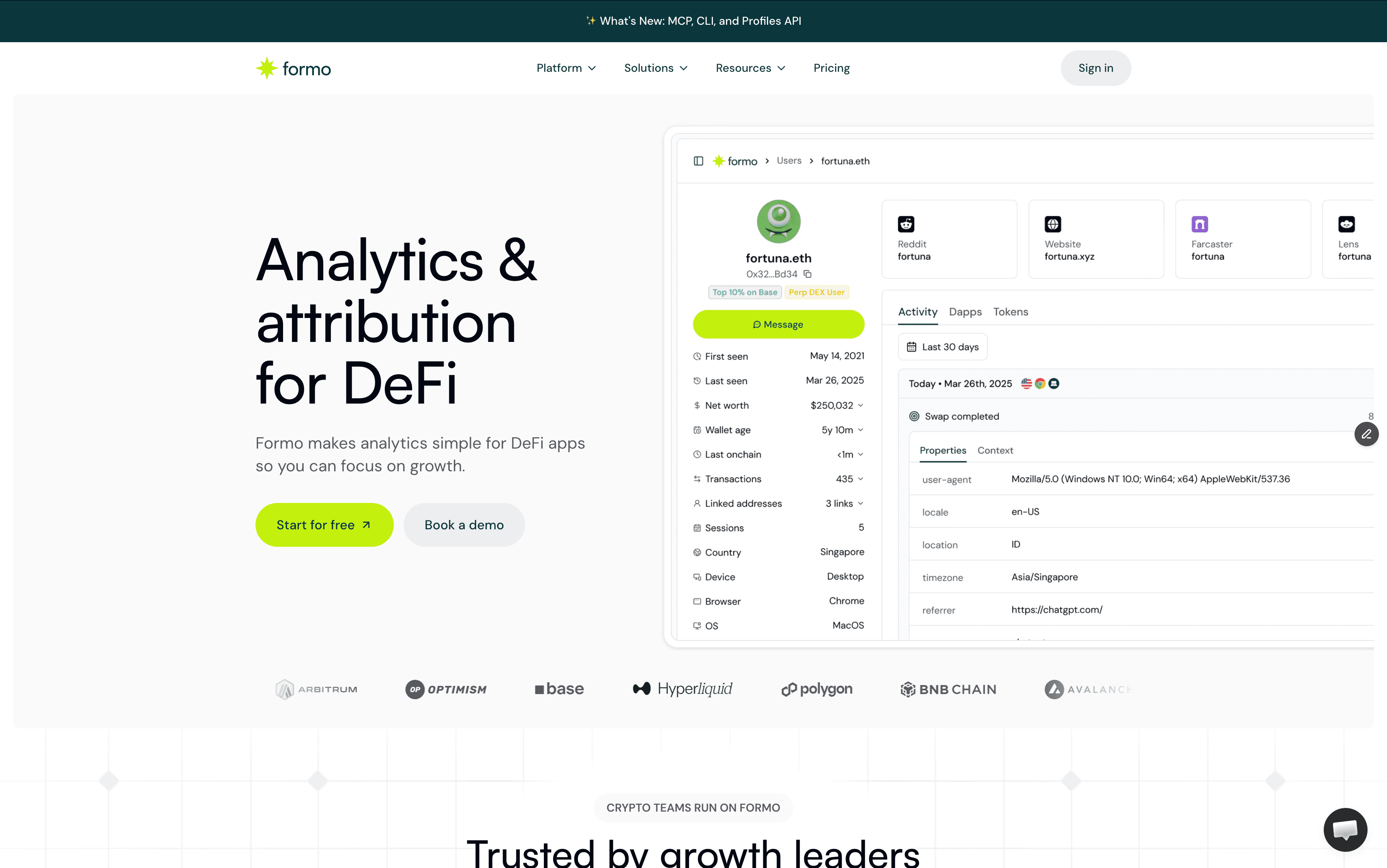
Wallet Intelligence
Formo turns wallet addresses into useful profiles with balances, assets, labels, DeFi activity, transaction history, and public identity where available. Product and marketing teams can use this context in funnels, cohorts, dashboards, BI, segmentation, and attribution. GA4 has no native wallet intelligence layer. Wallet intelligence surfaces net worth across chains, transaction frequency, DeFi protocol usage, token holdings, social handles, and wallet labels. GA4 has no equivalent capability to offer for DeFi teams.
Onchain Attribution
Formo connects acquisition sources and product behavior to wallet connects, transactions, and revenue. GA4 supports web and app attribution models, but it does not natively attribute blockchain outcomes or revenue to a wallet-aware journey.
Attribution totals can differ because the platforms use different identities, event definitions, conversion rules, time zones, attribution windows, consent settings, and data processing timelines. For onchain outcomes, failed transactions, bots or Sybil filtering, and indexing latency can create additional differences.
Revenue Per Wallet (RPW)
GA4 supports ecommerce and configured revenue events. Formo adds wallet-level transaction value and onchain revenue, so teams can compare acquisition sources by the wallets, volume, revenue, and repeat behavior they generate. RPW is the total onchain transaction value generated by a single wallet, equivalent to customer lifetime value (LTV). Formo helps you see which acquisition channels bring in the highest-value wallets by volume and revenue and how RPW changes over time. GA4 does not have onchain volume or wallet-level revenue tracking built in.
When to Choose Formo or GA4
✅ Choose Formo if | Choose GA4 only if |
|
|
Why Crypto Teams Choose Formo
Choose Formo for crypto and DeFi. It covers GA4’s high-level website and mobile app traffic, acquisition, and advertising reporting, then adds full product analytics, marketing attribution, dashboards, BI, wallet intelligence, smart contract activity, revenue, cohorts, and retention in one platform.
Pricing and Setup
Google Analytics 4
|
Moving from GA4 to Formo
If you currently use GA4, move the measurement plan first. Define the events and conversions that matter, map the GA4 events you want to preserve, and decide how wallet and onchain outcomes should be counted.
Install Formo: sign up, create a workspace, and add the Formo SDK. Installation takes 30 minutes or less.
Map the measurement plan: preserve the GA4 events and conversions that still matter, then define wallet and onchain outcomes.
Validate the transition: compare shared events using the same definitions, time zones, filters, and attribution windows.
Make Formo the source of truth: use one analytics and attribution platform for acquisition, product behavior, wallets, and onchain outcomes.
What about historical data? Formo does not currently support importing historical GA4 data, but you can export your GA4 data via the GA4 Data API and store it separately for reference. All new data from the point of migration is captured in Formo. |
Relevant Proof
“Exactly what I was missing while leading growth in DeFi. Using other tools with onchain data was clunky for analytics, especially in web3..”
Zachariah Zhang, Product Manager in DeFi
“Formo gave us valuable insight into our existing users - where they’re finding us, how active they are across DeFi, and social connections where we can reach them for feedback.”
Vince DePalma, CTO at Kairos Swap (a DEX on Base)
“Formo is a strong fit for startups with a relatively narrow budget - it can be launched quickly, is straightforward to use, and covers most core metrics without requiring a complex data stack.”
Will Fey, Founder at Ammalgam (backed by Lightspeed Faction and Framework Ventures)
Direct Verdict
Formo is the more complete choice for crypto and DeFi apps. It covers high-level website and mobile app traffic, acquisition, and ads attribution, then connects product behavior, wallets, and verified onchain outcomes. GA4’s native data model stops before wallet intelligence and blockchain attribution.
Choose Formo when product and marketing decisions depend on traffic, acquisition, ads attribution, product behavior, wallet identity, onchain conversion, revenue, retention, dashboards, or BI. Choose Formo if you are building onchain and your analytics need to extend beyond the wallet connect button, reaching the transactions, revenue, and retention that actually determine your protocol’s health.
Choose Formo for analytics and attribution. Formo connects acquisition, product behavior, wallet identity, wallet intelligence, transactions, revenue, and retention. Install within 30 minutes and give product and marketing teams one source of truth. What you get with Formo:
|
More in This Series
Evaluating analytics and attribution for crypto? Read the other comparisons in this series:
Product analytics, attribution, and wallet intelligence vs behavioral product analytics | Product analytics and onchain attribution vs acquisition attribution |
Product analytics, marketing attribution, and wallet intelligence vs current Safary offering | Product analytics, retention, and onchain attribution vs wallet-targeted paid acquisition |
Product analytics, marketing attribution, and wallet intelligence vs digital product analytics | Product analytics, marketing attribution, and wallet intelligence vs product engineering analytics |
Product analytics, marketing attribution, and wallet intelligence vs current Cookie3 offering |
Frequently Asked Questions
Can GA4 track wallet activity and onchain conversions?
Yes, through configured custom events. GA4 can record that the application reported a wallet connect or transaction, but it does not natively identify wallets, enrich profiles, verify blockchain activity, or attribute onchain outcomes. Formo handles this through onchain attribution.
How does identity work in GA4 and Formo?
GA4 commonly uses a first-party client identifier and can use an optional User-ID. Formo connects anonymous visitors, known users, and wallets, including relationships across multiple wallets. Learn more about privacy-friendly attribution.
What is Revenue Per Wallet (RPW)?
RPW is the onchain value associated with a wallet over time. GA4 can receive configured revenue events, but it does not natively calculate wallet-level onchain revenue. Learn more about RPW and Web3 monetisation.
How does Formo measure retention differently from GA4?
GA4 can analyze retention from configured web and app events. Formo adds product, wallet, and verified onchain activity, so teams can ask whether a wallet returned, transacted again, and generated additional value. Explore Formo’s retention analytics.
Which platform should crypto and DeFi teams choose?
Choose Formo. It covers GA4’s high-level website and mobile app traffic, acquisition, campaign, and advertising reporting, then adds full product analytics, dashboards, BI, wallet identity, wallet intelligence, and onchain attribution. See our Google Analytics alternatives guide.
Does Formo provide full product analytics, dashboards, and BI?
Yes. Formo combines full product analytics, marketing and ads attribution, funnels, cohorts, retention, custom charts, dashboards, BI, wallet intelligence, and onchain attribution in one platform for crypto product and marketing teams.
Why may Formo and GA4 report different totals?
Counts can differ because of identity rules, event definitions, failed transactions, duplicate events, bots or Sybil filtering, time zones, attribution windows, consent settings, and blockchain indexing latency. Compare the same conversion definition and reporting window.
Can I migrate from Google Analytics to Formo?
Yes. Install Formo alongside Google Analytics and run both while you validate event names, identity, and key conversions. New Formo data starts flowing after installation. Historical Google Analytics data does not transfer automatically, so keep any exports or reports you still need. After you reconcile definitions and totals, move the relevant reporting workflows to Formo.
See the full Formo vs. Google Analytics comparison.
Pricing reviewed 24 September 2026. Check Formo pricing and Google Analytics details before purchase; limits and prices can change.


