
How to Design a DeFi Ambassador Program (2026 Guide)

Key Takeaways
A well-designed DeFi ambassador program requires a three-layer attribution standard: wallet connect, first value-bearing onchain action, and retention at D7/D30/D90, enabling ROI measurement that wallet-count metrics cannot achieve because signups alone are trivially gameable by bots and farmers.
Unlike programs that reward follower count or raw wallet connects, attribution-based recruitment uses onchain history to distinguish DeFi-native ambassadors from broad-reach accounts with no protocol credibility, genuine activated wallets from mercenary capital that farms rewards and leaves, and micro-KOLs with focused audiences from macro-influencers with larger but shallower reach.
The five metrics that drive ambassador budget decisions are wallet connect rate, activation rate, cost per activated wallet, LTV by acquisition source, and retention cohorts at D7/D30/D90, all requiring a ref parameter tied to wallet activities rather than session or signup counts.
Six components of an effective program: conversion-based recruitment (screening wallet history and community embeddedness over follower count), a three-tier outcome-based incentive model, sybil resistance (minimum activity thresholds, self-referral filters, wallet clustering, payout delays), per-ambassador ROI reporting, cohort iteration against organic acquisition, and budget reallocation based on cost per activated wallet.
Effective programs treat the D30 retention "quality bonus" tier as the real safeguard against gaming, where a wallet that connects and makes a transaction once still counts as nothing until it retains.
Ambassador programs are one of the highest-cost, lowest-measured growth channels in DeFi. Protocols allocate token budgets, onboard community members, and track activity such as post counts. The question that should drive every program decision, whether ambassadors produced wallets that completed a first transaction and retained, goes unanswered.
DeFi ambassador programs are tricky to get right. Cohorts acquired through incentive programs in late 2025 retained worse than organic cohorts once rewards ended. Lido’s referral program saw suspicious abuse cases reach 60% by the third reward payout period, with 4.7M LDO paid out before the program switched to whitelist mode. A TS Finance analysis of Perpetual Protocol found that 22.8% of the 488 referral codes created since December 2021 were potentially self-referencing.
Both programs paid for actions that were easy to fake by bots and farmers. One solution is to only pay out on actions that correspond to real value from a provably human user.
This guide covers five steps to design a great DeFi ambassador program:
Why attribution matters: what “measurable” means, and why wallet counts are the wrong metric
Tracking infrastructure: the analytics stack you need before recruiting ambassadors
Recruitment: how to filter for and qualify ambassadors
Incentive design: how to tie payouts to activation and retention, with sybil defences
Reporting with Formo: the SQL queries, funnels, and dashboards for an ambassador program ROI report
As a rule, every referred wallet must be attributable to a specific ambassador, and your DeFi ambassador program’s cost must be justifiable against the volume, revenue, and LTV of the wallets it acquires.
Ambassador Programs Must Be Measurable
Most DeFi teams define “measurable” as wallet/signups per ambassador. That metric is gameable, as Lido discovered, and it conflates acquisition with activation and retention. A wallet that connects once and completes no meaningful actions produces no long-term value.
The attribution standard for a well-designed program has three layers:
Wallet connect attributed to a specific ambassador via the
refparameter: the acquisition signalFirst value-bearing onchain action from that wallet (a swap, deposit, or liquidity provision): the activation signal, and the first point at which the referral has real protocol value
Retention at D7, D30, and D90: the quality signal, separating sticky users from mercenary capital
Onchain attribution connects marketing campaigns to wallet activity, protocol revenue, transaction volume, and user retention. For an ambassador program, that means the ref parameter on every link is the thread that runs from a social post through to a swap, deposit, or liquidity provision event. Without it, the program produces counts. With it, it produces attribution data you can act on.
Key Metrics That Drive Ambassador Programs
Wallet connect rate: the share of sessions from an ambassador’s link that result in a wallet connect. This measures reach and audience intent. A high session count with a low wallet connect rate signals the ambassador is driving traffic from an audience without genuine intent to use the app.
Activation rate: the share of connected wallets that complete a first value-bearing onchain action, such as a swap, deposit, or liquidity provision. This is the audience quality signal. A high wallet connect rate paired with a low activation rate points to onboarding friction or a mismatch between the ambassador’s messaging and the app’s actual value proposition.
Cost per activated wallet: total ambassador spend divided by wallets that completed a first value-bearing onchain action. This is the DeFi equivalent of cost per conversion and the most direct ROI signal for budget allocation decisions.
LTV by acquisition source: which ambassadors bring wallets that deposit, swap, or provide liquidity repeatedly? LTV variance by acquisition source is the most important metric for scaling spend: channels that produce retained, high-value wallets justify higher spend per acquisition than those producing single-session depositors.
Retention cohorts at D7, D30, and D90: the quality signal that separates sticky users from mercenary capital. An ambassador whose referred wallets retain at D30 at a rate comparable to organic cohorts is building sustainable growth. One whose cohorts drop off after the first transaction is producing a temporary TVL spike.
With this standard defined, the next step is building the infrastructure that makes it measurable.
Step 1: Set up Attribution
Attribution infrastructure built after the program starts means months of referral activity with no attribution data. Build it first so you can measure what is working and what is not.
The minimum viable stack has two components:
Track Referral Links
Formo captures referrals and UTM parameters automatically when a user lands on your DeFi app, associating them with the session. When that user connects a wallet, the wallet address is linked to the session. When the wallet completes a transaction, the transaction is attributed back to the ambassador. You can attribute users, wallets, and transactions back to the referral.
Every ambassador gets a unique link in this format:
https://yourapp.xyz/?ref=ambassador_handle&utm_source=twitter&utm_medium=social&utm_campaign=ambassador_jun26
The ref parameter is the ambassador identifier. The UTM parameters identify the channel. Both are captured independently, so you can answer two questions: which ambassador drove this wallet, and from which platform.
Use the free UTM generator to generate correctly formatted links for your ambassador roster.
Track Key Events
Proper attribution requires at least three events tracked in sequence. Each one needs to be live before any ambassador link goes out:
Page views with
refand UTM parameters captured on landingWallet connect event linked to that session (the acquisition signal)
Conversion events such as transactions or deposits from the referred wallet (the activation signal)
Formo auto-captures page views, wallet connect, chain switch, transaction, and signature events alongside full attribution data. The SDK requires no manual event configuration for these core events. Custom contract events, such as a specific swap or deposit function, are supported through custom event tracking.
Step 2: Recruit Ambassadors by ROI, Not Follower Count
Follower count predicts reach. It does not predict ROI. The two are loosely correlated at best and frequently inverse: micro-KOLs with 10,000 to 100,000 followers generate engagement rates of 3 to 8%, compared to 1.2% for macro-KOLs with over 100,000 followers. Mid-tier KOLs with focused, niche audiences convert at 7% to wallet activation compared to 3% for macro-influencers.
The practical implication: a smaller audience that fits your target ICP trusts the ambassador’s protocol recommendations is worth more than a large audience that follows for price commentary.
What to Evaluate in Ambassador Candidates
Onchain activity. An ambassador’s wallet history is public. A wallet with meaningful activity across lending and liquidity provision signals genuine DeFi engagement. Ambassadors who use DeFi apps carry credibility with DeFi-native audiences that token holders without protocol usage do not.
Community embeddedness. The relevant question is whether the ambassador has genuine influence in a specific community, not how many platforms they post on. A moderator in an active trading Telegram group, a regular contributor to a governance forum, or a Farcaster channel host with consistent engagement all have something that a broad-reach X (formerly Twitter) account often does not: a specific audience that acts on their recommendations.
Content follow-through. Check whether the ambassador’s past protocol promotions generated engagement beyond the initial post. Replies, threads, follow-up questions from their audience, and evidence of community discussion are signals that their audience engages with protocol recommendations rather than scrolling past them.
Willingness to be paid on outcomes. This is the most direct filter. An ambassador confident in their ability to convert their audience will accept performance-based compensation. An ambassador who insists on a flat stipend regardless of wallet outcomes is signalling that they expect their audience not to convert at a meaningful rate.
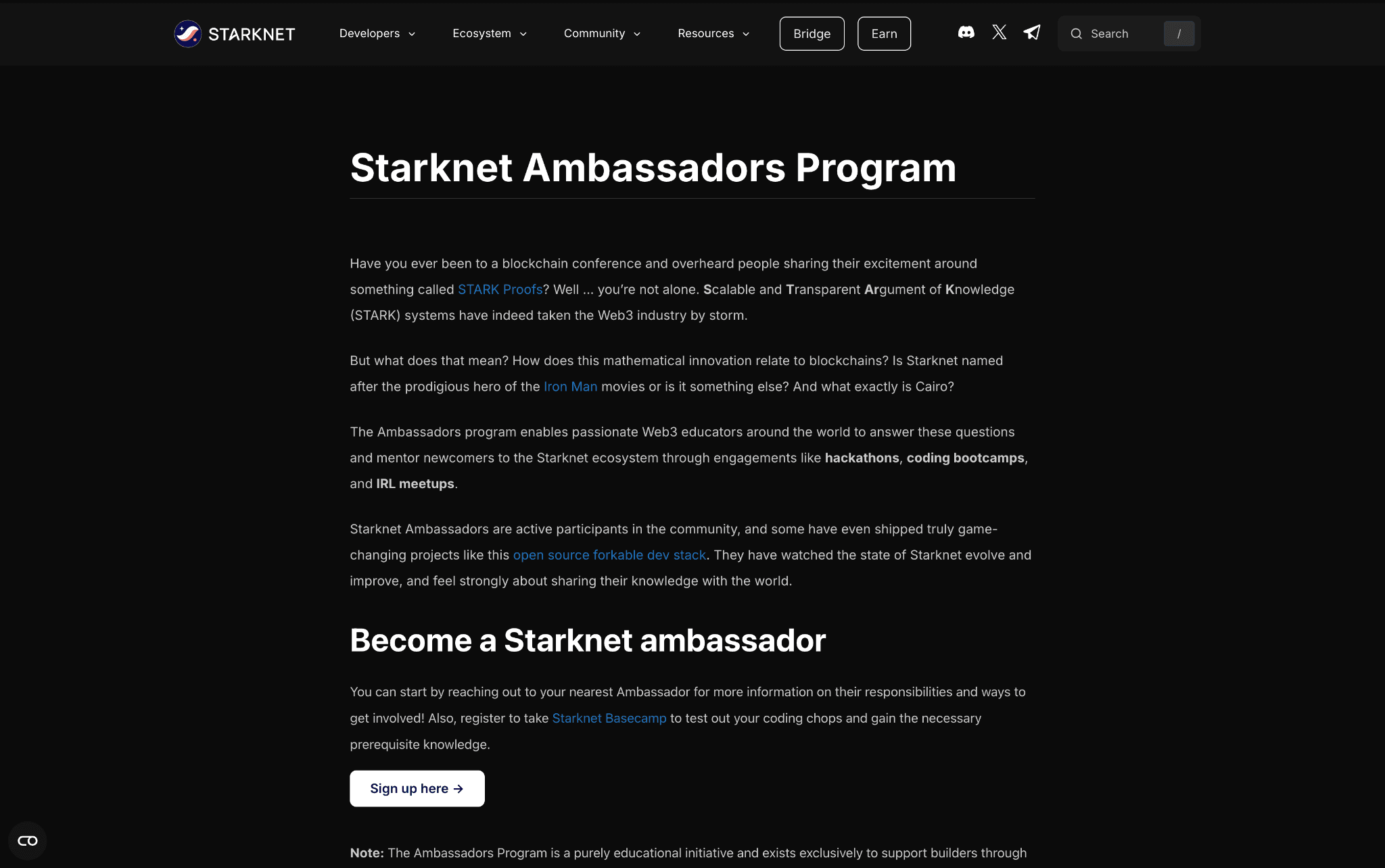
What this looks like in practice. Starknet’s ambassador program selects candidates based on demonstrated builder credentials: hackathon participation, coding bootcamp completion, and shipped open-source projects. The qualification bar is technical depth. The program produces developer-led IRL meetups, coding bootcamps, and hands-on mentorship for newcomers.
The Pre-Onboarding Checklist
Before issuing any referral link, verify each of the following:
Wallet history reviewed: active DeFi usage across lending, liquidity
Community role confirmed: moderator, contributor, or consistent presence in at least one high-signal community
Protocol knowledge verified: can explain your app’s mechanics and core value proposition
Performance-based incentive structure agreed: primary compensation tied to activated wallets or other key metrics
Step 3: Design Incentives That Reward Wallet Activation and Retention
The incentive structure is where most programs create their own measurement problem. Paying per wallet connect is gameable. Paying a flat monthly stipend disconnects reward from outcome entirely. Both produce the same result: a program that consumes budget without a reliable signal on whether that budget is producing real growth.
Both the Lido and Perpetual Protocol programs paid on actions that were easy to fake. The fix is to pay for onchain actions that correspond to real protocol value: completed swaps, deposits, or liquidity provision events matched to your app’s core interaction.
A Three-Tier Outcome-Based Model for DeFi Ambassador Programs
Structure ambassador compensation across three tiers, each tied to a progressively higher-value onchain action:
Tier | Trigger | Reward type | What it aligns |
Base | Referred wallet connects | Small fixed reward or points | Covers the ambassador outreach effort |
Performance | Referred wallet completes first value-bearing onchain action | Larger variable reward | Tied to actual protocol activation |
Quality bonus | Referred wallet is still active at D30 | Retention multiplier | Rewards bring in sticky users, not mercenaries |
The quality bonus tier is the most important. It directly penalises ambassadors who bring in airdrop farmers and rewards those who bring in wallets that generate sustained protocol revenue. Tie incentives to meaningful actions, such as completed swaps, deposits, or liquidity provision above a minimum size, rather than to signups alone. This approach discourages bot activity and ensures quality user acquisition.
Token vs. Stablecoin Rewards
Paying entirely in your protocol’s token attracts people seeking token exposure rather than people embedded in the communities you need to reach. A hybrid model works better: stablecoin for base rewards, token for quality bonuses. The stablecoin component signals a serious program; the token component creates upside for ambassadors who genuinely believe in the protocol’s trajectory.
How do real programs structure this?
1inch runs a 3-tier points system:
Ambassadors earn points through content creation and bringing new users
Tier level determines reward scale
The program includes a referral component alongside content engagement

Sommelier lists performance-based incentives alongside community moderation and content creation tasks.

Both illustrate the same design choice: mixing activity-based and outcome-based rewards in the same program. The attribution challenge this creates is separating which reward tier drove which wallet. Keeping the outcome tier distinct, with a separate ref parameter per ambassador, preserves the ability to measure each component independently.
Sybil Resistance
As of 2026, Sybil-resistant airdrops are now a standard use case for Web3 identity tooling because wallet farming at scale is a solved problem for bad actors. Ambassador programs face the same threat. The standard defences, applied at the analytics layer rather than requiring onchain enforcement:
Minimum activity threshold: a referred wallet must complete at least one value-bearing onchain action before the referral counts. Wallet connects have no cost floor; a swap or deposit does.
Self-referral prevention: filter the ambassador’s own wallet address from their referral count. This is straightforward to enforce in your attribution queries and is frequently missed.
Wallet clustering check: single-wallet attribution counts each address as a unique user. Wallet clustering, using shared funding sources, ENS handle, or common counterparties, is the only reliable way to identify coordinated farming activity. Flag clusters for manual review before processing payouts.
Payout delay: hold ambassador rewards until referred wallets have remained active for a defined period. The length of that window should match your app’s typical time-to-second-transaction. For a DEX with fast decision cycles, that may be a few days. For a lending app with longer consideration cycles, it may be two weeks. Formo’s funnel builder lets you set a conversion window per funnel step and measure the actual distribution of time between wallet connect and first transaction for your own users, so you can set payout delays based on real data rather than guessing.
Step 4: Measure Ambassador Program ROI with Formo
With tracking infrastructure live and incentives tied to outcomes, the reporting layer is what turns the program into a learning system. The core report is a per-ambassador performance table. It answers 5 questions:
How many referred wallets are connected
What percentage completed a first value-bearing onchain action
What percentage is retained at D30
What is the average wallet quality of their referrals
What is the cost per activated wallet
Formo provides three ways to build this report, depending on how much customisation you need.
Option 1: The Overview Referrals Chart
The fastest starting point. In the Formo dashboard, the Overview page’s Referrals chart shows visitors, wallet connects, transactions, and volume broken down by referral, referrer, UTM source, and other dimensions. For each referral and traffic source, you see:
Sessions: traffic volume from that source
Wallets: wallet connects to that source
Transactions: completed transactions from that source
Volume: total transaction volume in USD
Click any referral row to drill down into the list of wallets that came from that source. Filter by referrals to measure ambassador traffic and evaluate the ROI for each.
Option 2: Funnel with Referral Breakdown
For a more structured view of the ambassador conversion funnel, Funnels shows conversion rates at each step for each ambassador, so you can see exactly where referred wallets drop off: at the landing page, at wallet connect, or between connect and first transaction.
Each drop-off point has a different diagnosis:
High sessions, low wallet connect rate: the ambassador is driving traffic from an audience without genuine intent to use the app
High wallet connects, low first-action rate: the audience is DeFi-native, but onboarding has friction, or the ambassador’s messaging is creating wrong expectations about the app
High first-action rate, low D30 retention: the ambassador is bringing in mercenary capital, users who deposit or swap once to qualify for a reward and then leave
Option 3: Custom SQL in the Explorer
To get even more flexibility, use Formo’s Explorer to run SQL queries directly against your data. For example, the following query produces a per-ambassador performance table grouped by ref parameter:
Save this as a chart on your attribution dashboard. Schedule a weekly review.
Option 4: Wallet Quality Segmentation
Activation rate tells you whether referred wallets completed a transaction. Wallet quality tells you whether those wallets are worth acquiring at all. Wallet segmentation in Formo lets you filter referred wallets by net worth, lifecycle stage, DeFi apps used, token holdings, and in-app activity.
To segment referred wallets from a specific ambassador:
Go to Users in the Formo dashboard
Under Attribution, filter by
ref=ambassador_handleAdd a Net Worth filter to see the wealth distribution of their referrals
Add a Lifecycle filter to see how many are New, Returning, or Power Users
Add an Apps Used filter to see which protocols their wallets have used before
An ambassador whose referred wallets have a high average net worth and prior DeFi apps usage is producing higher-quality acquisition than one whose referrals are low-net-worth, first-time users, even if the raw wallet connect count is similar.
Sharing Data with Ambassadors
Ambassadors who can see their own performance data improve faster. Share a filtered, read-only view of their attribution data showing referred wallet count, activation rate, and estimated earnings.
To make it easy, Ask Formo generates these summaries in natural language: “Show me wallet connects and transactions referred by ambassador_alice in the last 30 days.”
Step 5: Iterate Using Cohort Data
Each program cycle produces data that sharpens the next one: tighter recruitment criteria, adjusted incentive tiers, and a clearer picture of which community types produce your best wallets.
Compare Ambassador Program Cohorts Against Your Other Acquisition Channels
Run a cohort analysis by acquisition source using Formo’s retention tracking. The 2 comparisons that matter most:
Ambassador program cohort vs. organic cohort. If ambassador-acquired wallets retain significantly worse, the incentive structure is attracting mercenary capital. Tighten the quality bonus criteria or raise the deposit threshold for the performance tier.
Ambassador cost per activated wallet vs. other paid channels. Calculate as: total ambassador spend divided by wallets that completed a first value-bearing onchain action. Compare against your cost per activated wallet from KOL campaigns, Discord promotions, and paid social. A program that is more expensive per activated wallet and retains worse needs structural changes before scaling.
Identify What Your Top Ambassadors Have in Common
After your first program cycle:
Segment ambassadors by activation rate and wallet quality
Look for shared traits among top performers: community type, content format, audience demographics, protocol knowledge depth
Use wallet segmentation to compare wallet profiles of top-ambassador referrals against lower-performing ones, filtering by apps used, net worth, and lifecycle stage
Use those patterns to sharpen recruitment criteria for the next cohort
When to Reallocate Budget
Set a performance threshold before the program launches and communicate it during ambassador onboarding. A workable basis:
Compare each ambassador’s cost per activated wallet against the program average after a full cycle
Ambassadors above the program average on cost per activated wallet and below average on D30 retention are candidates for reallocation
Communicating this standard upfront attracts ambassadors confident in their conversion ability and removes ambiguity from later budget decisions
The Attribution Dashboard to Maintain
The reporting infrastructure you build in Step 4 should stay live throughout the program. The minimum set of charts to maintain:
Per-ambassador funnel: sessions, wallet connects, first onchain actions, activation rate, broken down by
refparameterRetention cohort by source: D7, D30, D90 retention for ambassador-acquired wallets versus organic wallets
Wallet quality distribution: net worth and lifecycle stage of referred wallets by the ambassador
Cost per activated wallet by ambassador: total spend allocated divided by activated wallets, updated each payout cycle
Formo alerts notify you when a referred wallet above a net worth threshold connects or completes a deposit, so high-value referrals get immediate attention. These are the wallets worth prioritising for retention.
The DeFi Ambassador Program Launch Checklist
Run through this before onboarding any ambassador. Every unchecked item is a gap in your program’s ability to produce and measure referred wallets.
Tracking Infrastructure
Refparameter tracking is live and capturing ambassador identifiers automaticallyUTM parameters are configured for each ambassador’s primary channels
Wallet connect events are linked to sessions in your analytics layer
First transaction events are captured and attributable to the referral source
D7 and D30 retention queries are ready to run in the Explorer
Cross-chain bridge events are indexed if your protocol operates across multiple chains
Naming conventions are documented and distributed to all ambassadors before link generation
Recruitment
Wallet history reviewed for genuine DeFi activity
Community role verified: moderator, contributor, or consistent presence in a high-signal community
Protocol knowledge confirmed: can explain mechanics, not just the token
Performance-based incentive structure agreed upfront
Referral links generated via the UTM generator and tested before distribution
Incentives
Three-tier incentive model in place: wallet connect (base), first value-bearing onchain action (performance), D30 retention (quality bonus)
Sybil defences configured: minimum transaction threshold, self-referral filter, wallet clustering check
Payout delay window set and matched to your protocol’s typical time-to-second-transaction
Payout calculation methodology documented and shared with ambassadors
Reporting
The per-ambassador performance table lives in the Formo dashboard, scheduled for weekly review
Attribution funnel built with
refbreakdown: sessions, connects, transactions, activation rateWallet quality segmentation filter saved for per-ambassador analysis
Retention cohort chart configured to compare ambassador-acquired versus organic wallets
Alerts set for high-value referred wallets connecting or making transactions
Performance threshold defined and communicated to ambassadors during onboarding
Summary
A DeFi ambassador program designed around attribution improves with each cycle. Each cycle produces data that sharpens recruitment criteria, refines incentive tiers, and identifies the community types that produce your best wallets.
The DeFi apps that run effective ambassador programs treat them the same way they treat any other acquisition channel: with clear KPIs, regular performance reviews, and a willingness to reallocate budget based on what the data shows.
The difference between a program that consumes budget on nothing measurable and one that produces a consistent pipeline of qualified wallets is proper analytics and attribution.
If your program does not currently have analytics or attribution set up, fix that first. Without data, you are not running an attribution-based program. You are wasting your marketing budget without a clear ROI.
Measuring Ambassador Program Performance with Formo
Formo makes analytics and attribution simple for DeFi teams, so you can focus on growth. It helps you connect offchain referral activity to onchain wallet behaviour, giving growth teams a single place to define, measure, and act on your ambassador program workflow.
Capture every referral automatically. Formo’s SDK auto-captures
refcodes and UTM parameters on landing, then connects them to the wallet address at connection. No manual event configuration required for wallet connect, transaction, chain switch, or signature events. See the onchain attribution setup guide.Track the full funnel per ambassador. Build a page view to wallet connect to the first transaction funnel in Formo’s funnel builder, broken down by
refparameter. Conversion windows are configurable to match your protocol’s typical time-to-first-transaction.Segment referred wallets by quality. Once attributed, wallet profiles enrich each address with net worth, lifecycle stage, protocol usage history, and chain activity. Use wallet segmentation to compare referral quality across ambassadors, not just volume.
Query attribution data directly. Explorer gives you ClickHouse SQL access to your events table for the per-ambassador queries in Step 4. Ask Formo returns the same answers in natural language without writing SQL.
Set alerts on high-value referred wallets. Formo alerts notify you when a referred wallet above a net worth threshold connects or completes a transaction, so you can act on high-value referrals in real time.
For full setup instructions, see How to Set Up Marketing Attribution and Onchain Attribution in 2026: The Complete Guide for DeFi Teams.
Frequently Asked Questions
What is a DeFi ambassador program?
A DeFi ambassador program recruits community members to refer new users to an app in exchange for rewards. In an attribution-first design, each ambassador receives a unique referral link with a ref parameter, so every referred wallet is traceable back to a specific ambassador and measurable against activation and retention outcomes.
How do you measure the ROI of a DeFi ambassador program?
The 2 core metrics are cost per activated wallet (total ambassador spend divided by wallets that completed a first value-bearing onchain action) and LTV by acquisition source (how much referred wallets deposit, swap, or provide liquidity over time). Tracking both requires ref parameter attribution tied to wallet activities, not just wallet connects.
What is the difference between a wallet connect and an activated wallet?
A wallet connect is a user linking their wallet to your app. An activated wallet has completed at least 1 value-bearing onchain action, such as a swap, deposit, or liquidity provision. Wallet connects are easy to fake; onchain activations have a cost floor that filters out low-intent referrals.
How do you prevent sybil attacks in a DeFi ambassador program?
The standard defences are: requiring at least 1 value-bearing onchain action before a referral counts, filtering the ambassador’s own wallet address from their referral count, running wallet clustering checks on shared funding sources or ENS handles, and delaying payouts until referred wallets have remained active for a defined period. Sybil-resistant airdrops are now a standard use case for Web3 identity tooling for the same reason.
What UTM parameters should DeFi ambassador links include?
Every ambassador link should include ref (the ambassador identifier), utm_source (the platform, e.g. x, telegram, farcaster), utm_medium (social), and utm_campaign (a dated campaign identifier, e.g. ambassador_alice_jun26). Consistent lowercase naming and underscores as separators are required to keep attribution queries clean across the program.


