Robinhood Chain is now LIVE on Formo

Key takeaways:
Robinhood Chain is live on Formo. Track users, funnels, and onchain events across the chain.
The chain launched on 1 July 2026 and reached $305M+ TVL and 1M+ weekly active addresses within its first month.
Formo gives builders on Robinhood Chain a unified view of offchain traffic and onchain activity, from first pageview to first transaction.
The real story in the data: early analysis showed that only 1.7% of those new addresses had interacted with DeFi protocols before arriving on Robinhood Chain.
Because Robinhood Chain’s users skew toward retail rather than experienced DeFi participants, wallet profiling is particularly useful.
Formo now supports Robinhood Chain, the Ethereum Layer 2 built for tokenised equities, ETFs, and real-world assets. Teams building apps on Robinhood Chain can now track users, measure funnels, and attribute growth with Formo's unified analytics platform.
What is Robinhood Chain?
Robinhood Chain is a financial-grade Ethereum L2 built on the Arbitrum Nitro stack by Robinhood Markets. It settles to Ethereum mainnet, uses ETH as the gas token, and produces blocks roughly every 100ms. The chain is fully EVM-compatible, which means existing Solidity contracts deploy without changes.
What sets it apart from most new L2s is the ecosystem it launched with. Robinhood has already tokenised hundreds of US equities and ETFs, and those assets are native to the chain. Uniswap, Morpho, and PancakeSwap were live at launch. Chainlink provides oracle feeds and cross-chain data.
Key technical specs
Spec | Detail |
Stack | Arbitrum Orbit + Nitro |
Settlement | Ethereum mainnet |
Block time | ~100ms |
Gas token | ETH |
EVM compatibility | Full |
Account abstraction | ERC-4337 (smart wallets, bundler APIs) |
Cross-chain | LayerZero, Chainlink CCIP |
The chain opened to the public on 1 July 2026 and moved fast. Within 11 days, it had attracted 492,793 new addresses. By 22 July, TVL had climbed to $305M with weekly active addresses surpassing 1 million. Cumulative DEX volume crossed $9 billion within the first three weeks.
The real story in the data: early analysis showed that only 1.7% of those new addresses had interacted with DeFi protocols before arriving on Robinhood Chain. That is a meaningful signal. The chain is pulling in a genuinely new cohort of users, not recycling existing DeFi wallets. For builders, that means the analytics question shifts from "how do we retain our existing users?" to "how do we activate users who have never used DeFi before?"
Why analytics matters more on Robinhood Chain
Most L2s launch into an existing DeFi user base. Robinhood Chain is different. Its users are arriving from a retail brokerage context, many of them interacting with onchain apps for the first time. That creates a specific set of analytics challenges that generic tools are not built to handle.
The activation gap
The early data makes the challenge concrete. Of the 492,793 addresses that joined Robinhood Chain in its first 11 days, only 1.7% had prior DeFi activity. Compare that to the 20.6% historical baseline across established protocols. These users know how to buy stocks. They do not necessarily know how to bridge, swap, or interact with a lending protocol.
For product teams, that gap between arrival and meaningful onchain activity is the core problem to solve. You need to know:
Where users are dropping off between your landing page and their first transaction
Which acquisition channels are bringing users who actually activate, versus those who browse and leave
How long activation takes for this cohort, and what in-app behaviour predicts it
Which wallet profiles correlate with higher LTV on a tokenised-equity platform
None of those questions are answerable with TVL dashboards or raw transaction counts alone.
The measurement problem
Robinhood Chain's user base sits at the intersection of two data worlds. They arrive via offchain channels (search, social, referral) and interact via onchain transactions. Traditional web analytics stops at the wallet connect. Onchain analytics starts there. The gap between the two is where most teams lose visibility.
Formo bridges that gap. By tracking both the offchain journey (UTM source, page views, session behaviour) and the onchain events (wallet connections, contract interactions, transaction values), builders get a complete picture of how users move from first visit to first trade on tokenised equities.
What you can measure with Formo on Robinhood Chain
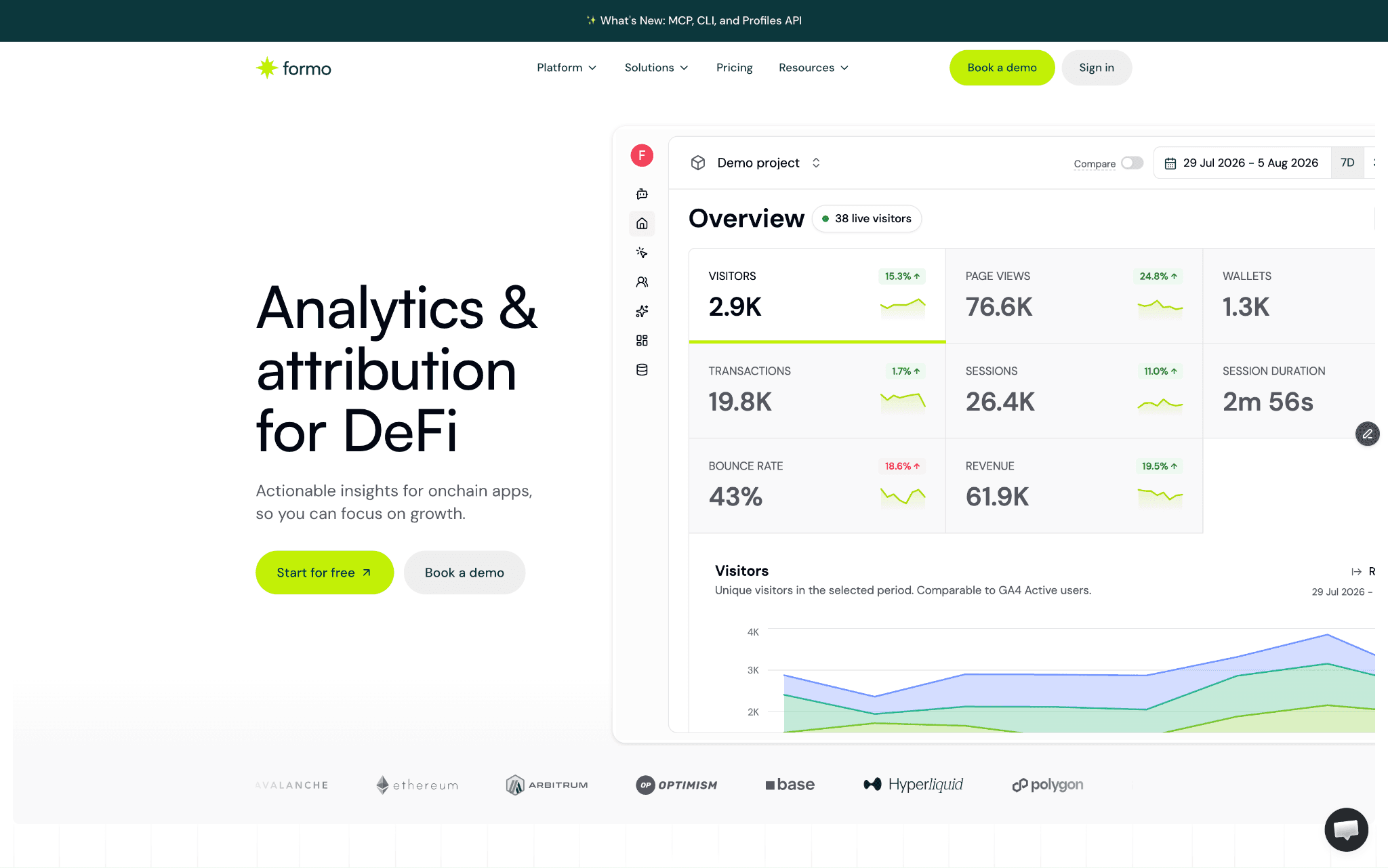
Formo's SDK tracks events across your app and connects them to onchain activity on Robinhood Chain. Here is what that unlocks in practice.
Product analytics
Track the full user journey from first pageview to first onchain transaction. Formo auto-captures wallet connections, page views, and custom events, so you can build funnels without manual tagging for every step.
DAU, WAU, MAU broken down by wallet activity level
Funnel analysis from landing page to wallet connect to first trade
Retention cohorts showing whether users who interact with tokenised stocks return within 7 and 30 days
Custom events for specific interactions, such as viewing a stock token page, initiating a swap, or completing a lending position
Onchain attribution
Robinhood Chain is attracting a new cohort of users from offchain channels. Onchain attribution connects the UTM parameters from your marketing campaigns to the wallet addresses that eventually transact. You can see which channels drive users who activate, not just users who arrive.
This matters because a channel that sends 10,000 visitors but zero wallet activations has a very different value from one that sends 500 visitors and 200 activations.
Wallet intelligence
Because Robinhood Chain's users skew toward retail rather than experienced DeFi participants, wallet profiling is particularly useful. Formo's wallet intelligence layer enriches each address with:
Cross-chain activity history (to understand prior DeFi exposure)
Net worth and token holdings
Social identity connections (Farcaster, ENS, etc.)
Segment membership based on behaviour in your app
This lets you identify which users are genuinely new to DeFi versus which ones migrated from other chains, and tailor onboarding flows accordingly.
Real-time alerts
Set alerts for high-value events: a wallet connecting for the first time, a user completing their first stock token trade, or a whale depositing into a lending pool. Alerts let your team respond in real time rather than discovering patterns days later in a dashboard.
Getting started
Adding Robinhood Chain analytics to your app takes a few minutes. Install the Formo SDK, connect your project, and Formo begins tracking wallet connections and page events automatically. Contract events for Robinhood Chain are available via the contract events pipeline in your project settings.
Setup steps
Install the SDK via npm or CDN into your app
Create a project in your Formo dashboard and copy the project key
Add Robinhood Chain in your project's chain settings (chain ID: 4663)
Subscribe to contracts in the contract events pipeline to ingest onchain events
Build your first funnel connecting offchain entry points to onchain conversions
Full documentation is available at docs.formo.so.
Robinhood Chain is live in Formo today. Get started or book a demo to see how it fits your stack.


