
Power Users vs Dormant Users in DeFi: How to Identify and Retain Them (2026 Guide)

Key Takeaways
Power users and dormant wallets look identical in aggregate metrics like wallet counts, TVL, and DAU, but Formo’s lifecycle model defines a power user as a wallet active on at least 5 distinct days in the last 30, while dormancy splits into 3 distinct subtypes, each requiring a different response, enabling retention decisions that aggregate reporting cannot support.
Unlike a single re-engagement broadcast, effective diagnosis distinguishes mercenary capital that rotates out when a competing app offers better yield from genuine product churn, wallets that never activated despite active positions elsewhere from users who converted once and went quiet, and dormant whales worth manual outreach from casual wallets that swapped $200 once, since Binance Research found average DeFi retention sits at just 5.4%.
The onchain signals that identify genuine power users are transaction frequency, multi-feature engagement, unprompted return outside incentive campaigns, active position management, and cross-app activity, all requiring wallet-level tracking.
Four churn patterns demand four different fixes: mercenary capital needs a product-value case independent of APY, exploit-triggered withdrawal needs trust repair before outreach, weak product adoption needs onboarding rebuilt as retention infrastructure, and competitive pressure needs product and fee improvements before re-engagement, since Sushiswap’s vampire attack pulled $840 million from Uniswap in two weeks and no single broadcast message could have addressed all four causes.
Effective retention treats the intervention window as narrow, typically 2 to 3 weeks of declining activity before a power user goes fully dormant, and treats dormant whales as requiring personalised, human outreach rather than automation, since an automated sequence sent to a wallet responsible for $500k in historical volume signals the app doesn’t know who its best users are.
Two groups of users exist inside every DeFi app. Power users are actively making transactions, opening the biggest positions, and generating the majority of fees. Dormant users signed in once and never returned.
Use retention analysis to compare lifecycle segments and measure repeat activity over time.
Aggregate metrics make both groups look the same. Wallet counts, TVL, and DAU blend power users with dormant wallets, producing headline numbers that overstate product traction and obscure where the most value and activity are concentrated.
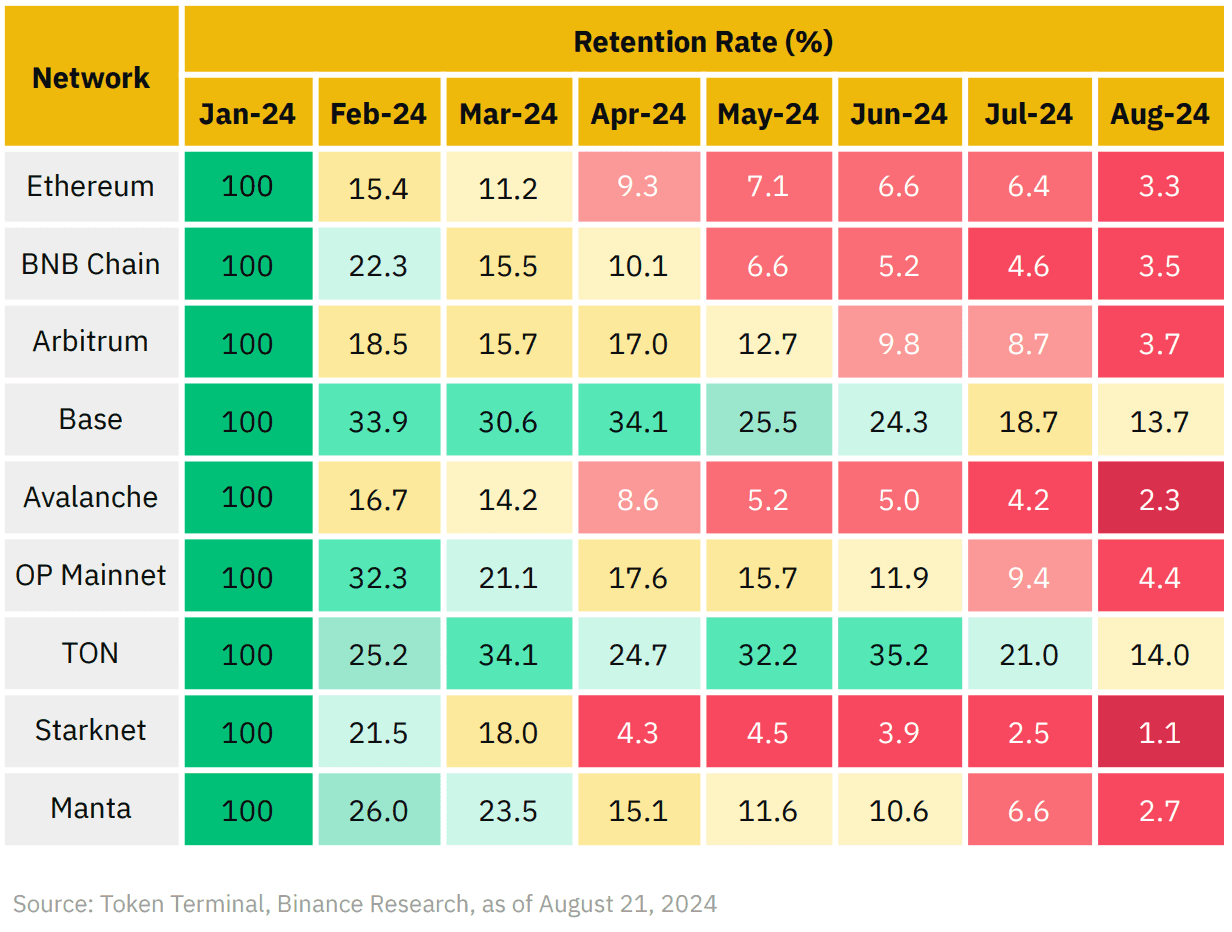
Binance Research's August 2024 Web3 Adoption Report reported an average retention rate across DeFi networks of 5.4%, with the vast majority of users churning after their first session.
This playbook covers:
Why wallet counts misrepresent DeFi app health, and which signals replace them
How to identify power users using the specific onchain signals that separate genuine high-value participants from passive holders
How to classify dormant wallets across 3 distinct subtypes, each with a different cause and a different response
What to do with each segment, including concrete retention tactics for power users and diagnosis-first re-engagement for dormant wallets
The gap between those 2 user segments is where most DeFi growth strategies are won or lost.
Why DeFi Users Go Dormant and Churn
Dormancy has 3 distinct causes in DeFi. Each one requires a different response. Running the same re-engagement campaign across all 3 is the most common mistake growth teams make.
Pattern 1: Incentives attract mercenary users
Points, quests, token rewards, and airdrop speculation can rapidly drive user acquisition, but they also attract incentive-driven users who are more interested in collecting rewards than becoming long-term users. People optimize for the incentives they're given. If a campaign rewards wallet activity more than meaningful product adoption, users will maximize transactions instead of genuine engagement. And if the product offers no compelling reason to return after the rewards are gone, retention will quickly collapse.
Even without airdrops or points, yield is the primary acquisition lever in DeFi. Capital enters when the yield advantage is strong and rotates out when a competing app offers better economics. This is the most common churn pattern in DeFi and the most frequently misread.
DL News' State of DeFi 2025, drawing on DeFiLlama data, reports that yield-bearing stablecoins grew from $9.5B at the start of 2025 to over $20B, with sUSDe, BUIDL, and sUSDS attracting the bulk of inflows as users rotated toward higher-yielding alternatives. Capital in DeFi follows yield spreads, not product loyalty.
The signals: Cross-reference your app's transaction cadence against reward program dates. Transaction volume that spikes during high-reward and high-APY periods and falls when yields normalise points to mercenary liquidity, where the app captured capital rather than users.
Pattern 2: Security and exploit-triggered withdrawals
Exploits, smart contract vulnerabilities, and contagion fears trigger rapid withdrawal events. Apps with no direct exposure face outflows as users reassess system-wide risk. According to Immunefi's Ecosystem Vulnerability Scoreboard: 6 Years of DeFi Loss Data, a single exploit involving bad debt on Aave triggered $13B in DeFi TVL withdrawals within 48 hours.
Trust repair and credible operational communication are prerequisites before any re-engagement outreach. A campaign launched before trust is restored accelerates outflows.
The signals: Wallet inactivity that clusters within 48 to 72 hours of a security event, either on your app or across the broader ecosystem, points to exploit-triggered churn. Check whether the timing correlates with a specific incident rather than a gradual trend.
Pattern 3: Lack of Product-Market Fit (PMF)
High acquisition cannot compensate for a product that doesn't solve an ongoing user need. A wallet connection, token swap, bridge, or stake may bring someone into your app once, but it doesn't mean your product has earned a place in their financial routine.
The strongest Web3 products are built around recurring financial jobs. Users return because they need to move money, earn yield, manage collateral, track portfolios, trade efficiently, access liquidity, protect assets, or automate repetitive actions. The product becomes part of a habit, not just a campaign.
Stablecoins are a good example. Andreessen Horowitz's 2025 State of Crypto report highlights stablecoins as one of the clearest signs of crypto's maturation alongside growing institutional adoption and broader onchain activity. Stablecoins have strong retention because they support recurring behaviors such as payments, transfers, remittances, savings, treasury management, settlement, and yield allocation. Users come back because the product continues to solve the same problem every day.
Poor product-market fit often becomes visible after incentives end. Users may initially arrive because of points, token rewards, or airdrop speculation, but if the product doesn't provide lasting value, they have little reason to return. The campaign generates activity, while the product fails to generate habits.
Poor product-market fit can also stem from a lack of user understanding. This is common in DeFi and yield products, where users join because of attractive APYs, influencer recommendations, or market hype without fully understanding how the protocol works. When volatility increases, rewards fall, or risks become apparent, many users leave because their conviction was built on the campaign rather than the product itself.
Education is therefore not just a marketing function. For financial products, it's part of product-market fit. Users who understand how a protocol creates value, the risks involved, and why it remains useful in different market conditions are far more likely to become long-term users than those who joined solely for incentives.
The signal: A widening gap between activation and retention. Users successfully reach the activation event, but very few return to complete a second transaction, start another session, or engage with the product again. The activation funnel works, but the product fails to generate repeat behavior.
Pattern 4: Competition and markets
When fees fall behind competitors, users don't leave all at once, they thin out. And in DeFi, that thinning can happen fast.
Capital in DeFi rotates faster than most retention models account for. When a competing app launches superior incentives, liquidity and network effects moves before any retention campaign can respond. Liu, Chen, and Zhu's analysis of the Uniswap/Sushiswap vampire attack found that Sushiswap pulled $840 million in deposited liquidity from Uniswap within two weeks, against Uniswap's pre-attack base of $185 million.
The current lending market reflects the same concentration dynamic. DeFiLlama shows total lending TVL at $37.8 billion, with Aave holding 34% ($12.7 billion) and Morpho 18% ($6.9 billion). Capital concentrates where liquidity depth and fee structures are strongest.
The signals: gradual wallet inactivity spreading across weeks with no correlation to a specific event, combined with position reductions rather than full exits.
Cross-reference the timing against your fee schedule and competitor rate changes: position reductions that track a fee increase on your side or a rate cut from a competing protocol point to fee compression and competitive liquidity migration.
How to Address Churn in DeFi
Churn patterns | Root cause | Right response |
Incentives attract mercenary users | Yield advantage compressed | Make the product-value case independent of APY |
Security exploit-triggered withdrawal | Trust breakdown | Trust repair and operational communication before outreach |
Lack of Product-Market Fit | Low feature adoption and insufficient product understanding at onboarding | Redesign onboarding around recurring use cases and build education as retention infrastructure |
Competition and markets | Fee compression and competitive liquidity migration | Product and fee structure improvement before re-engagement outreach |
Before running any re-engagement campaign, identify which pattern applies. A single broadcast to all dormant wallets conflates 4 different problems and reduces the credibility of each message.
With the four churn patterns established, the next question is how to see them in your own data, starting with why aggregate metrics hide the split between power users and dormant wallets in the first place.
Why Active Addresses Can Mislead Growth
A headline wallet address count mixes together active participants and wallets that signed in once and left. Both are distinct groups of users, but aggregate metrics such as total wallets, DAU, and TVL treat them as one unit.
Tracking at the wallet level tells a different story than aggregate counts.
Tracking activity of individual wallets may reveal that a small cohort accounts for the bulk of inflows, while the majority of dormant wallets never engage in anything meaningful. Aggregate reporting obscures the root cause behind the who and why.
Retention measurement compounds the problem.
Retention in DeFi requires a user to return and complete another meaningful action (transactions, deposits, swaps). Retention is measured by repeat transactions, not repeat visits. Segment analysis only works when the underlying definition of "active" reflects genuine engagement.
How to Identify DeFi Power Users: The Onchain Signals That Matter
Power users are not simply your highest-balance wallets. Just looking at wallet net worth conflates 2 distinct profiles: active participants and passive holders who signed in once and parked their assets.
This section explains other metrics and approaches for identifying the power users in your DeFi app or protocol.
User Lifecycles
In Formo's user lifecycle model, a power user is defined as a wallet first seen more than 30 days ago that remains active and has been active on at least 5 distinct days in the last 30.
That threshold is configurable per app from Settings > Lifecycle, because the right definition of "active" varies by product type. A DEX where daily activity is normal has a different power user threshold than a lending app where positions stay open for weeks.
User Behaviour
Beyond user lifecycles, the behavioural signals that distinguish genuine power users from passive holders are:
Transaction frequency: Multiple transactions per week. Daily wallet activity is the strongest single signal.
Multi-feature engagement: Activity across more than one product surface. A wallet that only swaps is less embedded than one that swaps and provides liquidity.
Unprompted return: Transactions that occur outside of incentive campaigns. This is the clearest test of genuine retention versus reward farming.
Position management: Active rebalancing of liquidity, topping up lending health factors, or adjusting staking positions. These actions signal ongoing economic commitment.
Cross-app activity: Power users in DeFi typically interact with one or more apps monthly. Cross-chain activity on the same app indicates loyalty rather than opportunism.
In Formo's Users page, filter by Lifecycle = Power User to see your current cohort of power users.
For a more precise behavioural segment, use the Behavioural Segments feature. The docs give a concrete example: "Users who connected their wallet and made a transaction more than 3 times in the last 30 days."
You can cross-reference that segment against incentive campaign dates to isolate wallets that submit transactions at a consistent frequency regardless of whether a reward program is running.
Wallet Concentration by Volume and LTV
The OECD's April 2024 analysis of Uniswap v2, v3, and Curve found that 20% of liquidity pools account for more than 90% of trading volume, with the majority of liquidity providers concentrating in a small number of high-activity pools. The same pattern appears at the wallet level: a core cohort of active wallets drives the bulk of fee-generating transactions, while the wider wallet base contributes intermittently or not at all.
Losing a single power user carries an LTV impact orders of magnitude larger than losing a casual user, because revenue, liquidity contribution, and referral effect are not evenly distributed across the wallet base.
The DeFi user segmentation framework that separates power users, core users, and dormant wallets makes this concentration visible and actionable.
At-Risk or Churned Power Users
Within the power user cohort, users with high historical activity that show a declining trend warrant specific attention. Formo surfaces these automatically as the At Risk lifecycle stage: users last seen at least 14 days ago, with fewer than 5 active days in the last 30, that had at least 1 active day in the prior 30 to 60-day window. Users who were last seen more than 30 days ago are considered churned.
Warning signs at the wallet level include:
Transaction frequency falling over consecutive 7-day windows
Position sizes are shrinking without a corresponding market movement
The window for proactive retention is narrow: typically 2 to 3 weeks of declining activity before a wallet goes fully dormant. Intervention at that point costs far less than re-acquisition after the wallet has gone cold.
How to Identify Dormant Users in DeFi
Dormant wallets are not a monolithic group of users. Here are 3 different types of dormant users in DeFi:
Wallets that never activated
These wallets were signed in but recorded zero transactions. They are active DeFi participants who did not complete the first action on your app.
Key question: is this wallet active elsewhere?
In Formo, the Apps tab on a wallet profile shows a wallet's DeFi positions across all major chains. A never-activated wallet with active positions on Aave, Uniswap, or Lido is an active DeFi participant who did not convert on your app. That points to onboarding friction as the cause, not a lack of intent.
Previously active, now dormant
These wallets completed at least 1 transaction but have been inactive for 30 days or more. They understood the product well enough to use it, which makes them fundamentally different from never-activated wallets. The churned active cohort is the highest-value re-engagement opportunity in most DeFi apps because prior usage confirms the conversion barrier was already cleared.
Key question: when did inactivity begin, and what happened then?
In Formo, filter your Churned lifecycle segment and sort by last active date. Inactivity that clusters immediately after a reward campaign ended means the app retained incentives, not users. A gradual drop-off over several weeks points to product friction or a competitive shift.
Dormant whales and power users
Wallets with significant historical volume that have gone inactive. Their departure represents a larger capital and credibility loss than average, and their reactivation value is correspondingly higher.
Key question: who are my dormant whales / power users?
To identify them: in Formo, filter by Lifecycle = Churned, then sort by Volume or Revenue. Both are tracked at the wallet level in wallet profiles. Flag any wallet above a threshold based on your app's median position size. These wallets belong in a manual outreach queue, not an automated campaign.
How to set the dormancy threshold
Formo's default churn threshold is 30 days of inactivity, appropriate for DEXs and high-frequency apps. For lending apps where positions stay open for weeks, 60 or 90 days is more accurate.
The threshold is configurable per project in Lifecycle Settings, so the classification reflects your app's actual transaction cadence.
Dormant type | Key signal | Formo filter | Re-engagement priority |
Never-activated | Zero transactions, signed in | Lifecycle = New, Sessions = 1, Transactions = 0 | Medium: fix onboarding first |
Churned active | Prior transactions, 30+ day gap | Lifecycle = Churned, Sessions > 1 | High: targeted re-engagement |
Dormant whale | High historical volume, now inactive | Lifecycle = Churned, Volume > threshold | Very high: manual outreach |
Tracking the DeFi KPIs that matter for growth teams requires separating these subtypes rather than lumping them into a single "inactive" bucket.
How to Retain Power Users in DeFi
Retention strategies that work
VIP access and early feature previews are a proven retention lever for power users. These wallets already understand the app. What keeps them is the signal that the team values their participation. Early access to new features, private beta invitations, and dedicated support channels communicate that distinction without requiring financial incentives. Token-gated forms are one practical mechanism: gate early access behind a wallet holding threshold that only power users clear.
Proactive alerts on positions are particularly effective for lending and liquidity apps. Alerting power users to health factor changes, impermanent loss thresholds, or pool composition shifts before they become problems builds trust and reduces the likelihood of a reactive withdrawal.
How to catch at-risk power users before they churn
When a power user enters the At Risk lifecycle stage, the response should be immediate and specific. Formo surfaces At Risk wallets automatically in the Users page and in Lifecycle charts. Effective intervention at that point looks like:
A direct message referencing their specific activity pattern ("We noticed you haven't rebalanced your position since X")
A relevant product update that addresses a friction point they may have encountered
An invitation to a protocol call or AMA where their feedback is explicitly solicited
Generic campaigns signal that the app does not know who its best users are. Power users recognise broadcast messaging immediately, and it accelerates churn rather than preventing it. Export the At Risk segment as a CSV from Formo's wallet segmentation and use those resolved social profiles (X, Farcaster, Discord, Telegram) for direct outreach on the channel each wallet uses.
How to Retain Dormant Users in DeFi
Fix the onboarding and activation funnel
Before messaging this cohort, run a diagnostic. In Formo, use the Funnels feature to build a conversion funnel from page visit to wallet sign-in to first transaction. The drop-off step tells you where friction is concentrated.
Re-engagement messaging for this segment should be framed around removing a specific barrier. "We simplified the swap flow" outperforms "Come back and earn yield" because it addresses the reason they left. The first transaction is the critical threshold. Getting a never-activated wallet to complete 1 transaction is the entire objective for this cohort.
Understand why active wallets churned
For wallets that previously completed a transaction and then went quiet, the first step is understanding why. In Formo, filter by Lifecycle = Churned, sort by last active date, and look for patterns:
Inactivity that clusters immediately after a reward campaign ended: the protocol was retaining incentives, not users
Gradual drop-off over several weeks: more likely a product friction or competitive issue
Multiple wallets going inactive at the same time: points to a specific protocol event, fee change, or UX update as the trigger
Use Ask AI to query: "Why did wallet activity drop in [date range]?" Formo will surface the cohort-level patterns in your event data. The diagnosis shapes the message. A wallet that is left after an incentive programme ends needs a reason to return that is grounded in product value. A wallet that was left after a UX change needs to know the issue has been resolved.
For the full win-back playbook, see DeFi Win-Back Campaigns: 6 Steps to Re-Engage Churned Wallets.
Dormant whales require warm outreach, not automation
Dormant whales warrant a fundamentally different approach. They represent significant capital and, often, significant influence in the broader DeFi community. Automated re-engagement sequences signal that the app treats a wallet responsible for $500k in historical volume the same as one that swapped $200 once.
The right approach is direct, personalised outreach that acknowledges their history with the app and offers something specific: a conversation with the core team, early access to a feature relevant to their usage pattern, or a direct ask for feedback on what drove their departure.
In Formo, open the wallet profile for each dormant whale to see their resolved social handles (X, Farcaster, Telegram, Discord) alongside their full activity history, current DeFi positions, and net worth. Outreach can then reference specific positions and interactions rather than sending a generic message.
Craft a personalized outreach message
Example:
"Hey [ENS/handle], noticed you haven't been active on [protocol] since [month]. We've shipped [specific update relevant to their position type] since then. Would value your take on it, and happy to walk you through what's changed. Open to a quick call?"
Keep it under 3 sentences. Reference something specific. Offer something concrete.
The user acquisition channels that work in DeFi are relationship-driven at the high-value end of the market. Re-engaging dormant whales follows the same logic.
How to Build Power User and Churn Detection for DeFi
Identifying power users and dormant wallets at scale requires three things: a unified data model that combines onchain transaction data with offchain behaviour, a classification system that updates in real time, and alerting logic that surfaces the right wallets at the right moment.
The data model
The minimum viable segmentation model for a DeFi app tracks, at the wallet level:
Transaction frequency over rolling 7, 30, and 90-day windows
Last active date and days since last meaningful onchain action
Feature adoption: how many distinct features the wallet has used
Position value and whether it is growing, stable, or declining
Active days per window: the same signal Formo uses to classify Power User vs At Risk lifecycle stages
Reward campaign overlap: did transaction frequency spike during incentive periods and drop after? This distinguishes genuine retention from reward farming.
Cross-app wallet data adds a further layer. Knowing whether a dormant wallet is active elsewhere tells you whether you have a churn problem or a broader DeFi market problem.
Formo's Audience Insights and wallet labels surface cross-app activity at the wallet level, so segmentation teams can distinguish app-specific churn from broader DeFi disengagement.
Classification system
Formo's lifecycle classification is computed automatically and updated in real time. The default thresholds are:
Lifecycle stage | Criteria | Default review cadence |
Power User | Active N+ distinct days in the last 30, first seen 30+ days ago | Weekly monitoring |
At Risk | Last seen 14+ days ago, fewer than 5 active days in the last 30, active in the prior 30-60 day window | Immediate alert |
Returning | Active recently, does not meet Power User criteria | Monthly review |
Churned | Last seen more than 30 days ago | Weekly re-engagement queue |
New | First seen within the last 30 days | Onboarding funnel review |
All thresholds are configurable per project from Settings > Lifecycle. A lending app where positions stay open for weeks will set a different churn threshold than a DEX where daily activity is the norm. The analytics requirements differ meaningfully by app type, and a single classification applied across all DeFi product types produces misleading segment assignments.
Alerting and activation
Classification without action is just reporting. Your data infrastructure needs to be able to trigger specific workflows:
Power user enters At Risk status → Formo alert fires to assigned team member; flag wallet for proactive outreach within 48 hours
Churned active wallet crosses 30-day threshold → enters re-engagement sequence appropriate to churned trigger
New wallet shows early multi-interaction pattern → flag as emerging power user, enrol in VIP onboarding track
Dormant whale crosses 60-day threshold → add to manual outreach list with full wallet history summary pulled from wallet profile
Tracking the Web3 product metrics that matter at each growth stage means building these workflows before you need them, not after a cohort of power users has already churned.
How Formo Solves Analytics for Onchain Apps
The framework above requires three capabilities: lifecycle classification that updates automatically, behavioural segmentation that goes beyond simple wallet labels, and wallet profiles from unified offchain and onchain data. Formo is built specifically to provide all three for DeFi apps.
Lifecycle classification out of the box
Formo automatically assigns every wallet to a lifecycle stage: New, Returning, Power User, At Risk, Resurrected, or Churned, based on activity recency and frequency. The At Risk stage, launched in June 2026, specifically surfaces wallets whose engagement is fading before they fully churn. All thresholds are configurable per app from Settings > Lifecycle, so a lending app and a DEX can each define "active" on their own terms.
Behavioural segmentation for wallets
Formo's Behavioural Segments let you build cohorts based on specific sequences of onchain and offchain actions. From the docs: "Users who connected their wallet and made a transaction more than 3 times in the last 30 days" to identify power users, or "DeFi users who use Ethena with >$10,000 net worth, who started but rejected a transaction 1 time in the last 7 days" to activate at-risk users. These segments update dynamically and can be filtered by net worth, DeFi positions, tokens held, attribution source, and wallet labels, including KYC verification, Passport scores, and Merkl campaign participation.
The Transaction Frequency chart on the Users page shows the distribution of transaction counts per wallet, so the boundary between power users and casual users is visible at a glance.
Wallet profiles with in-app and onchain context
Each wallet profile in Formo combines your app's event data with onchain data such as DeFi positions, token balances, net worth, wallet age, and resolved social handles. For dormant whale outreach, this means seeing that a wallet with $400k in historical volume on your app is currently active on Aave and Uniswap, and has a Farcaster or X handle you can reach them on directly.
For DeFi growth teams running the segmentation workflow in this article, the practical starting point is the Users page: filter by Lifecycle = At Risk to see your power users at risk of churning, filter by Lifecycle = Churned with Sessions > 1 to see your churned active cohort, and sort each by Volume to identify your dormant whales. Export any segment as a CSV for campaign targeting on X, Farcaster, Discord, or Telegram.
Next Steps
Most DeFi teams reading this will not have all of the above infrastructure in place. Start asking this question: of your wallets that completed a transaction in the last 90 days, which ones have not made a transaction in the last 30?
That list is your dormant segment. It is the highest-value re-engagement cohort you have, and it requires no new infrastructure to identify. Pull it, look at the transaction dates, and check whether the inactivity clusters around a specific event. That single analysis will tell you more about your retention problem than any aggregate dashboard metric.
Next, add frequency thresholds to identify your power users. Add cross-protocol data to understand which dormant wallets are still active in DeFi. Add alerting to catch at-risk power users before they churn.
Priority checklist:
Identify and protect existing power users
Build alerting for at-risk power users
Re-engage churned active wallets with diagnosis-first messaging
Fix onboarding friction for never-activated wallets
Build manual outreach for dormant whales
The DeFi apps that compound growth know exactly which wallets matter, why those wallets behave the way they do, and what to do before churn becomes a problem. Understanding how to reduce crypto user churn starts with knowing which users you are at risk of losing.
Frequently Asked Questions
What is a power user in DeFi, and how do you identify one?
A power user is a wallet that has been active for more than 30 days and returns to submit transactions on at least N distinct days within any 30-day window. The defining signal is unprompted return: meaningful actions and transactions that occur outside of incentive campaigns, indicating genuine product engagement rather than reward farming.
Why do DeFi users stop using a protocol?
DeFi users stop using a protocol for several reasons. Some join only for incentives such as points, token rewards, or high APYs and leave once those incentives end. Others encounter security concerns, discover a competing protocol with better fees or liquidity, or realize the product doesn't solve a recurring financial need. Identifying the cause of churn requires wallet-level analysis rather than aggregate metrics, because each pattern requires a different retention strategy.
How do you identify dormant users in DeFi?
A dormant user is a wallet that previously completed meaningful onchain activity but has stopped returning. The most useful signals include days since the last transaction, declining transaction frequency, shrinking position sizes, and reduced engagement with core product features. It's also important to distinguish between wallets that never activated, previously active wallets that churned, and dormant high-value wallets, since each group requires a different re-engagement approach.
What metrics should DeFi teams track to improve retention?
The most important retention metrics extend beyond wallet counts and TVL. Growth teams should track repeat transaction rate, active days per wallet, 7-, 30-, and 90-day wallet retention, second-transaction rate, transaction frequency, feature adoption, wallet lifecycle stages, and churn by acquisition source. Together, these metrics reveal whether users are building lasting habits or simply completing a one-time transaction.
How is a dormant wallet different from a wallet that has never been activated?
A dormant wallet previously submitted at least 1 transaction and then went inactive beyond your app's churn threshold (typically 30 to 60 days). A never-activated wallet was signed in but never completed a transaction. The distinction matters because each type points to a different problem: product churn versus onboarding friction.
What signals indicate a power user is about to churn?
Watch for 3 signals: transaction frequency declining over consecutive 7-day windows, position sizes shrinking without a corresponding market move, and increasing activity on competing apps visible through cross-app wallet data. The intervention window is typically 2 to 3 weeks before the wallet goes fully dormant.
What causes weak PMF in DeFi?
Poor product-market fit occurs when a DeFi app fails to solve a recurring financial need or deliver enough ongoing value for users to return. Many users arrive because of points, token rewards, high APYs, or market hype, but leave after completing a single transaction if the product doesn't become part of their financial routine. A common signal is wallets that perform one meaningful action, such as a swap, stake, or deposit, and never return. In contrast, products with strong product-market fit, such as stablecoin payments, lending, and perpetual trading naturally encourage repeat engagement and long-term retention.
How does competitive pressure cause DeFi user churn?
Competitive pressure causes user churn when another protocol offers a more attractive combination of incentives, lower fees, deeper liquidity, better execution, or new features. Because users can move capital with relatively low switching costs, liquidity and activity can migrate quickly. One well-known example is the Uniswap–SushiSwap "vampire attack," where hundreds of millions of dollars of liquidity moved to SushiSwap within weeks as liquidity providers followed higher rewards. Competitive churn is typically reflected by declining repeat activity, shrinking liquidity positions, lower transaction volumes, and wallets becoming increasingly active on competing protocols. Rather than looking for a single signal, teams should compare onchain behavior across protocols to determine whether users are leaving for a competitor instead of becoming inactive altogether.


